This post contains affiliate links. We may earn a small commission when you buy through our links — at no extra cost to you.
Freeze-dried daphnia is exactly what it sounds like: whole water fleas, dried and packed in a tub. For a fish that’s gone off flakes, or a betta that inspects every pellet with open contempt, it’s the closest thing to live prey you can keep in a cupboard, and it doubles as a solid conditioning food for bringing females into spawning shape. The problem is the tubs themselves. Two jars at the same price can hold very different things — plump whole fleas in one, mostly dust and broken legs in the other.
I’ve kept tanks for years, and the lesson I keep relearning is that price tells you almost nothing about what’s actually in the jar. My team spent four months working through 14 tubs, feeding them across betta tanks, a community setup, and a fry grow-out tub, and the differences showed up fast — in how eagerly fish struck and in what was still sitting on the substrate the next morning. Every pick below earned its place on both counts.
Top Picks
Best for Everyday Feeding
Hikari Bio-Pure Freeze-Dried Daphnia
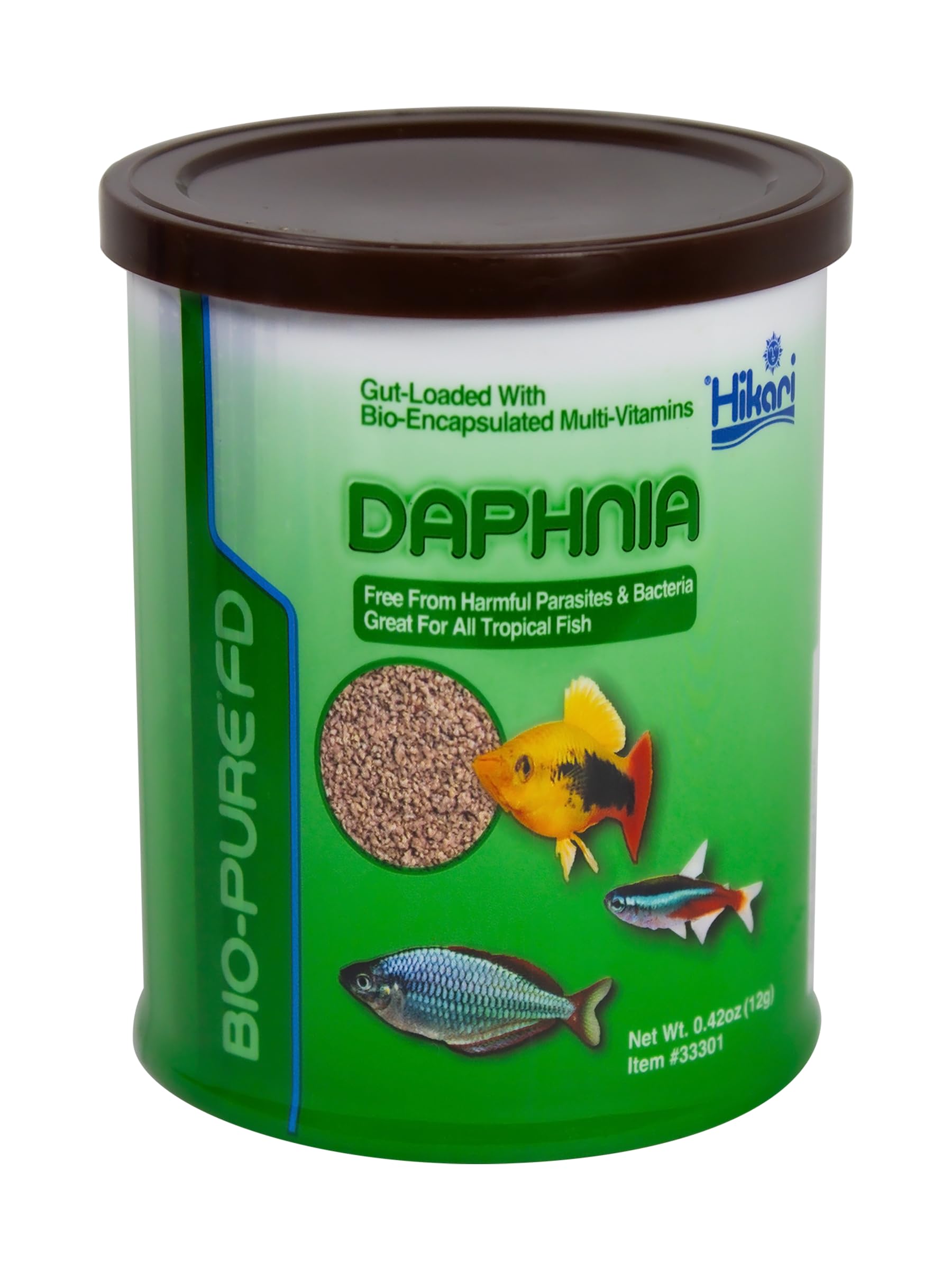
Rating: 4.6 ★ | Price: Midrange | Form: Freeze dried | Container: Pouch | Net weight: 0.42 oz (12g) | Water type: Freshwater and marine
Tip too much of this into a tank and you see the problem before the fish do: a pale cloud spreading across the surface, most of it too fine for anything to eat. Hikari’s pouch runs from dust to recognizable little bodies, and that spread is both why it works and why it needs a careful hand. Pinched between two fingers and dropped in, it floats, and it stays up long enough for the fish cruising the top to work through it properly. Of the three daphnia foods here, this is the one we reach for first.
Daphnia earns its place as roughage rather than as a staple. It is what we feed a betta that has come up bloated or gone off its food, a couple of times a week alongside its normal diet, and it is the reason a pouch stays on the shelf by our betta tank even when every fish looks fine. That function is the real argument for keeping daphnia at all: as a snack it is pleasant, as something to move a sluggish betta along it is genuinely useful.
Hikari lists the pouch for freshwater and marine tanks, fry, small-mouthed fish and invertebrates, which makes it the most flexible of the three on species coverage, and a pinch really is enough for a nano tank. What it is not is generous. The pouch holds the least here, so a big community tank empties it quickly, and the Aqua Natural tub gives you far more daphnia for the money. One betta, a fry net, or a tank of small rasboras is where this one makes sense.
Pros
- Floats at the surface where top feeders reach it
- Fine enough for fry and small-mouthed fish
- Useful roughage when a betta is bloated
- A little goes a long way in a small tank
Cons
- Acceptance varies — some fish refuse it outright
We point anyone feeding small-mouthed fish or a bloated betta to Hikari: it floats within reach, and it behaved most predictably of the three in our tanks.
Best for Community Tanks
Aqua Natural Freeze Dried Daphnia

Rating: 4.4 ★ | Price: Budget | Form: Freeze dried | Fish size: Small to medium | Net weight: 0.7 oz | Water type: Freshwater and marine
A screw-top tub rather than a foil pouch, filled close to the rim with whole, pale daphnia bodies — the Aqua Natural container looks like the bulk buy it is. The pieces are whole rather than dusty, closer to small flakes than to powder, and they hold their shape when they hit the water instead of dissolving into a haze. For a tank where several fish feed at once, that is the texture you want.
Value is where this one wins, and it wins clearly: more daphnia by weight than either of the other two, for less money than the Hikari pouch. Feeding is quick — a pinch, a swirl, done — and the water stays clear enough that you are not netting out leftovers an hour later. Acceptance is not an issue either: daphnia of this size suits bettas, livebearers, loaches, corydoras and most community fish with a mouth to match.
We keep it as the everyday tub and save the Hikari pouch for fish that need tempting. A single betta would take months to work through this much daphnia, and an open tub sitting around that long is nobody’s friend. A busy community tank finishes it while the pieces are still worth eating, which is exactly the tank this one is built for.
Pros
- Most daphnia for the money of the three
- Whole pieces that leave the water clear
- Suits a broad range of community fish
Cons
- Too coarse for the smallest tetras and rasboras
For a community tank that goes through food quickly, Aqua Natural is the tub we grab: the most daphnia for the least money, in whole pieces that don’t dissolve on contact.
Best for Portion Control
Aquatic Provisions Freeze Dried Daphnia

Rating: 4.3 ★ | Price: Premium | Form: Freeze dried | Container: Bottle | Net weight: 0.5 oz (14.2 g) | Ingredients: 100% daphnia, no additives
Overpouring daphnia is easy and unpleasant to watch: a tipped pouch sends a cloud of fragments across the surface and half of it goes uneaten. Aquatic Provisions sells the same food in a bottle you tap rather than pour, and that single difference is why it is on this list. A few pieces come out at a time, so you can feed a small tank without redecorating it.
It is the most controllable daphnia of the three, and we appreciate that the bottle makes the right amount the easy amount — two taps for one betta, far less of the dust a tipped pouch produces. The contents are daphnia and nothing else, no fillers or additives, and the pieces are big enough to be a proper mouthful for an adult betta. That matters when the goal is getting food into a fish that has gone off its dinner.
Buy it for the small setup: one betta, a hospital tank, a fry grow-out where a tap of the bottle lands closer to the right amount than a pinch of powder. In a big community tank the control matters less, the bottle empties slowly, and the value tub does the job for a lot less.
Pros
- Bottle taps out a few pieces at a time
- One ingredient, no additives or fillers
- Listed for freshwater, marine and inverts
Cons
- Priciest of the three
- Pieces run large for the smallest fish
The bottle is the reason to buy this one — if you feed a single betta and keep overpouring, it is the most controlled daphnia here, and the price reflects it.
How We Tested Freeze-Dried Daphnia
We started with every freeze-dried daphnia we could find that was a single-ingredient food rather than a daphnia-flavored blend, then cut the ones with a muddled guaranteed analysis, a silly price per gram, or a listing that hadn’t been restocked in a year. That left 14 tubs, fed over four months, each rotated through more than one tank so nothing was judged on a single hungry morning.
Feedings happened at the same two windows daily — before work and after the lights went down — so I was watching the same fish at comparable appetite. I dropped a pinch at the surface and timed how long it floated before sinking, plus where the fish met it: some rushed the top, some waited for it to drift down, several ignored it until it had soaked through. To compare preference fairly, two foods went in at opposite ends of the same tank on alternate days, and I noted which end got hit first and how much was still there an hour later.
Back at the counter I sifted a level scoop of each through a fine mesh strainer and weighed what stayed whole; that ratio, not the tub size, is the honest measure of value, since a jar of dust is gone in a week. I lined fleas up against a ruler and matched size against the fish being fed — a whole flea is a mouthful for a young guppy and a single snap for an adult betta — then rolled a few between my fingers to see how quickly they softened and picked out the hard glassy bits fish spit back out. Every food ran at least two weeks straight in one tank so I could watch for bloating, stringy waste, or a fish that went off its feed.
How to Choose Freeze-Dried Daphnia
The daphnia itself is rarely the variable — what separates these packs is piece size, what happens when they hit the surface, and how much control you get over the amount that goes in.
Match the piece size to the mouths in your tank
Daphnia is sold whole, crushed, or something in between, and the container in front of you tells you more than the front label. A tub marketed for fry can still hold pieces a neon tetra has to work at, so tap a little into a saucer before the first feeding and look at it. Whole pieces suit adult bettas, guppies, corydoras and loaches; dust suits fry and the smallest tetras.
If the pieces come out too big, crush them between your fingers or roll them in a cup. It takes five seconds and turns any tub here into fry food.
Watch how it behaves at the surface
Freeze-dried daphnia is light, so most of it rides the surface before it waterlogs and starts to sink. That is a feature if you keep top feeders — bettas, hatchetfish, rasboras — because you can see exactly who is eating and who is not.
The fine fraction is the catch. Tip a pouch in and the dust spreads into a film that nothing eats and the filter has to deal with. Pinch, don’t pour, and drop it over one corner rather than the whole tank.
Read the preservation method, not just the word daphnia
Not everything sold as daphnia is freeze-dried. Big-box treats are often sun-dried, and some instant pots are a wet preparation that has to go in the fridge once opened. Freeze-dried keeps the shape of the animal and the texture fish actually respond to, and it sits in the cupboard until you need it.
Check that the front of the pack says freeze-dried and that the ingredient list says daphnia. In this category that is the whole specification.
Decide how much control you want over portions
A tub, a pouch and a bottle put very different amounts in your hand. A tub is the cheapest way to feed a busy community tank, a pouch is plenty for one betta, and a bottle with a narrow opening is the answer if you tend to overpour.
Whatever the container, daphnia is a supplement: feed it a couple of times a week alongside a complete staple, in an amount the fish clear in a few minutes.
Frequently Asked Questions
Do I need to soak freeze-dried daphnia before feeding?
No, but thirty seconds in a small cup of tank water does two useful things: it takes the surface dust out of the equation, and it makes the pieces sink so mid-water fish get a look in. It is worth the cup for fry, for fussy eaters, and for any fish that gulps at the surface and takes in air.
Is freeze-dried daphnia the same as freeze-dried brine shrimp?
They are different animals doing different jobs. Daphnia is a freshwater organism with a soft body, and it is the one to reach for when a betta is constipated or a fish needs something small enough to swallow. Brine shrimp is a saltwater animal, usually fed for growth and weight.
Keep both if you like, but do not expect daphnia to do a brine shrimp’s job, or the reverse.
Can I feed freeze-dried daphnia in a saltwater or reef tank?
Yes. Both the Hikari pouch and the Aqua Natural tub are listed for marine as well as freshwater use, and small marine fish, inverts and corals will take it. Feed it sparingly and target the fish rather than broadcasting it — a reef tank has plenty of mouths happy to take food meant for somebody else, and uneaten daphnia is just nutrient load.
How should I store an open container?
Keep it sealed and dry. Moisture is what ruins freeze-dried food — it goes soft, clumps, and loses the texture fish respond to. A cool cupboard beats the shelf above the tank, where splash and humidity get to it, and the lid is worth using every time even if you are feeding again in an hour.
Final Verdict
Three freeze-dried daphnia foods held up to real feeding, and Hikari’s is the one we recommend to most people: it floats where small fish can reach it, it earns its keep when a betta is sluggish, and it covers everything from fry to nano marine tanks. The pouch is the smallest of the three, so a big community tank should look at the Aqua Natural tub and its whole, water-clearing pieces instead.
And if the problem you are solving is your own heavy hand at the tank, the Aquatic Provisions bottle is the answer. It costs more than the others, and for a single-betta setup it is worth it.