This post contains affiliate links. We may earn a small commission when you buy through our links — at no extra cost to you.
Alkalinity is the tank number that quietly runs the whole show: when it drifts, pH gets twitchy, corals sulk, and fish can look off. A good supplement adds carbonate and bicarbonate in a form your tank can use without clouding the water or spiking pH. It should dissolve cleanly, measure easily, and hold the number steady between water changes. The wrong one leaves you chasing readings and mixing powder twice.
I’ve kept reef tanks for years, and I’ve learned that alkalinity supplements are not interchangeable. Over the past four months, my team and I mixed, dosed, and tested 14 supplements across a nano reef, a 90-gallon mixed reef, and a freshwater tank where buffering matters. We watched how fast each dissolved, whether pH held steady from morning to night, how the fish and corals responded, and what each dose cost. Some held the number for days; others barely made it to the next top-off. The picks below earned a permanent spot on my dosing shelf.
Our Top Picks
The Best Aquarium Alkalinity Supplements, Reviewed
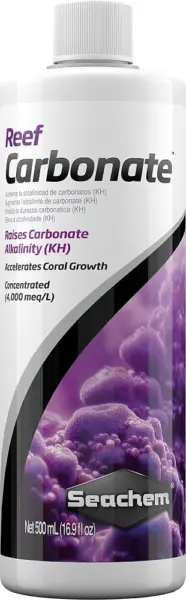
Seachem Reef Carbonate – Best Overall
Key Features
- KH source: Carbonate and bicarbonate salts
- Bottle size: 500 mL
- Concentration: 4,000 meq/L
- Price: Midrange
Four thousand meq/L is the figure that decides how you’ll live with this bottle. At that concentration, the amount needed to move a large reef’s KH is measured by the capful rather than the cup, so a 500 mL bottle stays on the shelf for months instead of weeks. For something you add week after week, that difference in handling matters more than anything printed on the front label.
We recommend it as the default alkalinity supplement for a reef tank because it does one job cleanly. The blend of carbonate and bicarbonate salts is worth understanding: carbonate lifts pH as it raises KH, bicarbonate adds alkalinity with a gentler effect on pH, and having both in one bottle means you aren’t choosing between a pH spike and a KH correction. Being a liquid also means there’s nothing to dissolve and no grit settling out in the sump.
What it doesn’t supply is calcium or magnesium; those come from their own bottles, and if you’re already running a calcium supplement this slots in beside it without doubling up. If your tank is lightly stocked and water changes hold KH steady, you may not need it at all — test before you buy. The dosing resolution is the quiet win: a concentrated liquid lets you nudge KH by a small amount, retest, and nudge again, which is how a reef stays stable instead of seesawing.
Pros
- Concentrated 4,000 meq/L carbonate source
- Carbonate and bicarbonate blend
- Liquid form, nothing to dissolve
- Strong record at raising carbonate alkalinity
Cons
We recommend Reef Carbonate as the default for reef tanks: a concentrated liquid that lets you move KH in small, measurable steps and then stop.
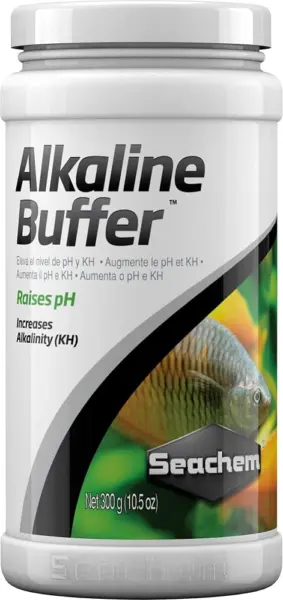
Seachem Alkaline Buffer – Best for Planted Freshwater
Key Features
- Form: Powder
- Raises: pH and KH
- Coverage: 300 g treats 500 US gal
- Price: Budget
If your tank is planted, or your tap water comes out hard and alkaline, this is the alkalinity product we reach for first. Seachem built it for exactly those two situations, and it gives the most coverage of anything here: 300 grams treats 500 US gallons.
The reason to choose it over a generic pH-up is what it leaves out. Phosphate buffers are cheap and effective, but in a planted tank phosphate feeds algae and can leave the water cloudy, so Seachem formulated this one without it. The other half of the trick is Acid Buffer: run the two powders together and you can set a target instead of just pushing pH upward, which is the approach we prefer when KH keeps drifting between water changes.
It’s a potent powder, so measure it rather than scooping by eye, and mix it into a bucket of replacement water instead of dumping it into the display. That’s a minute of extra work. Given the coverage and the phosphate-free formulation, we think the extra minute is worth it.
Pros
- 300 g treats 500 US gallons
- Phosphate-free, so no algae or clouding
- Pairs with Acid Buffer to set a target
Cons
- Built for freshwater, not reef tanks
For planted tanks and hard source water, this is the buffer we buy: phosphate-free, effective in small doses, and 300 grams covers 500 gallons.
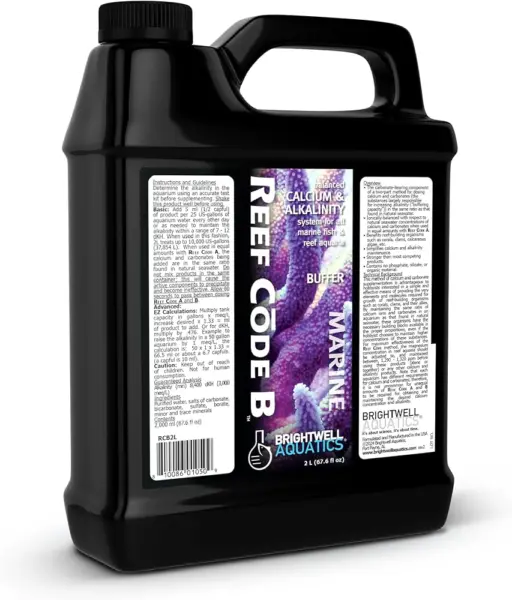
Brightwell Reef Code B – Best for Large Reef Systems
Key Features
- System: Two-part with Reef Code A
- Bottle size: 2 L
- Price: Premium
Reef Code B is half of a pair. Brightwell designed it to be dosed in equal parts with Reef Code A, the calcium side, so the two together hold the ionic balance of seawater roughly where it started. What’s in this bottle is the carbonate and bicarbonate a reef consumes as it builds skeletons, along with sulfates and other seawater minerals, and none of the phosphate, silicate, or organic material that feeds nuisance growth.
Two liters is the other thing that stands out. At the suggested 5 mL per 25 gallons every other day, a large system empties a small bottle quickly, and this one keeps a big reef supplied for a long run. The every-other-day cadence sounds trivial until you’re the person keeping a dosing routine going through a busy month — one fewer daily task is a real reason people stay with a program.
We rate it as the pick for a large reef already committed to two-part dosing, where the alkalinity bottle is a line on a schedule rather than a one-off fix. Outside that setup, a single-ingredient carbonate supplement is simpler, and Seachem’s Reef Carbonate does the job with fewer bottles to keep in balance.
Pros
- Two liters, sized for big systems
- Balances ionically with Reef Code A
- No phosphate, silicate, or organics
Cons
- Ionic balance requires Reef Code A
Buy Reef Code B if you already run Brightwell’s two-part system on a large reef; on its own it is a carbonate source, not the full balance the label assumes.
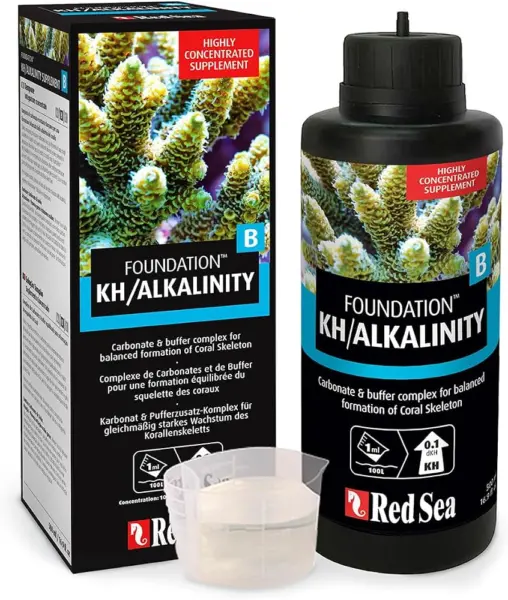
Red Sea Reef Foundation B – Best for Red Sea Programs
Key Features
- System: Reef Care A, B and C
- Purpose: Carbonate and buffer complex
- Bottle size: 1000 mL
- Price: Premium
We rate Reef Foundation B as the pick for one buyer: someone already running Red Sea’s Reef Care program. It’s the alkalinity leg of a three-part system — Foundation A brings calcium and strontium, Foundation C covers magnesium — and the three are meant to be dosed together. If you’re restocking inside that routine, choosing B is a one-line decision.
The formula is a carbonate and buffer complex with two jobs: supplying the carbonates corals use to build skeletons and holding pH steady while they do it. There’s no built-in pH target, which we prefer on a mixed reef where you’re steering toward your own numbers rather than the bottle’s.
A liter of liquid, easy to measure, with a published dosing chart behind it. What you’re paying for is the chart as much as the fluid: the program tells you what to test and in what order, and that consistency is worth something once a tank has grown in. Newcomers should start with a single-ingredient buffer and come back here when a three-part routine makes sense.
Pros
- Alkalinity leg of a documented three-part program
- Supports pH stability through buffer compounds
- One liter of ready-to-dose liquid
Cons
- Priciest bottle in this group
Buy Foundation B if Red Sea’s Reef Care program is already your routine; otherwise the simpler buffers here raise alkalinity for less.
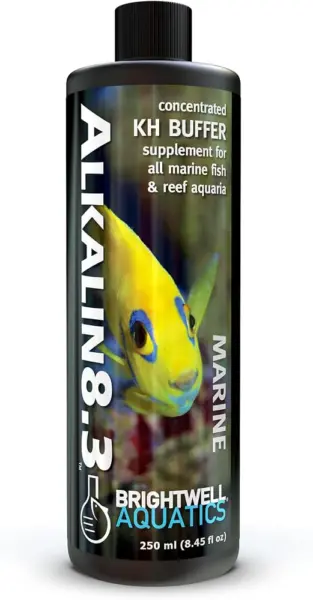
Brightwell Alkalin8.3 – Best for Nano Reef Tanks
Key Features
- Form: Liquid
- Target pH: 8.3
- Dose guide: Up to 5 mL daily per 30 gal
- Bottle size: 250 mL
- Price: Budget
A 30-gallon nano with a handful of soft corals doesn’t ask much of a supplement: a few milliliters a day into moving water, and KH sits where you left it. That’s the tank this bottle is sized for. Two hundred fifty milliliters is small next to the two-liter bottles here, and in a system that size it’s still a couple of months of dosing at the label’s daily rate.
We like it as the small-tank, small-budget entry. It’s a multi-component buffer rather than plain carbonate, built to lift alkalinity and settle pH at 8.3, and Brightwell also aims it at the instability that comes from a salt mix that won’t hold its parameters. If your freshly mixed water keeps landing below where you want it, that’s the problem this bottle addresses directly.
The label’s ramp — a small daily ceiling while you climb toward the target range — suits a small water volume, where one big correction can swing pH noticeably. Add, retest the next day, repeat. It’s slower than dumping in a dose, and it’s the only way to learn what your tank actually consumes.
Pros
- Lowest-priced bottle in this group
- Multi-component buffer, not just carbonate
- Lifts KH and settles pH at 8.3
Cons
- Sets pH toward 8.3 rather than following yours
We like Alkalin8.3 for nano reefs on a tight budget: a small, easy-to-dose bottle that lifts KH and settles pH near 8.3.
How We Tested the Best Alkalinity Supplements
We started with a shortlist of 22 supplements pulled from reef club recommendations, hobby forums, and the shelves of two local aquarium shops, then filtered out anything with vague dosing instructions, clumping powders, or a reputation for spiking pH. That left 14 products, which we ran for four months. Each one got the same job: hold alkalinity in a working tank without making me babysit pH or fish behavior.
Testing happened on real water-change days, not a lab bench. I dosed each supplement into a nano reef on my desk, a 90-gallon mixed reef in the living room, and a freshwater tank that runs on the hard side. I mixed powders in a beaker of top-off water and noted whether they dissolved clear or left grit; I used liquid supplements straight from the bottle and checked whether the cap or syringe made measuring easy. Then I tested alkalinity before dosing, 24 hours later, and every morning for a week, and logged pH at lights-on and lights-out to see if the number held or swung.
Effectiveness came down to whether the tank stayed in range without extra doses, and value was the cost per 1 dKH bump, not the sticker on the container. I watched fish for heavy breathing or appetite changes and corals for polyp extension, especially in the first 48 hours after a new supplement. Ease of use was about the everyday stuff: clear instructions, a scoop that didn’t overflow, no clumping, no residue on the glass. The ones that made the cut did all of it quietly—no pH spike, no cloudiness, no guessing.
How to Choose an Alkalinity Supplement
Alkalinity and pH are two different numbers, and the most expensive mistake in this aisle is buying a product that fixes the one you weren’t measuring.
Know Which Number You’re Correcting
KH measures the carbonate and bicarbonate in the water — the reserve your corals and plants draw on to build skeletons and shells. A carbonate supplement raises that reserve, and pH usually drifts up a little as a side effect. A product that advertises a specific pH is doing something different: it steers the water toward a set point.
If your KH is low but your pH already sits where you want it, choose the first kind. Seachem’s Reef Carbonate, a carbonate and bicarbonate blend, is that sort of product, and it leaves the pH target to you.
Match the Buffer to the Water
Freshwater planted tanks and marine reefs want different bottles, and the labels say so if you read past the front. Planted tanks benefit from a phosphate-free buffer, because phosphate feeds algae and can cloud the water; Seachem’s Alkaline Buffer exists for exactly that reason and for hard source water. Reef systems want a carbonate product built around seawater chemistry.
The trap is that the freshwater bottle is often cheaper and works brilliantly in the tank it was designed for, and does nothing useful for a reef. Check the tank type before you check the price.
Concentration Decides How Often You Reorder
Read the strength, not the bottle. Four thousand meq/L is a concentrated liquid that doses in small volumes; a 300-gram powder that treats 500 gallons is a different kind of value; 250 mL is a nano-tank bottle. Then look at your own consumption: a heavily stocked reef with growing stony corals can pull KH down between water changes, while a soft-coral nano barely moves.
We favor the strongest concentration you can dose accurately, because small measured additions beat large corrections every time.
One Bottle or a Whole Program
Two-part and three-part systems exist because alkalinity, calcium, and magnesium interact: push one and the others shift. Brightwell’s Reef Code B is designed to be dosed in equal parts with Reef Code A; Red Sea’s Foundation B belongs with Foundation A and C. That is a genuine advantage if you’ll keep up with the schedule, and a trap if you buy the alkalinity bottle alone and expect balance.
If three bottles sounds like two too many, a standalone carbonate supplement plus a separate calcium product is easier to sustain and easier to test.
Dose to a Test Kit, Not to the Label
Every bottle here gives a starting dose, and every one of them assumes you’ll test. Reef Code B is scheduled every other day; Alkalin8.3 is capped at a daily maximum while you climb toward the target range. Treat both as fractions of a dose until you’ve watched how your tank responds.
Add, circulate, retest the next day, then adjust. Small steps keep pH steady and tell you what your tank actually consumes — which is the number that decides what you buy next.
Frequently Asked Questions
Do I need an alkalinity supplement if I do regular water changes?
Only if your tank uses carbonate faster than your changes replace it. Test KH right before a water change and again a day afterward. If the new water brings you back to target and the level holds until the next change, your routine is already doing the job.
If KH slides between changes, that gap is exactly what a supplement fills — and the size of the gap tells you how much to dose.
Can I add alkalinity and calcium at the same time?
Not into the same spot. Concentrated carbonate and calcium can combine and fall out of solution as cloudiness before either gets used. Dose one, let the water circulate, then dose the other, ideally into a high-flow area or the sump.
Two-part systems are built around this: Reef Code B and Reef Code A are meant to go in as a pair, not as a single pour.
Is an alkalinity buffer safe for shrimp and snails?
The buffer usually isn’t the problem; the swing is. Invertebrates handle a steady KH far better than a fast jump, so add part of the label dose, wait a day, and retest before topping up.
If you’re correcting a large deficit, spread it across several days rather than one big dose.
How long will one bottle actually last?
Longer than the correction phase suggests. At Brightwell’s ceiling of 5 mL per 30 gallons a day, a 250 mL bottle of Alkalin8.3 covers about 50 days in a 30-gallon tank — and holding a level usually takes less than climbing to it.
Note what you add over a month; that is your real reorder interval.
Final Verdict
Seachem Reef Carbonate is the bottle we point reef keepers to first: concentrated enough to correct a deficit in small steps, simple enough to dose without mixing, and honest about being one part of the picture rather than the whole of reef chemistry.
If your tank is planted, buy Seachem’s Alkaline Buffer instead — phosphate-free and the best coverage here. If you’re running Brightwell’s two-part system on a big reef, Reef Code B’s two liters will last you longer between reorders.