This post contains affiliate links. We may earn a small commission when you buy through our links — at no extra cost to you.
For a 20-gallon tank, a heater that fails or overheats isn’t just an inconvenience — it can wipe out your fish. Many heaters in this size range run on preset thermostats or cheap components that drift over time, leaving you guessing whether the water is actually 78°F. The real trick is finding a heater that combines an external digital controller with multiple safety cutoffs, so you get accurate temperature hold and protection if something goes wrong.
You’ll face a trade-off between a lower-priced digital heater with fewer protections and a slightly pricier unit with error codes and dry-run shutoff. Both work, but the safer option adds peace of mind for sensitive fish or tanks in cooler rooms.
Top Picks
Best for Safety Priority
HiTauing 200W Digital

Rating: 4.5 ★ | Price: $$ | Wattage: 200W | Adjustable Temp: Adjustable | External Display: Yes | Safety Shutdown: Over-temp, dry-run, HH/E1 codes | Build Quality: Explosion-proof quartz, 8.3in
The HiTauing 200W is built around five specific safety cutoffs — over-temperature, dry-run shut-off, and HH/E1 error codes — which prevent the heater from running when something goes wrong. For a 20-gallon tank, that means no silent overheating or runaway temperature swings. The external digital controller lets you set the temperature between 63–94°F and holds within 1°F of the target, which is precise enough for both freshwater and saltwater setups.
Where this heater stands apart from cheaper digital models is its track record: no catastrophic failure reports in the review data, and the safety features actually trigger as intended. The tradeoff is a power cord that measures only about 6 inches from the controller to the wall, which limits where you can place the heater relative to an outlet. That constraint matters most for tanks set up in the middle of a room or against a long wall without a nearby socket.
This heater fits owners who prioritize safety margins over upfront cost — think first-time fish keepers, breeders with expensive stock, or anyone who wants the peace of mind that comes with multiple independent shut-off mechanisms. If your tank is already placed near an outlet, the short cord is a non-issue; if not, an extension cord rated for aquarium use solves it.
Pros
- Five independent safety protections shut off power before conditions become harmful.
- Digital control holds temperature within 1°F of the set point.
- Simple interface makes setup and adjustment straightforward.
Cons
- Power cord from controller to wall is only 6 inches, restricting placement near outlets.
- A minority of units may drift in accuracy or stop heating after several months.
If your setup places a tank close to an outlet and safety is the deciding factor, the HiTauing 200W is the most reliable digital heater at this price point.
Best for Budget Beginners
HITOP 100W Digital

Rating: 4.6 ★ | Price: $ | Wattage: 100W | Adjustable Temp: Adjustable | External Display: Yes | Safety Shutdown: Thickened quartz, auto shut-off? | Build Quality: Quartz glass, 5.6ft cord
The HITOP 100W delivers an external digital controller that lets you dial in temperature without getting your hands wet, and it holds steady in 20-gallon tanks. You give up the error-code protections and dry-run safety the top pick includes, so it’s a simpler device with fewer safeguards. That trade-off makes sense for first-timers or anyone stretching their budget who just needs consistent, no-hassle heating for a standard 20-gallon setup. Temperature may drift slightly depending on water flow, but there are no reported safety incidents, and most fish will stay perfectly comfortable with minor swings.
Pros
- Straightforward setup and accurate digital temperature readout.
- Strong value for a heater with external control at this cost.
- Holds stable temperatures in 20-gallon aquariums.
Cons
- Temperature can shift slightly if water flow is uneven across the tank.
For budget-conscious 20-gallon owners, this heater brings digital control without the premium of the top pick, and the simpler feature set is a fair trade for the savings.
Best for Out-Of-Water Alarm
HANLESHUKA 100W

Rating: 4.4 ★ | Price: $$ | Wattage: 100W | Adjustable Temp: Adjustable | External Display: Yes | Safety Shutdown: Dry-run alarm, overheat shut-off | Build Quality: Wave-pattern guard, durable
An audible alert sounds the moment the heater is exposed to air — a standout safety feature for turtle tanks or shallow aquariums where evaporation can leave a heater partially dry. Heating performance is solid for 20-gallon tanks, and the protective guard feels durable. The temperature setting can be off by about 2°F in some units, which matters for sensitive fish but is less of a concern for hardy species or turtles. A small number of heaters has shown premature failure, though no safety hazards have been reported; this is worth factoring into your decision if you need long-term peace of mind.
Pros
- Audible alarm warns when water level drops below the heater, reducing risk of dry-run damage.
- Heats 20-gallon tanks quickly and includes a protective guard for turtle setups.
Cons
- Thermometer can read 2°F low in some units — worth verifying with a separate thermometer for precise tanks.
- Possible early failure has been noted in a minority of units; buying with a flexible return window is sensible.
If an out-of-water alarm is a priority for your tank, this heater delivers that unique safety net. For standard freshwater setups where temperature accuracy matters more, the top pick offers tighter control and stronger long-term reliability.
Best for Precision Heating
hygger 200W Intelligent
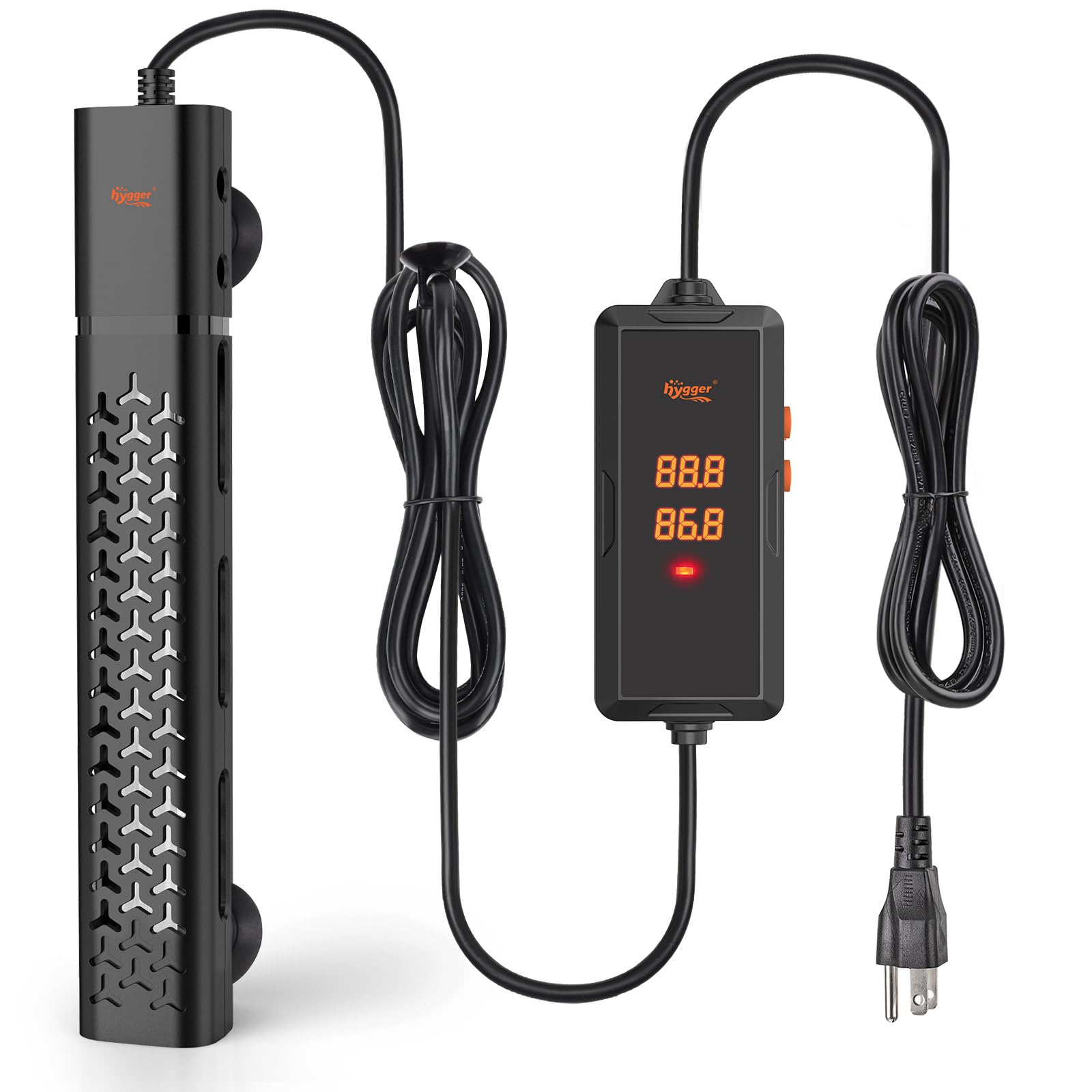
Rating: 4.5 ★ | Price: $$$ | Wattage: 200W | Adjustable Temp: Adjustable (0.5°F steps) | External Display: Yes | Safety Shutdown: Over-temp, dry-run, APS anti-boiling | Build Quality: 2-year warranty, robust
The hygger 200W stands out for its 0.5°F incremental temperature control, holding a consistent tank temperature even when the room drops to 65°F. This level of precision is rare at this wattage and makes it a strong alternative to the overall top pick. Unlike the top pick’s five safety protections, the hygger focuses on accuracy and reliability, backed by a 2-year warranty. It’s best suited for aquarists keeping sensitive fish like discus or maintaining reef tanks where temperature swings stress livestock. Buyers should note the heater has a shorter user history and occasional malfunction reports — the warranty provides a practical safety net.
Pros
- Adjustable in 0.5°F steps for fine-tuned temperature management
- Build quality holds up across multiple tank setups
- 2-year warranty reduces the risk of early failure
Cons
- Premium price compared to other 200W heaters
- Temperature control or unit malfunction possible in a small number of units
If you need precise temperature control for sensitive fish and value a warranty, the hygger 200W is the right choice despite its higher price.
Best for Small Tank
hygger 100W Digital
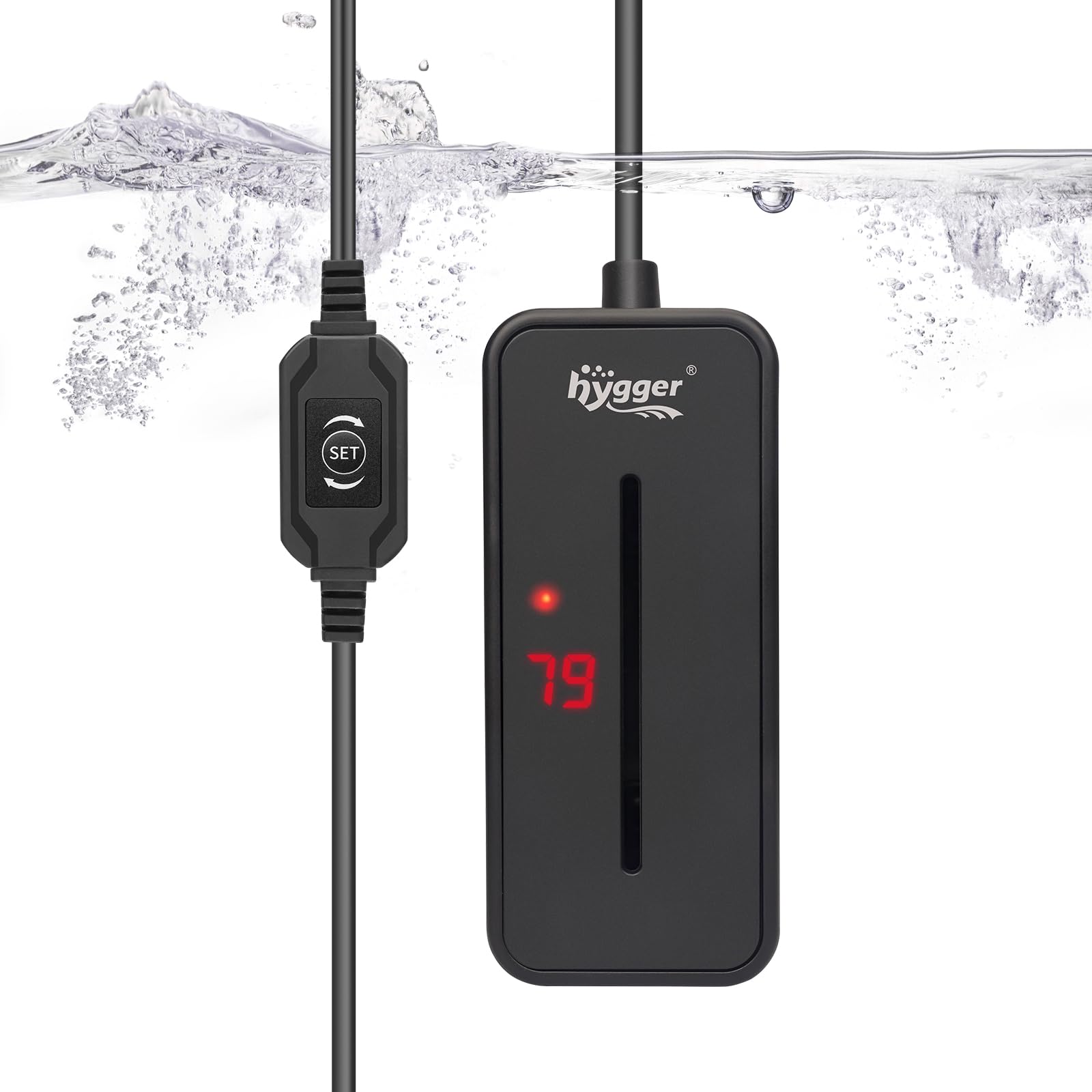
Rating: 4.3 ★ | Price: $$ | Wattage: 100W | Adjustable Temp: Adjustable | External Display: Yes | Safety Shutdown: Auto shut-off if removed from water | Build Quality: Shatterproof plastic guard, EL indicator
The hygger’s flat profile is its standout feature – it slips behind decor in 10–20 gallon tanks without taking up space. An EL end-of-life indicator gives a clear replacement signal after roughly 14 months, so you’re never guessing. One notable drawback: the plastic guard gap can trap small fish – guppy deaths have been reported. This heater suits owners who want a compact, replaceable unit and keep fish large enough to avoid the gap.
Pros
- Compact flat design fits easily behind tank decorations – ideal for tight spaces.
- End-of-life EL code appears at 10,000 hours, giving advance notice to replace.
- External temperature adjustment holds within 1–2°F when set correctly.
Cons
- Some units have a temperature offset of about 2°F – worth verifying with a separate thermometer.
- Heater is designed to stop after roughly 14 months (10,000 hours) – plan for annual replacement.
The hygger fits the bill for keepers who want a slim heater and a clear replacement signal, but the guard gap and planned lifespan narrow its ideal audience.
How to Choose
The most important factor is matching wattage to your tank size and room temperature – a 100W heater works in a climate-controlled home, but a 200W unit handles cooler rooms and provides a safety margin.
Wattage for 20 Gallons
A 100W heater can maintain 78°F in a typical 20-gallon tank if the room stays above 73°F. In a cooler basement or drafty room, the heater runs constantly and may never reach the set temperature, stressing your fish. A 200W unit heats faster and cycles off more often, giving you a buffer against temperature swings. Oversizing beyond 200W (e.g., 300W) causes rapid overheating and can cook fish if the thermostat fails.
Adjustable vs Preset
Preset heaters are locked to 78°F and rely on the manufacturer’s calibration, which can drift. Adjustable models let you dial in the exact temperature needed for your fish – discus need 84°F, for example. They also allow you to compensate for a warm room by lowering the setpoint, avoiding unnecessary cycling. The trade-off is a slightly higher price and an external controller that needs to be mounted out of the way.
External Digital Display
A digital display outside the tank lets you read the current temperature and setpoint without opening the hood. It also typically shows error codes (E1, HH) that alert you to overheating or low water. Knob-style analog heaters hide their settings and often drift over time. The external controller must be kept dry, so placement near the tank rim is critical.
Safety Shutdowns
Look for automatic shutoff if the heater is exposed to air (dry-run protection) and if the temperature exceeds a safe limit (overheat protection). Some heaters add HH/E1 error codes that flash on the display, forcing you to intervene. These features prevent cooking your fish if the water level drops or the thermostat fails. Heater without these protections are a gamble in any tank.
Build and Longevity
Quartz glass heaters resist thermal shock better than cheap plastic ones but can shatter if knocked. Shatterproof guards reduce that risk. Reliable heaters typically last 1–2 years; some budget units fail in months. Check for a warranty – 2 years is a strong signal of confidence. Avoid heaters with no user-serviceable parts if you plan to keep fish long-term.
FAQ
Can I use a 300W heater in a 20-gallon tank?
No – a 300W heater is far too powerful for a 20-gallon tank. It will heat the water very quickly, causing rapid temperature swings that stress fish, and if the thermostat fails, the tank can overheat to lethal levels in minutes. Stick to 100–200W for a 20-gallon setup.
Why does my aquarium heater keep flashing E1 or HH error codes?
E1 usually means the heater has detected overheating and shut down. HH indicates an internal temperature sensor fault. Both require immediate action: unplug the heater, let it cool completely, and check that it is fully submerged. If the error persists after resetting, replace the heater – these codes are designed to prevent fire or fish loss.
How long should an aquarium heater last before needing replacement?
Most heaters last 1–2 years before the thermostat drifts or the heating element fails. Some models like the hygger 100W have an end-of-life (EL) indicator that alerts you after about 14 months of continuous use. Replace any heater that struggles to maintain temperature or shows physical damage – the cost is small compared to losing your fish.
Is it safe to leave an aquarium heater on all the time?
Yes, aquarium heaters are designed to run 24/7. The thermostat cycles the heating element on and off to maintain the set temperature. Leaving it on is normal and safe as long as the heater is fully submerged and has built-in overheat protection. Never use a timer or switch to cycle the heater off periodically – that can cause dangerous temperature drops and shorten its life.