This post contains affiliate links. We may earn a small commission when you buy through our links — at no extra cost to you.
The fear with aquarium fertilizers is always the same: you dose the tank, and a week later it’s a green soup with unhappy fish. I’ve been there—once I ignored the instructions and turned a quiet community tank into an algae farm. But the right liquid fertilizer does the opposite. It gives your plants the nutrients they’re missing so they can grow strong and outcompete algae, without clouding the water or messing with your fish. That’s the balance every planted-tank keeper is chasing.
Over the past four months, my team and I have been dosing 16 different fertilizers across 16 tanks, from a low-tech betta setup to a high-light nano cube. We watched for new leaves, richer color, and the dreaded nitrate spike that can come with overfeeding. The best ones made plants perk up without tinting the water or triggering an algae bloom—and they didn’t leak all over the shelf, either. The picks below are the ones that earned a permanent spot next to my test kits.
Our Top Picks
The Best Liquid Fertilizer for Aquarium Plants, Reviewed
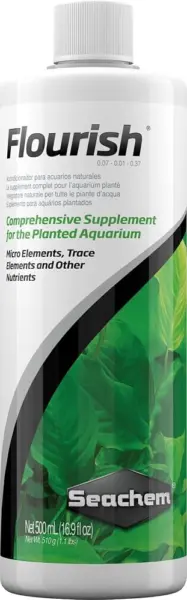
Seachem Flourish – Best Overall
Key Features
- Nutrients: Micro and trace elements
- Bottle size: 500 ml
- Nitrogen and phosphorus: No significant levels
- Price: Midrange
The first thing to know about Seachem Flourish is what isn’t in it: no significant nitrogen, no significant phosphorus. That looks like a strange omission in a fertilizer until you look at a stocked tank, where fish food is already breaking down into both. Flourish covers everything else — the micro elements and trace nutrients that plants draw down fastest and that water changes don’t reliably replace.
That division of labor is why it’s our default. You can dose it on the label schedule without watching nitrate climb or adding water changes to your week, and it behaves much the same in a low-tech tank as under moderate light. Shrimp and snails come through it without trouble, which isn’t true of every bottle here.
Where it stops is a tank that outruns its fish. Add CO2 and strong light, or run a dense planting with almost no livestock, and the missing macros become the ceiling — growth stalls and new leaves come in pale while everything else is in order. The fix is easy: keep dosing Flourish and add a nitrogen and phosphorus source beside it rather than switching brands entirely.
It’s also concentrated, which is a compliment until you’re measuring for a nano tank, so we keep a syringe next to the bottle and skip the guesswork. That’s the only fiddly part of owning it.
Pros
- Broad micro and trace coverage
- Adds no significant nitrate or phosphate
- Safe with shrimp and snails
Cons
- Bottle can arrive leaking in transit
For most planted tanks this is where we start: the broadest micro-and-trace base on the list, and the one that leaves nitrate and phosphate to your fish.
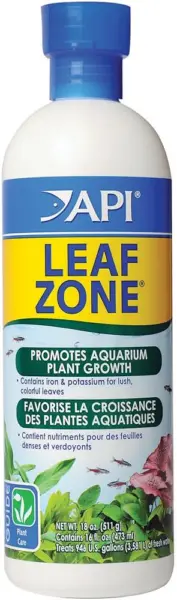
API Leaf Zone – Best Budget
Key Features
- Dose rate: 5 ml per 10 US gallons weekly
- Nutrients: Chelated iron and potassium
- Bottle size: 16 fl oz (473 ml)
- Price: Budget
Leaf Zone is the budget pick, and we mean that as a compliment. It’s the cheapest bottle in this group, it doses at 5 ml per 10 gallons once a week, and it carries the two nutrients that show up first when plants start looking tired: chelated iron and potassium. If you’ve been dosing nothing at all, this is the least expensive way to find out whether feeding changes anything.
What it does, it does plainly. New leaves come in greener, the yellowing on older foliage stops spreading, and it takes about a minute a week. That’s the whole job in a low-tech tank with a normal fish load.
One thing to plan for: fish and snail losses have followed dosing in some tanks, so start under the label rate, watch the tank for a day, and never stack a dose on top of a big water change. That’s the routine we follow with any new bottle going into a tank with invertebrates in it.
Pros
- Chelated iron and potassium in one weekly dose
- Cheapest bottle in this group
- Dose is easy to measure and remember
Cons
- Tints the water yellow after dosing
- Iron and potassium only, no trace mix
A cheap, simple weekly feed for a lightly stocked tank — start under the label dose and watch the tank for a day after the first one.
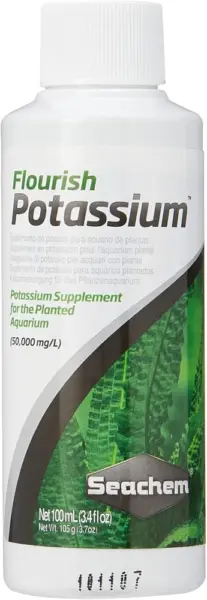
Seachem Flourish Potassium – Best for Potassium Deficiency
Key Features
- Form: Liquid
- Nutrient: Potassium
- Bottle size: 100 ml
- Price: Budget
Pinholes in the older leaves, yellowing that spreads between the veins, new growth that comes in small and pale — that cluster is the classic signature of a potassium shortfall. Flourish Potassium is a single nutrient in liquid form: no trace mix, no nitrogen, no phosphorus, just the one thing the plant is short of.
Its value is diagnostic. The damaged leaves won’t repair, but new growth comes in green and clean, and on java fern and swords the old pinholed foliage drops away as the plant pushes fresh leaves. If the symptom stops appearing on new leaves, you’ve found your limit.
We treat it as a cheap test rather than a treatment plan. A small bottle goes a long way at these doses, so ruling potassium in or out costs very little, and either answer is useful: if the new leaves come in clean you’ve learned something permanent about your water, and if they don’t, the problem is elsewhere and you’ve spent almost nothing finding that out.
Pros
- Clears the pinholes of potassium shortage
- Small bottle lasts a long time
- Proven on java fern and swords
Cons
- Not a standalone fertilizer — pair it with a broad one
Keep a bottle as a diagnostic: a small, inexpensive one that settles quickly whether potassium is why your older leaves are full of pinholes.
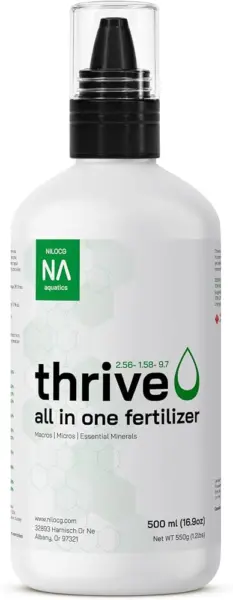
NilocG Thrive – Best All-In-One for Co2 Tanks
Key Features
- Dose rate: 1 ml per 5 gallons, 1–3 times weekly
- Nutrients: Macros, micros and minerals
- Bottle size: 500 ml
- Price: Premium
Where Flourish stops at the micronutrients, Thrive keeps going. This is a complete all-in-one — nitrogen, phosphorus and potassium alongside the micros and minerals, in a single pump bottle. For a tank running CO2 and serious light, that’s the difference between feeding the plants and merely topping them up: the macros are the part those plants burn through fastest.
It’s made for tanks with an appetite, and it’s easy to keep up with. One pump of the bottle on the label schedule, no clouding afterwards, and the water stays clear the next morning.
Completeness brings a caution, and it’s about the animals rather than the plants. Some tanks react badly to a first full dose, with plants melting back or fish and shrimp lost within days. A half dose for the first two weeks is the sensible way in, particularly in a tank that has never been fertilized.
Where that leaves us is a bottle that earns its shelf space through routine rather than novelty: a dose you can halve, clear water, and new leaves that tell you within a few weeks whether the rate is right.
Pros
- Macros, micros and minerals in one bottle
- Pump dosing is quick and consistent
- One bottle treats 2,500 gallons
Cons
- Raises nitrate and phosphate — test before increasing
- Feeding past plant demand fuels algae
For a CO2-injected, well-lit tank this is the one-bottle answer: complete macros and micros, with a pump that makes a weekly routine easy to keep.
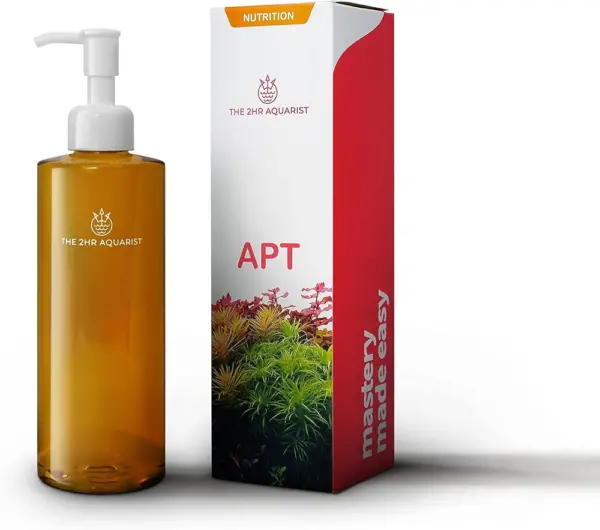
2HR Aquarist APT 3 Complete – Best Lean-Dose Complete Formula
Key Features
- Dose rate: 3 ml per 100 liters
- Nutrients: NPK plus iron, magnesium and traces
- Bottle size: 300 ml
- Price: Premium
The dose on the APT 3 label is 3 ml per 100 liters, which is leaner than the other complete formula here and says a lot about what this bottle is for. Full coverage — NPK plus iron, magnesium and trace minerals — delivered in small, frequent amounts, so demanding plants get what they need without the water column turning into a nutrient soup.
We like it for tanks that punish sloppy dosing. Plants respond with deeper green and faster new growth, ferns and moss fill in, and the water stays clear — no clouding, no tint, nothing to explain to a visitor.
Where it differs from the other all-in-one is temperament. The lean rate leaves room for error while you learn the tank, and the routine is simple and repeatable. For a keeper who wants to dose by measurement rather than by feel, that’s the whole argument.
Pros
- Complete NPK plus iron, magnesium and traces
- Keeps the water clear, with no clouding
- Lean dose suits demanding, high-light plants
Cons
- 300 ml bottle empties quickly on large tanks
The complete formula for a precision-minded keeper: lean dosing, full coverage, clear water, and a bottle that rewards a small tank.
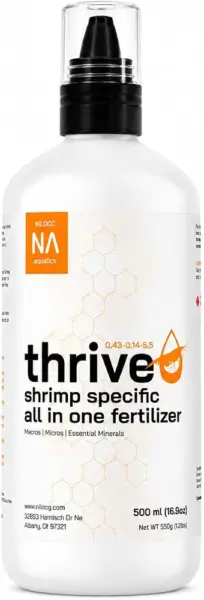
NilocG ThriveS – Best for Shrimp Tanks
Key Features
- Coverage: 2,500 gallons
- Bottle size: 500 ml
- Formulated for: Shrimp tanks with live plants
- Price: Premium
The first question shrimp keepers ask about any fertilizer is whether it will wipe out a colony, and it’s the right question: invertebrates tolerate trace metals far less well than fish do. ThriveS is the bottle here aimed squarely at that tank — a complete all-in-one formulated for shrimp setups with live plants.
What we found was mostly reassuring. Shrimp stayed active and molting, plants greened up and pushed new leaves, and the shrimp-specific picture was positive. It’s a pump bottle like the standard Thrive, and the label claims a bottle treats 2,500 gallons.
Where we hesitate is the price. It costs the same as the standard all-in-one while aiming at a narrower setup, so if you keep fish alongside your shrimp you’re paying for positioning rather than a different job. And at least one tank running it lost a colony outright — a single tank isn’t a pattern, but it’s reason enough to dose under the label and watch for a few days before committing a whole bottle to a breeding setup.
Pros
- Formulated for shrimp tanks with live plants
- One bottle treats 2,500 gallons
Cons
- Same price as the standard all-in-one, narrower aim
A complete feed built for shrimp tanks, with a solid invert record here — priced like a specialty product, because that’s what it is.
How We Tested the Best Liquid Fertilizers for Aquarium Plants
We began by scanning forums, retailer reviews, and ingredient labels to build a shortlist of 16 liquids that were easy to find, had clear dosing instructions, and didn’t cost more than a decent bottle of wine. We filtered out anything with vague nutrient breakdowns or a reputation for staining silicone, then ordered every bottle new so we could check for leakage right out of the box.
Over four months, each fertilizer lived next to a different tank—my 40-gallon community setup with angelfish and a thicket of val, a 10-gallon shrimp tank full of moss and crypts, and a low-tech betta bowl. We dosed on a twice-weekly schedule and kept a shared log. Every Sunday morning, before the water change, I tested nitrate, phosphate, and pH, then held a white cup of tank water against a white card to judge color and clarity.
Plant growth was tracked by counting new leaves on a marked stem of rotala and checking whether older leaves stayed green or developed pinholes. Algae got a weekly rating—none, a dusting on the glass, or a full bloom. We also watched fish appetite and behavior for any sign of stress, and after each bottle had been opened and closed a few dozen times, we checked the cap and threads for leaks or crusty residue.
For value, we calculated cost per weekly dose over the full four months—some bottles ran dry in six weeks, others lasted the whole test. Quality showed up in the details: no sediment, no clogged droppers, and a smell that didn’t clear the room. The fertilizers that scored best were the ones that made plants perk up within two to three weeks without pushing nitrates too high or turning the water yellow.
How to Choose a Liquid Fertilizer for Aquarium Plants
The most useful thing to know about liquid fertilizer is that the right dose is set by your tank, not by the bottle — light, CO2 and fish load decide how much your plants can actually use.
Work out what your tank already supplies
Fish food is fertilizer. Every feeding breaks down into nitrogen and phosphorus that plants can take up, and in a normally stocked tank with modest light, that supply covers the macros. What it doesn’t replace is the micronutrient side — iron and the trace elements that water changes dilute away.
That gap is what a broad micro-and-trace bottle such as Seachem Flourish fills, and why a stocked, low-tech tank can run on it indefinitely. A dense planting with almost no fish is the opposite case: nothing is producing macros, so a complete formula earns its place.
Complete formulas versus micro-and-trace
An all-in-one such as Thrive or APT 3 carries nitrogen, phosphorus and potassium alongside the micros; a bottle such as Leaf Zone or Flourish carries iron, potassium or traces and leaves the macros out. Neither is better in the abstract — the match is what matters.
The trap is putting a complete formula into a low-demand tank. The plants can’t use the nitrate and phosphate as fast as you’re adding them, and the surplus feeds algae instead. If you buy complete and run without CO2, start at half the label rate and watch the glass and older leaves for two weeks.
Read the dose rate against the bottle size
Two bottles selling for similar money can be very different value. Divide the bottle volume by your weekly dose and you get the number of weeks it lasts; do that before you compare anything else. Dose rates here run from 5 ml per 10 gallons weekly to 3 ml per 100 liters, which is a wide spread in how far a bottle goes.
Concentration isn’t the same as strength, though. A lean dose of a complete formula can deliver more than a heavy dose of a trace mix, so read the nutrient list alongside the milliliters.
Livestock, and the first dose
Shrimp and snails are the animals to think about first. Invertebrates tolerate trace metals, copper in particular, far less well than fish do, and a new bottle isn’t the moment to discover how your colony reacts.
Dose below the label rate for the first two weeks, avoid dosing on the same day as a large water change, and watch behavior rather than waiting for a body count. If something else has already gone wrong in the tank, fix that first and start fertilizing once the water is stable.
Frequently Asked Questions
Can I use regular houseplant fertilizer in my aquarium?
No. Terrestrial plant foods are built for soil and often supply nitrogen as ammonia or urea, which is the last thing you want in a tank with fish, and they lack the chelated iron that keeps nutrients usable in water. Buy a fertilizer labeled for aquarium use, dose at the rate printed on the bottle, and keep the houseplant food for the houseplants.
How long does one bottle last?
Work it out once before you buy. A 55-gallon tank dosed at 5 ml per 10 gallons uses 27.5 ml a week, so a 473 ml bottle runs about four months. The same tank at 3 ml per 100 liters uses roughly 6 ml a week, which stretches a 300 ml bottle close to a year. Divide your weekly dose into the bottle volume and you have the answer for any product.
How often should I dose?
Follow the bottle until your plants say otherwise. Most of the fertilizers here are weekly, while the Thrive bottle allows one to three doses a week, which suits high-light tanks where demand rises and falls. Splitting a weekly amount into two smaller doses smooths the supply and is gentler on livestock than one big hit. If you run a complete formula, test nitrate weekly so you know which way the tank is drifting.
Final Verdict
Start with Seachem Flourish. It covers the micronutrients most stocked tanks run short of and leaves nitrogen and phosphorus to the fish, which is why it suits more setups here than any other bottle.
Add CO2 and strong light and the calculation flips — those plants burn through macros, and a complete formula like Thrive earns its price. If shrimp are the priority, ThriveS is the bottle aimed at that tank, and the first dose should be a partial one.