This post contains affiliate links. We may earn a small commission when you buy through our links — at no extra cost to you.
An internal filter is the least glamorous thing you’ll buy for a tank and the thing you’ll hear about every night at bedtime. The wrong one rattles against the glass, pushes your floating plants into a corner, and leaves the water looking like weak iced tea. The right one disappears behind a piece of driftwood and you forget it exists. What you’re really buying is clear water and a quiet room, and those two things depend on the filter far more than most first-time fish keepers expect.
We’ve run 14 internal filters in working tanks over the past four months, from nano setups on a desk to a 40-gallon community tank with messy eaters and a bare quarantine tank that gets no mercy. I came away convinced the flow rate printed on the box tells you almost nothing; what matters is how water moves through the media and whether the impeller is still quiet three weeks in, once it’s good and slimy. The picks below run from shrimp-tank small to seriously stocked.
Our Top Picks
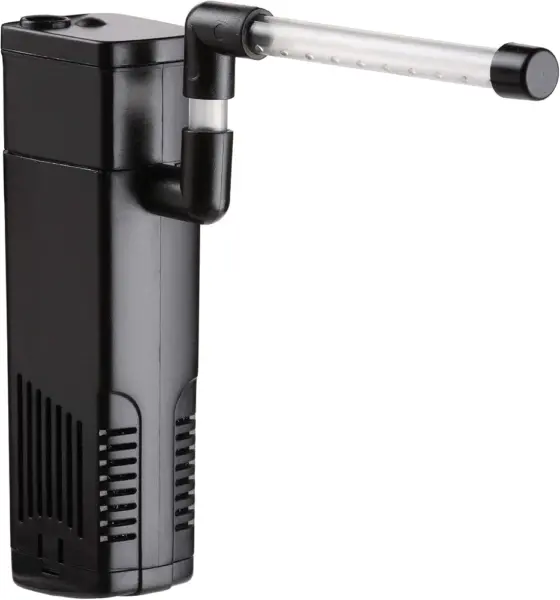
The Best Internal Aquarium Filters, Reviewed
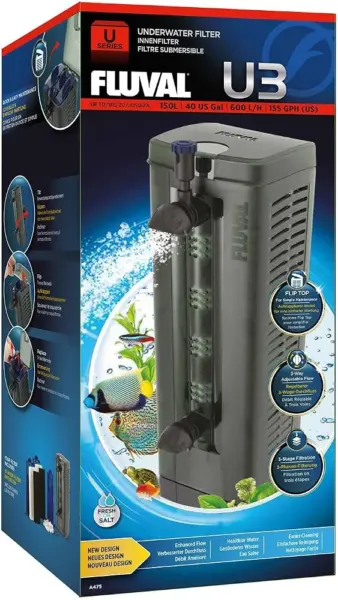
Fluval U3 – Best Overall
Key Features
- Media: Replaceable cartridge
- Mounting: Horizontal or vertical
- Warranty: 3 years
- Tank size: Up to 40 gallons
- Price: Premium
This is the most expensive filter in the group, and we still hand it to most people first, for a line on the warranty card rather than anything printed on the box. Fluval guarantees the non-replaceable parts for three years. Everything else here is covered for one year or not at all, and a filter that quits overnight is not an inconvenience; it is an emergency for everything in the tank. That is the whole argument, and we think it holds.
In the tank it behaves the way the price suggests. The pump is quiet enough that what we heard was water moving rather than a motor, and the flip-top lid lets you lift the cartridge out without unclipping the body from the glass, which is a small thing until the third time you clean it. The media cartridge traps debris well and the control panel on top is easy to work with wet hands.
Mounting is the underrated part. It hangs vertically against the back wall and pushes a current along the tank, or sits horizontally in a shallow setup, and the outlet can be aimed. Fluval rates it for tanks up to 40 gallons and lists it for fresh, salt and reptile setups, which is more range than most of this group offers.
One thing to know before you order: the flow control has a narrow range, and ours went from strong to slightly less strong, so a betta or any long-finned fish may still want a baffle in front of the outlet. That is a small workaround on a filter that otherwise keeps things simple.
Pros
- Three-year warranty, the longest in this group
- Runs quietly, with no motor hum
- Flip-top cartridge access without removing the body
- Mounts vertically or horizontally and aims
Cons
- Replacement cartridges are a recurring cost
We fit this one first in any tank up to 40 gallons: it runs quiet, services without unclipping, and it is the only filter here with a three-year warranty.
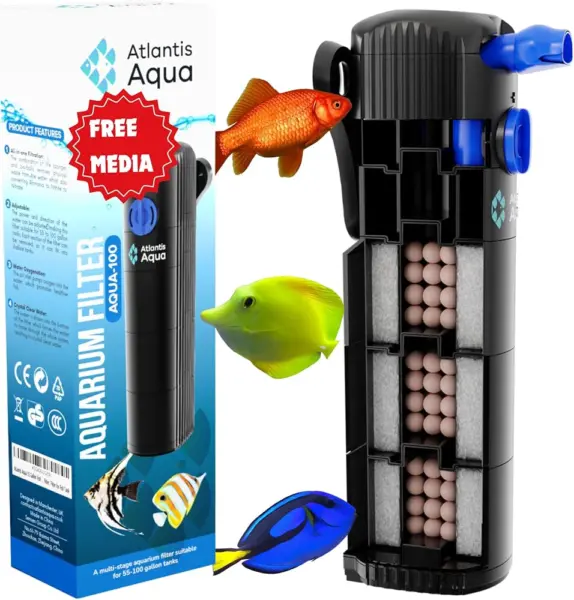
Atlantis Aqua Aqua-100 – Best for 55 to 100 Gallons
Key Features
- Media: Sponge and bio-balls
- Height: 15.3 inches
- Warranty: 1 year
- Tank size: 55-100 gallons
- Price: Midrange
The sponges in this filter are meant to last, and that changes the arithmetic of owning it. There are no pads to buy every month; you rinse the sponge, put it back, and the ceramic bio-balls in the second chamber carry the biological load. We like that for the same reason we like a reusable coffee filter: the spending stops when you check out.
Water enters through the base rather than the sides, because the body is sealed along its length and pushes the flow down through the media. For a 55 to 100 gallon tank that is the design we reach for first. The 3.14-inch profile disappears behind a plant or a piece of driftwood, the flow adjusts at the top, and ours ran quietly enough that the bubbles were the only thing we could hear.
The one thing to flag is the base intake: it pulls small shrimp and fry in along with the debris. In a shrimp tank, stretch a coarse prefilter sponge over the intake. In a community tank with full-grown fish, it never comes up.
Pros
- Sponges and bio-balls, no replacement pads
- Sealed body forces water through the media
- Quiet enough that only the bubbles register
- Slim 3.14-inch profile hides easily
Cons
- 15.3 inches tall, so shallow tanks limit placement
For a 55 to 100 gallon tank, this is the one we buy: the sponges never need replacing, the pump stays quiet, and nothing about it is fussy.
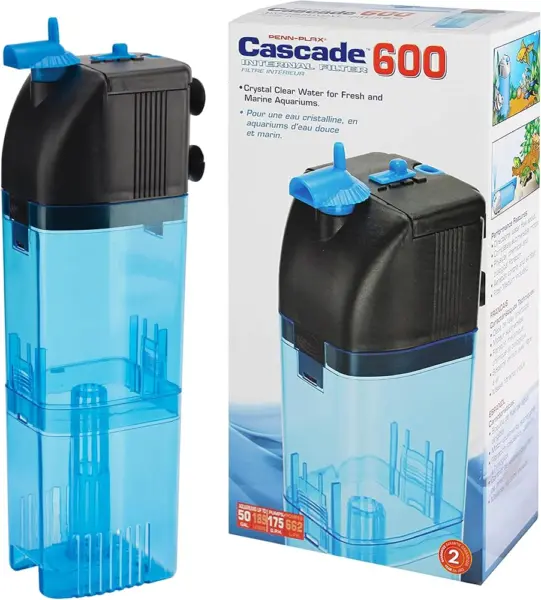
Penn-Plax Cascade 600 – Best for Messy Fish
Key Features
- Media: Carbon cartridge and bio-sponge
- Aeration: Venturi and spray bar
- Flow rate: 175 GPH
- Flow control: Adjustable switch
The first thing you notice is the clamp. It holds the two halves of the body together and it is stiff, stiff enough that the first time we opened it we went back to the manual to check we were not breaking something. Once it is apart, cleaning is easy: the media sits in two open chambers and goes back the way it came out.
175 gallons per hour is more turnover than the Fluval gives, and the Cascade spends it well. Two nozzles aim where you want them, a spray bar spreads water across the surface, and a venturi line pulls air into the outflow so the tank gets oxygenated without a separate air pump. On a tank of messy eaters that combination is the reason to choose it: surface movement plus air, from one plug.
The flow switch is the part we used most. Turn it down at feeding time so food stays where the fish can reach it, then open it back up; on a heavy-waste tank that control matters more than raw output. This is the sensible middle of the range, with more flow than the Fluval in a body that fits where the big Atlantis cannot.
Pros
- 175 GPH with two aimable nozzles
- Venturi aeration and spray bar, no air pump needed
- Two media chambers with a refillable cartridge
- Adjustable flow switch
Cons
- Suction cups let go and need reseating
We reach for this one with messy fish: 175 GPH, a spray bar and venturi aeration that saves you a separate air pump.
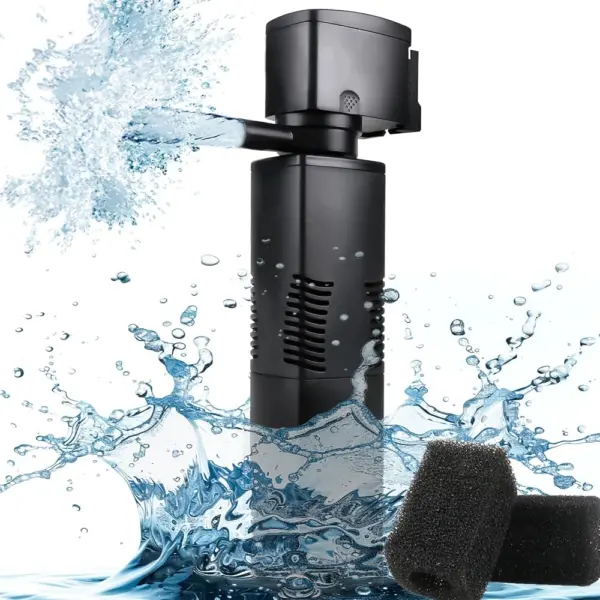
coospider-repta 024 – Best for Tanks over 100 Gallons
Key Features
- Body: Detachable lower section
- Air valve: Adjustable
- Flow rate: 300 GPH
- Tank size: 55-150 gallons
- Price: Midrange
Three hundred gallons per hour is a lot of filter, and it normally arrives as a column tall enough to dominate the tank. This one comes apart. For a tank under 15 inches tall you can lay it flat or drop the lower half of the sponge, and that single design choice is what makes it usable in a wide, shallow setup where nothing else here fits.
It moves water hard and clears a big tank quickly; both sponge stages lift out for rinsing and go back without a fight, and the air valve adds oxygen without a separate pump. Power is the whole point here, and the 55-gallon floor of its range is real. Below that, the current pushes fish around and there is nothing gentle about it.
So treat it as a specialist. Put it in a 125 with cichlids, a goldfish setup or a stock trough and you get a lot of filtration for the money, with a body that fits places a fixed column will not. Put it in a 55 with a slow-moving betta and the current wins.
Pros
- 300 GPH, rated to 150 gallons
- Body shortens or lies flat in shallow tanks
- Two sponge stages rinse out fast
- Adjustable air valve adds oxygen
Cons
- No way to turn the flow down
Our pick above 100 gallons, as long as the tank can take full-blast flow, because there is no dial to tame it.
NICREW Magi 200 – Best for Nano Tanks
Key Features
- Media: Carbon and fine foam
- Mounting: Four suction cups
- Flow rate: 53 GPH
- Tank size: 5-10 gallons
- Price: Budget
Fifty-three gallons per hour in a five-gallon tank is roughly ten turnovers an hour, which is why NICREW builds an air regulator into this one: the bubbles break up the output enough that a betta is not pinned to the glass. It is a small unit, with four suction cups, a carbon-and-foam cartridge that lifts out for rinsing, and a footprint you can hide behind a plant even in a ten.
We still fit it to a five rather than a ten. The 5-to-10 gallon rating is optimistic at the top end, and with no way to dial the pump back, a ten gets a current that moves anything not nailed down. In a five it is quietly excellent and it is the least expensive filter here, which makes it the easy answer for a quarantine tank or a child’s first betta setup.
Pros
- Least expensive filter in this group
- Four suction cups hold it steady
- Adjustable air regulator softens the current
- Compact enough to hide in a small tank
Cons
- Small media volume clogs quickly
We keep this one on five-gallon betta tanks and not on tens: small, quiet and the least expensive filter here.
How We Chose and Tested 14 Internal Filters
We started with the filters that keep turning up in hobby forums and on store best-seller lists, then narrowed by tank-size rating, media capacity, and whether replacement cartridges and impellers are actually sold — a filter you can’t buy media for has a built-in shelf life. That left 14 units across a range of prices, and each one ran continuously for four months.
They went into real tanks rather than a bench: a nano tank on a desk, a 40-gallon community tank with greedy eaters, a bare-bottom quarantine tank, and a betta tank in a bedroom where noise matters most. We measured sound with a decibel meter at three feet and again from the pillow, then slept in the same room, because a hum you stop noticing at noon is the one that keeps you up at 2 a.m. Flow got the floating-cork test — how far it drifted, whether plants were shoved into one corner, and whether the fish had a calm pocket to rest in.
For water quality, the same master test kit went on every tank weekly, and we photographed the water against a white card so "clear" wasn’t just a feeling. We also dripped food coloring near each intake to watch whether water actually passed through the media or slipped around it. Cleaning was timed end to end — impeller out, media swapped, back together, wet hands over a bucket — and we counted the pieces, since fewer parts means a faster Saturday job. We logged wattage on a meter to work out monthly running cost, priced a year of replacement media against each filter’s tank rating, and flagged any unit that rattled, cracked, stalled, or needed fiddling to restart.
How to Choose an Internal Aquarium Filter
The right internal filter is the one whose flow suits your fish and whose motor is still running next year; everything else on the box is a distant second.
Turnover Matters More Than the Gallon Rating
Filters are rated in gallons per hour, and the number that matters is turnover: how many times the pump moves your tank’s full volume in an hour. Community tanks do well at four to six times; a betta or a shrimp tank wants less. That makes the gallon rating on the box a ceiling rather than a target. The NICREW is sold for 5 to 10 gallons, but at 53 GPH it is about right in a five and too much in a ten. Work out your turnover before you read the box.
The Motor Is What You Are Really Buying
An internal filter sits in the water it is cleaning, so the impeller and shaft take constant wear. Warranty length is the closest thing to a durability signal you get before you buy: Fluval covers the U3’s non-replaceable parts for three years, and most of the others here offer a year or nothing. Keep the receipt and register the product. If the pump starts rattling, unplug it and check the impeller for grit before you decide it is finished.
Cartridges, Sponges and What You Spend After
There are two designs and two budgets. Cartridge filters, like the Fluval and the NICREW, are convenient, but the cartridge is a consumable and swapping it throws away bacteria you have grown. Sponge and bio-media designs, like the Atlantis, get rinsed and put back, so the spending stops at the till. Neither cleans better. The question is whether you prefer a recurring cost or ten minutes with a bucket. Whatever you run, rinse the media in water siphoned from the tank, never under the tap.
Measure the Height Before Anything Else
Internal filters are tall, and height decides where one can live. The Atlantis stands 15.3 inches; the coospider is a similar column until you pull it apart and lay it flat, which is what makes it work in a tank under 15 inches deep. Measure from the substrate to the rim rather than the glass. Then think about the mount: suction cups release on algae-film glass, and a filter sitting right at the waterline will trickle and gurgle all night.
Current, Oxygen and Small Fish
Water movement is the point, but too much of it is a problem for long-finned bettas, fry and shrimp. Look for an aimable outlet, a spray bar, or a pump you can turn down. Venturi aeration, which the Penn-Plax builds in, pulls air into the outflow so you do not need a separate air pump. Check the intake too: a filter that draws through its base will take shrimp with it unless you cover the intake with a coarse sponge.
Frequently Asked Questions
How often should I clean an internal aquarium filter?
Rinse the sponge every two to four weeks, or sooner if the flow drops, since a clogged sponge is the usual reason a filter seems to have stopped working. Squeeze it out in a bucket of water taken from the tank during a water change. Never rinse biological media under the tap, because the chlorine kills the bacteria you are keeping it for.
Should I switch the filter off at night?
No. The bacteria doing the filtering need moving, oxygenated water around the clock, and a switched-off internal filter is just a stagnant box in the tank. Unplug it only for maintenance. If noise is what keeps you awake, the fix is a quieter filter rather than a schedule; the Fluval and the Atlantis are the two we hear least.
Can I use an internal filter in a saltwater tank?
Some, not all. The Fluval U3 and the NICREW are both listed for fresh and salt water; several of the others here are freshwater designs. Check that the listing says marine before you order, rinse the media in saltwater taken from the tank, and wipe salt creep off the suction cups when you service it, or the filter starts sliding down the glass.
Final Verdict
Buy the Fluval U3 if your tank holds 40 gallons or less. It runs quietly, services without unclipping it from the glass, and carries the only three-year warranty here, which is worth the premium the day a pump stops and your fish are depending on it.
Above 55 gallons the answer changes. The Atlantis Aqua costs nothing to maintain after the purchase and stays quiet in a big tank; the coospider is the one for anything over 100 gallons, provided the fish can take the current. Between 40 and 55 gallons, the Penn-Plax is the better fit.