This post contains affiliate links. We may earn a small commission when you buy through our links — at no extra cost to you.
Many betta keepers discover too late that plastic plants labeled ‘soft’ still have rough seams that shred delicate fins. Live plants avoid that risk but demand light and nutrients. Some artificial plants also trap and injure bettas, making material choice critical. The real challenge is finding plants that are both safe and practical for your tank.
This guide focuses on options that solve that trade-off: soft artificial plants that won’t snag fins, and hardy live plants that thrive in low-tech betta setups. Both deliver the hiding spots and visual appeal bettas need, without the hidden hazards of cheap plastic. We’ve identified picks that balance safety, durability, and ease of care for different tank sizes and budgets.
Top Picks
Best for Live Plant Beginners
Marcus Amazon Sword 3pk

Rating: 4.6 ★ | Price: $$ | Height & Fullness: 7-12 inches | Live or Artificial: Live | Root System: Root tabs required | Water Benefits: Nitrate absorption
These Amazon swords arrive remarkably healthy, with established root systems and leaves reaching 7–12 inches right out of the box. For a betta keeper wanting instant cover and a lush backdrop, this pack delivers where many live plant sellers send wilted or tiny specimens. The plants thrive in moderate light with nutrient-rich substrate or root tabs – a standard requirement for swords, not a surprise.
The main tradeoff: bladder snails can hitchhike in, so a quarantine dip is wise if you’re snail-averse. Shipping stress may also cause a few melted leaves on arrival, but the roots are strong enough to regrow quickly in suitable conditions. These plants are best for tanks with gravel or sand and root fertilizers – skip them if you run bare-bottom or rely solely on liquid ferts.
Pros
- Arrives vibrant with well-developed root systems
- Larger and fuller than typical sword bundles
- Cost-effective pack outperforms local pet store singles
Cons
- May introduce bladder snails to the tank
- Shipping stress can cause temporary leaf melt on some plants
For betta keepers who want a tall, natural hiding spot and are ready to provide root tabs, this is the most dependable live sword pack at this price – just watch for snails.
Best for Nano Tanks
Marcus Anubias Nana

Rating: 4.6 ★ | Price: $$ | Height & Fullness: 1-2 inch leaves | Live or Artificial: Live | Root System: Attach to decor | Water Benefits: Nitrate absorption
This Anubias nana petite arrives in vibrant, dark green condition with no melting or damage, thanks to careful packaging. Unlike the large Amazon sword trio that dominates a tank, this plant stays under 2 inches — perfect for accenting a 5-gallon betta setup. Best for keepers who want a low-light, no-fuss foreground plant that won’t outgrow the tank. However, the small size means it won’t provide hiding spots for bettas; it’s a decoration, not a shelter.
Pros
- Arrives healthy with dark green leaves, ready to plant.
- Packed carefully — no damage or melting on arrival.
- Thrives in low light with minimal maintenance.
Cons
- Size is genuinely petite — may look insignificant in tanks over 10 gallons.
For betta keepers with nano tanks who want a dependable, low-maintenance foreground accent, this is a well-grown choice — just don’t expect a hiding spot.
Best for Budget Small Tanks
PietyPet 10-Pack Green

Rating: 4.4 ★ | Price: $ | Material Softness: Plastic | Height & Fullness: 2-7.9 inches | Live or Artificial: Artificial | Root System: Weighted base
The PietyPet 10-pack delivers great value for aquarists decorating a 10-gallon tank. The weighted bases hold position in gravel, and the vibrant green shades blend naturally alongside live plants. Unlike the softer silk alternatives, these plastic stems keep their shape. The tradeoff: plastic seams can be sharp — a few minutes with a nail buffer makes them safe for bettas. Best for budget-conscious keepers of short-finned bettas who want variety without spending much.
Pros
- Realistic green tones that pair well with live plants
- Weighted bases stay put under normal water flow in gravel
Cons
- Some plants have sharp edges that may tear betta fins; inspect and smooth before use
- Plants run smaller than expected, best for tanks under 20 gallons
A smart pick for small tanks on a budget — just budget a few minutes for edge inspection.
Best for Long-Fin Bettas
biOrb Plant Pack 2pk
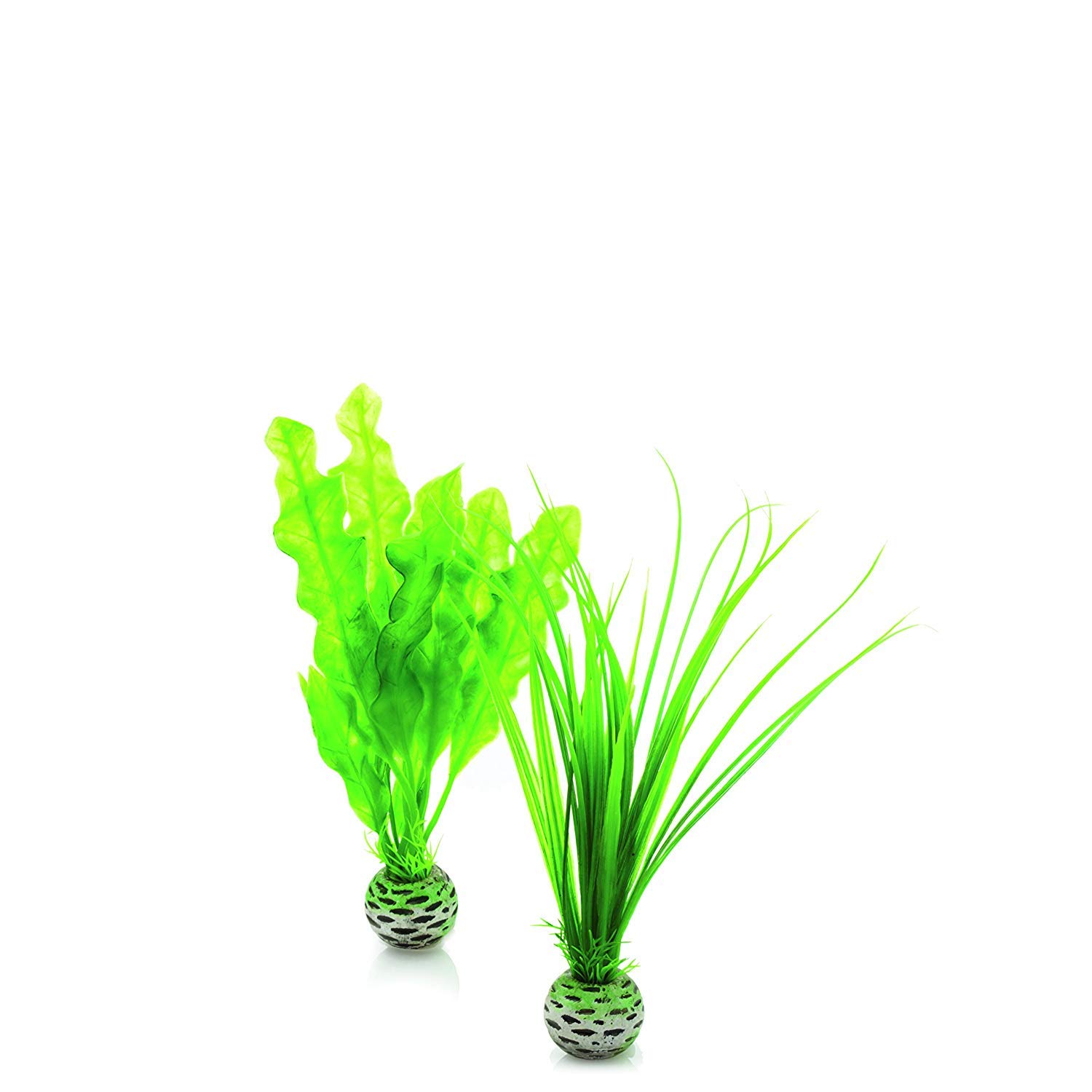
Rating: 4.3 ★ | Price: $$ | Material Softness: Silk blend | Height & Fullness: 7.9 inches each | Live or Artificial: Artificial | Root System: Weighted base
These silk plants deliver the softest leaves we’ve tested—gentle on betta fins and visually realistic with rich green tones. They provide decoration and hiding spots without the fin-tearing risk of harder plastic alternatives.
Best for biOrb aquariums or similar tanks in the 5–15 gallon range. Note that the 7.9-inch height may exceed very compact setups, and the stems and leaves can detach with handling. Tanks with active fish that frequently bump decorations are not ideal.
Pros
- Silky leaves that are gentle on betta fins.
- Rich green color and life-like texture.
Cons
- Height (7.9 inches) may be too tall for very small biOrb tanks.
- Stems and leaves can detach from the plant with handling.
A safe, soft option for betta fins—best in medium tanks where gentle placement is practical.
Best for Natural Filtration
Aquarigram Red Root Floaters

Rating: 4.3 ★ | Price: $$$ | Height & Fullness: Floating surface | Live or Artificial: Live | Root System: Free floating | Water Benefits: Removes ammonia
The Aquarigram Red Root Floaters bring vivid color and active water purification to calm betta tanks. Their long red roots offer cover for bettas while absorbing ammonia and nitrates. This floating plant suits low-flow setups with bettas, but will struggle in tanks with strong filters or surface skimmers. The exposed roots also need moderate humidity to avoid drying out. It requires moderate lighting to thrive. For those with appropriate tank conditions, this is a reliable addition.
Pros
- Bright red roots create visual contrast and provide hiding spots for bettas.
- Improves water quality by absorbing ammonia, nitrates, and heavy metals.
Cons
- Premium-priced for the quantity of leaves provided.
- Sensitive to strong surface agitation; may die off in tanks with high flow or low humidity.
A rewarding choice for betta keepers who can control tank flow and provide moderate light—the water quality benefits and visual appeal are genuine.
Best for Small Tanks
CousDUoBe 12pc Green

Rating: 4.6 ★ | Price: $ | Material Softness: Plastic | Height & Fullness: 2-8.6 inches | Live or Artificial: Artificial | Root System: Weighted base
This 12-pack delivers vibrant green plastic plants at a budget-friendly price, with heights from 2 to 8.6 inches that suit small tanks. Unlike live plants that demand lighting and care, these require no maintenance and hold their color permanently. The set includes multiple leaf shapes and sizes, offering good visual depth for a 10-gallon aquarium. The leaves, however, are not uniformly soft — they may be too stiff for bettas with long fins, so a manual softness check is advised before adding to a tank housing such fish.
Pros
- Vibrant green colors and realistic shapes add visual appeal to small tanks.
- Excellent value for a variety of plant sizes and leaf styles in one pack.
Cons
- Leaf texture can be too firm for delicate betta fins, making it unsuitable for long-finned varieties without prior softness inspection.
For budget-conscious aquarists with small setups and no long-finned bettas, this pack offers strong visual variety at a low cost.
Best for Budget Live Plants
Water Plants Sword 3pk

Rating: 4.4 ★ | Price: $ | Height & Fullness: 8-20 inches | Live or Artificial: Live | Root System: Root tabs required | Water Benefits: Nitrate absorption
Three low-cost Amazon swords that grow well under low light and need little maintenance. Plant condition on arrival is inconsistent — some may arrive in poor shape, and bladder snail hitchhikers can turn up. Best for budget experiments where losses are acceptable.
Pros
- Thrives in low light and grows quickly.
- Low maintenance and hardy for beginners.
Cons
- Plant condition on arrival is inconsistent; some may arrive dead or dying.
Worth considering if you’re okay with occasional losses in exchange for the lowest price per plant.
Best for Low-Light Tanks
AquaLeaf Java Fern

Rating: 4.2 ★ | Price: $ | Height & Fullness: 4-6 leaves | Live or Artificial: Live | Root System: Attach to decor | Water Benefits: Nitrate absorption
This Java fern grows well in low-light, no-substrate setups, making it a low-maintenance option for betta tanks. However, plant condition is inconsistent — some arrive healthy, others do not. It’s best for hobbyists who accept that risk.
Pros
- Thrives in low light without special substrate
- Healthy arrivals are vibrant with intact roots
Cons
- Condition varies between shipments; some plants arrive in poor health
A budget-friendly live plant for low-tech tanks if you’re prepared for possible condition issues.
Best for Small-Medium Tanks
Ameliade 26pc Green

Rating: 4.5 ★ | Price: $ | Material Softness: Plastic | Height & Fullness: 2-12 inches | Live or Artificial: Artificial | Root System: Weighted bases
With 26 pieces of realistic green plastic plants at a budget price, this set offers solid filler value for small tanks. Many plants are on the smaller side (2–12 inches) and some pieces have sharp edges that require pre-inspection — making this set better suited as background decor behind larger ornaments rather than as primary hiding spots for bettas. For betta keepers on a tight budget looking to bulk up an already safe setup, this pack works — but those with long-finned bettas should inspect every piece carefully.
Pros
- Affordable way to get 26 natural-looking green plants.
- Blends nicely with live plants for a cohesive look.
Cons
- Sharp edges can occur on some pieces — inspect each plant before adding to betta tanks.
Fits best as a budget-friendly filler for small tanks where each plant is checked for sharp edges — not a set-and-forget option for bettas.
Best for Colorful Bulk Filler
Ameliade 25pc Colorful

Rating: 4.6 ★ | Price: $ | Material Softness: Plastic | Height & Fullness: 2-12 inches | Live or Artificial: Artificial | Root System: Weighted bases
25 vibrant plastic plants offer bold color variety for large tanks at a very low cost. However, some stems have rough edges that can snag betta fins, and the plants tend to be smaller than their claimed heights. This pack works best as budget filler where fin safety is less critical and size inconsistencies are acceptable.
Pros
- Multi-colored assortment brings vivid, eye-catching variety to the tank.
- Large quantity of plants at a very low price point per piece.
Cons
- Rough edges can snag betta fins, and plants may be shorter than listed heights.
A cost-effective way to add color to a large tank when fin safety is not the top priority — just inspect each plant before adding to the aquarium.
Best for Ultra-Soft Silk
EDGCTYU Silk 4pc

Rating: 4.4 ★ | Price: $ | Material Softness: Silk | Height & Fullness: 5.9 inches | Live or Artificial: Artificial | Root System: Weighted base
These silk plants are the softest option for long-finned bettas — no risk of torn fins. However, the leaves and stems can detach after a few months, requiring replacement. Best for small tanks where you don’t mind swapping them out periodically.
Pros
- Extremely soft silk leaves prevent fin tears.
- Natural-looking green adds visual appeal to small tanks.
Cons
- Leaves and stems may detach in some cases, reducing longevity.
A solid choice for betta owners who prioritize fin safety over durability and are okay with replacing plants every few months.
Best for Water Clarity
Exo Terra Moss Ball

Rating: 4.1 ★ | Price: $ | Material Softness: Synthetic | Live or Artificial: Artificial | Root System: None (synthetic) | Water Benefits: Water clarity
This synthetic moss ball improves water clarity and reduces odors in a day or two, and the low price makes it easy to replace every couple of months. However, it’s a water treatment tool, not a plant — no biological filtration, no hiding spots, and no decorative benefit for a betta tank. The material can float and break down over time, so expect occasional mess. Best suited for temporary clarity fixes in non-planted setups like turtle tanks.
Pros
- Effectively clears cloudy water and reduces odors.
- Very affordable and lasts up to two months.
Cons
- Synthetic material offers no biological filtration or live plant benefits.
Works as a budget temporary water clarifier for turtle tanks or non-planted aquariums, but doesn’t serve as a betta-safe plant or decor.
Best for Algae Control
Fluval Moss Ball

Rating: 4.3 ★ | Price: $ | Material Softness: Synthetic | Live or Artificial: Artificial | Root System: None (synthetic) | Water Benefits: Algae control
This artificial moss ball absorbs phosphates to clear cloudy water and curb algae growth — a functional add-on for small tanks. However, it is not a plant: the synthetic fibers offer no biological benefits, and the ball floats for days before sinking. Bettas needing hiding spots or live plant water quality should look elsewhere.
Pros
- Reduces algae and improves water clarity in small tanks.
- Fish enjoy swimming around the decorative ball.
Cons
- Floats for days before sinking — requires patience during setup.
Best suited for aquarists who want chemical algae control without adding live plants — accept the initial float period.
How to Choose
The most important factor for betta tanks is plant material softness—plastic plants with hidden seams can shred fins even if labeled safe.
Material Softness
Plastic plants often have molding seams that feel smooth to fingers but can catch on betta’s delicate fins. Even plants labeled ‘soft’ may have rough edges at the base or tips. Silk or vinyl plants eliminate this risk entirely, though they can be less durable.
Testing each plant manually before adding it to the tank is the only reliable way to ensure safety: run a nylon stocking along the leaves—if it snags, so will your betta.
Plant Height and Fullness
Tall, bushy plants create hiding spots that reduce betta stress, but also require more vertical space. A 5-gallon tank may only accommodate plants under 8 inches, while larger tanks can handle Amazon swords reaching 12 inches.
Buyers often underestimate how small some ‘fully grown’ plants are. Anubias nana petite, for instance, stays under 2 inches even after months, making it unsuitable for tall tanks.
Live vs Artificial
Live plants improve water quality by absorbing nitrates and providing natural behavior cues for bettas. However, they need adequate light, nutrients, and patience during the initial melt phase. Artificial plants offer instant decoration with zero maintenance, but no biological benefits.
The hidden trade-off: many artificial plants sold as ‘aquarium safe’ are made with paints or dyes that can leach over time. Stick to reputable brands and rinse thoroughly.
Root System / Anchoring
Live plants have different root needs: Amazon swords require nutrient-rich substrate or root tabs, while Java fern and Anubias attach to driftwood or rocks. Planting them incorrectly—burying the rhizome—leads to rot.
Artificial plants typically use weighted bases that hold them in gravel. These can shift during water changes, so check placement periodically to avoid bare spots.
Water Quality Benefits
Floating plants like red root floaters absorb toxins directly from the water column, reducing algae and improving clarity. Rooted plants remove nitrates through their leaves, but the effect is slower and requires a healthy root system.
Artificial plants contribute nothing to water quality. If your goal is biological filtration, live plants are the only option.
FAQ
Are plastic plants safe for betta fish?
Most plastic plants sold for aquariums have rough seams that can tear betta fins. Only those made of soft silk or vinyl, or individually sanded, are safe. Always test with a nylon stocking before adding to the tank.
How to keep live aquarium plants alive in a betta tank?
Provide moderate light for 8–10 hours daily, use root tabs for root-feeders like Amazon sword, and avoid burying rhizomes of Java fern or Anubias. Expect some melting initially; new leaves will grow from the roots within a few weeks if conditions are stable.
What are the best low-light plants for a betta tank?
Java fern, Anubias, and Amazon sword all tolerate low light. Anubias nana petite and Java fern grow slowly but reliably. For a faster option, try floating plants like red root floaters, which need moderate light but thrive without CO2.
Do floating plants help reduce algae in betta tanks?
Yes, floating plants like red root floaters absorb excess nutrients and block light, reducing algae growth. They also provide cover for bettas. However, they need calm water surfaces; strong filters or surface skimmers will kill them.