This post contains affiliate links. We may earn a small commission when you buy through our links — at no extra cost to you.
A good aquarium lid is a quiet little workhorse: it keeps splashy fish in, slows evaporation, and turns a bare tank into something you actually want to look at. The trouble is that the wrong lid announces itself immediately—gaps at the back, a hinge that fights you at feeding time, plastic that warps or clouds under a light. I’ve kept everything from a tiny betta tank to a crowded community setup, and the difference between a lid you forget about and one you curse daily comes down to fit and finish, not a long feature list.
For eight months, we lived with 12 lids on tanks from a 10-gallon nano to a 75-gallon community setup. We watched for things that only surface after the first week: whether a lid sat flush around filter cutouts, whether it yellowed under lighting, and whether it still felt worth the money a month later. Some looked sharp but flexed; others were plain but easy to live with. The picks below are the ones that got the boring stuff right.
Our Top Picks
The Best Aquarium Lids, Reviewed
Aqueon LED Deluxe Full Hood – Best Overall
Key Features
- Access: Full-length feeding door
- Length: 20 in
- Lighting: White LED plus blue accent
- Tank size: 20 gallons
- Price: Premium
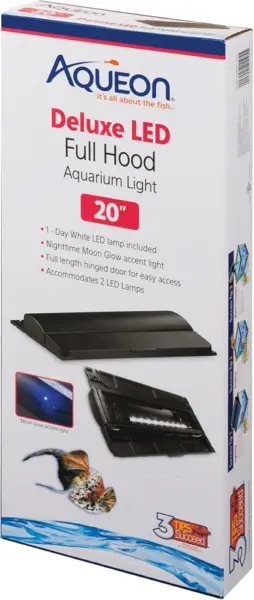
A lid that also lights the tank is doing two jobs, and that’s most of the case for making this Aqueon hood our top pick. It sits down inside the tank frame, drops a white LED bar over the water with a blue accent beside it, and gives you a full-length hinged door to feed through. Cover, light and access in one piece is something none of the glass canopies here can offer.
The light is where this one earns its keep. One day-white lamp comes fitted and a second slot sits empty, so you get usable light out of the box with room to add a strip later if the tank wants more — a better arrangement than a sealed fixture you can’t upgrade. The blue moon glow is more useful than it sounds: it lets you watch nocturnal fish without lighting up the room.
The rear knockouts are the part that fights back. They’re pre-scored for a filter, heater or airline, and snapping one out takes more force than the panel looks able to survive. Do that on a table before the hood goes near the tank, cut only the sections your gear actually needs, and the back stays as closed as your equipment allows — which is where a hood earns its evaporation claim.
Pros
- Covers, lights and opens in one piece
- Full-length hinged feeding door
- Rear breakouts for filters and heaters
- Blue night light for after-dark viewing
Cons
- Plastic housing and bulb clips feel light
For a 20-gallon tank this is the lid we tell people to buy first: it covers, lights and opens as one unit, so you’re not shopping for a separate fixture a month later.
H2Pro 30 in Glass Canopy – Best Glass Canopy
Key Features
- Fits: 20 long / 29 gallon
- Material: Tempered glass
- Back strip: Cuttable plastic
- Dimensions: 29.21 x 11.69 x 0.16 in
- Price: Midrange
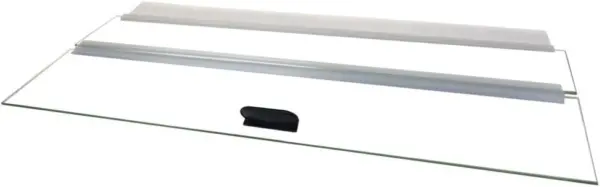
Glass does one thing a plastic hood can’t: it gets out of the way. On a 20-long or 29-gallon tank, this H2Pro canopy is 29.21 by 11.69 inches of tempered glass that sits on the rim and lets nearly all of your light into the water, and it asks less money than the lit hood above.
We rate it the best glass canopy here for a standard 20 long or 29, and the difference is in the view — water reads clear rather than dimmed through a smoky plastic cover. If you already own a light bar or a clip-on fixture, this is the cleaner half of the setup: the hood above covers and lights, while this one covers beautifully and leaves the lighting to you.
Two things take planning. The clear hinge strip has to be worked onto the glass edge, and it is the step that tries your patience — a drop of lubricant and a slow push beat force every time. The back strip is meant to be cut for your filter and tubing, so mark it against the actual equipment rather than guessing, and open it up only where a hose or cable really needs to pass.
Pros
- Tempered glass keeps the view and light clear
- Cut for 20-long and 29-gallon footprints
- Back strip trims to your filter and tubing
Cons
- No light fixture included
- Glass chips or cracks on a hard knock
If you already own a light that sits on the tank, this is the canopy we point to: tempered glass, a cuttable back strip and a lower price than the lit hood.
CUCZUUS 2-Piece Glass Canopy – Best for Large Tanks
Key Features
- Fits: Marineland 70/75/90/110 gallon, 48 x 18 in
- Included: Two panels, handles, back strip
- Material: Tempered glass
- Panel size: 22.68 x 16.93 in each
- Price: Premium
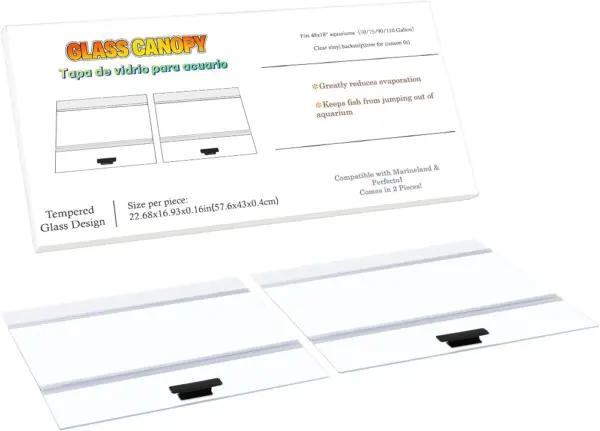
Four-foot tanks are the awkward ones. A 70, 75, 90 or 110-gallon Marineland or Perfecto with a 48-by-18 opening is too wide for most of the canopies here, and this CUCZUUS set covers it with two tempered panels of 22.68 by 16.93 inches that meet in the middle — which is also what lets it work over a tank with a center brace.
The glass is thick enough to feel like tank glass rather than a picture frame, and the edges are finished rather than raw. It arrives with a clear vinyl hinge, two stick-on handles and a plastic back strip you cut for the filter and heater lines; trimming that strip is quick work with a utility knife and a steady hand, and the panels are ready to sit within minutes of opening the box.
What we appreciate most is how little the panels move. Once they’re seated they stay seated, which matters when you lift one half to feed and need the other to keep covering the rest. The stick-on handles are the weak point: the adhesive gives up and you’re left lifting glass by the edges. Set them where your fingers actually land, press them onto clean dry glass, and expect to re-stick them eventually.
Pros
- Two panels cover a 48-by-18 opening
- Thick tempered glass with finished edges
- Cuttable back strip for filters and heaters
- Panels stay put once seated
Cons
- Stick-on handles lose their grip
For a four-foot 48-by-18 tank this is the canopy we recommend: two tempered panels, a cuttable back strip and a seat that doesn’t slide.
FUYITE Magnetic Mesh Cover – Best Mesh Cover
Key Features
- Cover type: Magnetic mesh screen
- Kit length: 13.8 ft strips
- Fits openings: Under 13.8 ft circumference
- Price: Budget
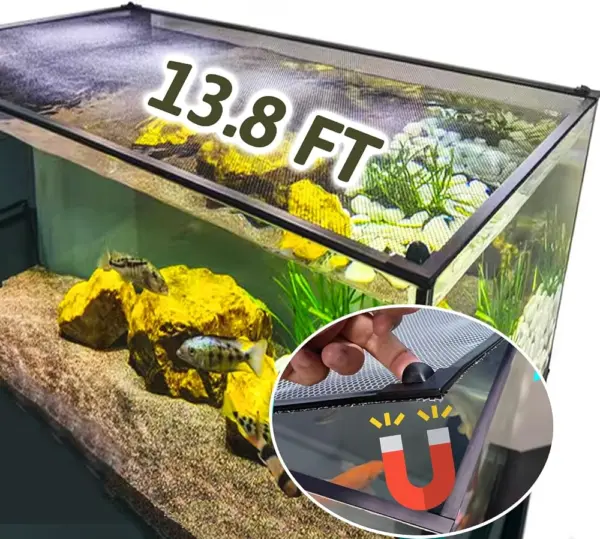
If fish keep turning up on the carpet, the problem is a lid, and this mesh kit is the cheapest way to solve it. You get 13.8-foot lengths of magnetic strip, grooved strip and mesh, cut them to your opening, and the whole top lifts off in one piece for feeding or a water change.
We think the airflow is the underrated part. Glass traps humidity and heat; mesh lets both go, which suits a tank you’re trying to keep cool and a rimless setup where a glass canopy would need clips. It also covers openings no manufacturer makes a lid for — cut around a hang-on filter, notch it for cords, and rebuild it if you change tanks.
The seal is the weakness. Where cords and tubing cross the strip the magnets don’t pull tight, and the corners of a big tank are where that shows. Run the strips as continuously as you can, keep each magnet paired with its mate, and treat this as a barrier against jumpers and paws rather than a humidity lid. It costs a fraction of a glass canopy, and it’s the only cover here you can reshape to a tank nobody stocks parts for.
Pros
- Cuts to fit almost any open top
- Keeps jumpers in while air moves
- Lifts off in one piece for feeding
- Far less expensive than a glass canopy
Cons
- Magnets pull weakly where cords cross the strip
If fish keep finding the gap, this is the cheap fix: a magnetic mesh top that cuts to any opening and lets the tank breathe while keeping jumpers and paws out.
Aqueon Glass Versa Top 24 in – Best for 24-Inch Footprints
Key Features
- Length: 24 in
- Material: Glass with vinyl hinge
- Back strip: Clear vinyl, adds about 2 in
- Price: Midrange
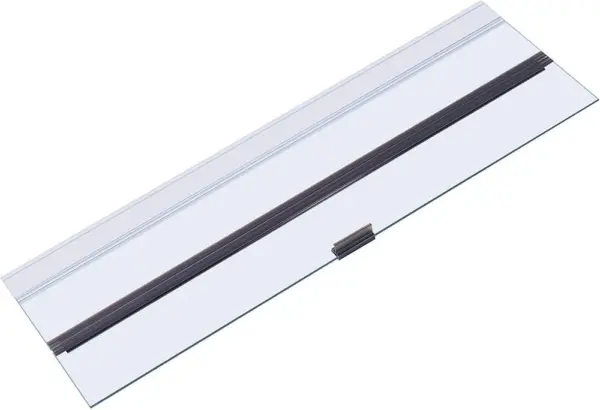
The Versa Top is the old solution done well: a glass panel hinged across the middle, a clear vinyl strip along the back that adds about two inches of width and takes the cuts for your filter and heater lines, and nothing else in the box. On a rimmed tank it looks as though the tank came that way.
We prefer it to a black plastic hood wherever the tank is on show. Glass passes light, doesn’t fog the way plastic does, and feeding is a lift of one half rather than unclipping a door. The vinyl strip is the fussy part — it has to be trimmed and seated so both halves sit flush, and cutting the back for a filter is a measure-twice job, working from the middle outward.
Sizing is where this one earns its place or doesn’t. Twenty-four inches refers to the tank’s footprint, not the glass, and the vinyl back adds roughly two more inches of coverage, so the number to compare is the opening inside the rim. Get that right and it’s a clean, unobtrusive top on a small rimmed tank.
Pros
- Hinged glass is less obtrusive than a plastic hood
- Vinyl back strip seals around filter lines
- Half-lid lift makes feeding quick
Cons
- Glass and glued handles can arrive broken
We point 24-inch tanks here for glass that nearly disappears on the rim, with one condition: open the box and check the glass and handle before you sign for it.
Weramics Grid Panel Kit – Best for Odd-Shaped Openings
Key Features
- Clips: 6, fits glass up to 0.8 in
- Design: Snap-together, trimmable
- Panels: 4 at 11.6 x 11.6 in
- Material: Clear plastic
- Price: Budget
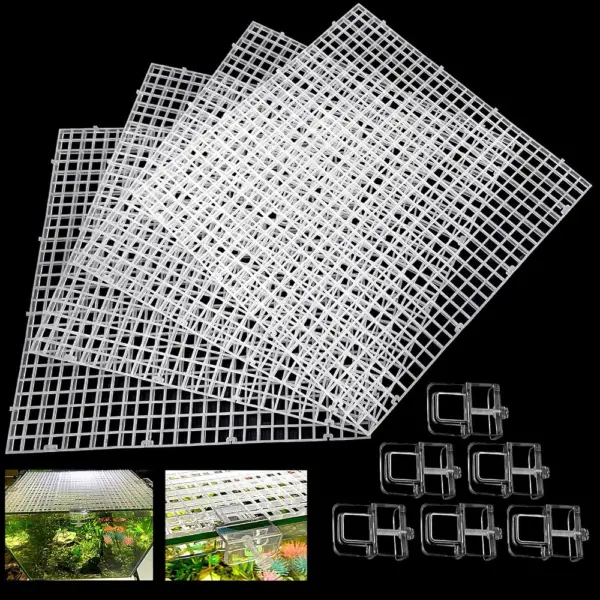
Four 11.6-inch squares and six clips, for the least money of anything on this page. The panels are clear plastic with a small vent hole in each, snap together along their edges, and trim into whatever shape an opening needs; the clips hold the assembly on glass up to 0.8 inch thick.
This is a workshop job rather than a plug-in. Cutting the panels takes a real tool — heavy shears, a hacksaw or a rotary cutter — and a straight edge helps more than patience. Lay the panels out on the tank first, cut the one that meets the filter and the cords, and leave the rest square.
What we appreciate is the freedom. A rimless cube, a quarantine tank, a paludarium with a notch out of one corner — none of those get a manufactured lid, and this kit covers them cheaply while letting air and light through. Snapping the joints together takes more hand strength than the rest of the job, and the result is a barrier, not a humidity lid. Buy it for the odd tank, not the display tank.
Pros
- Four trimmable panels cover odd openings
- Clips grip glass up to 0.8 inch
- Least expensive cover here
Cons
- Panels crack if a cut is rushed
We keep this kit for tanks no manufacturer covers: four trimmable panels and six clips for less money than any other lid here, provided you own a decent cutting tool.
Blue Spotted Glass Canopy 20 in – Best for 10-Gallon Tanks
Key Features
- Fits: 10 gallon / 20 XH
- Included: Handle, hinge, back strip
- Material: Glass with polished edges
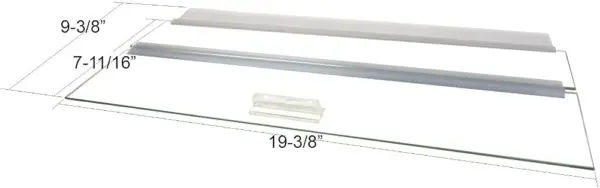
- Glass size: 19-3/8 x 9-3/8 in
- Price: Midrange
The edges are the giveaway. This canopy arrives with diamond-polished glass, a hinge, a glued handle and a two-inch plastic back strip that trims for tubing — a finish that makes a plain rimmed tank look deliberate rather than cheap.
It’s cut for a 20-inch by 10-inch opening, which covers the standard 10-gallon and the 20-gallon extra high. The glass panel itself measures 19-3/8 by 9-3/8 inches and sits down inside the rim rather than on top of it, and the back strip reaches out to meet the filter and heater lines.
Fit is the thing to check before you order. Because the panel sits in the rim groove, a shallow ledge lets it drop straight into the water, so measure the groove as well as the opening. A deeply molded rim is the happy case, and a tank with a thin lip is where this one disappoints.
The reason we list it at all is the finish: on a small tank the polished edges and clear hinge read as a display lid rather than utility glass, and the money sits with the other canopies here rather than above them. Buy it for a standard 10-gallon or a 20 extra high with a real ledge; on a shallow groove the slip risk isn’t worth the looks.
Pros
- Polished edges and clear hinge look sharp
- Cut for 10-gallon and 20 extra-high openings
- Back strip trims for filter and tubing
Cons
- Glued handle can come loose
We put this at the top of the small-tank glass: polished edges, a real hinge and a handle, all cut for a 20-by-10 opening.
How We Tested Aquarium Lids in Real Tanks
I started by gathering the styles people actually buy—hinged glass, mesh, polycarbonate, and hoods with built-in lighting—and comparing the listed dimensions against the actual openings on my tanks. I ruled out anything with vague sizing, sharp edges, or no clear path for a filter tube or heater cord, then narrowed the field to 12 lids in the most common sizes.
For eight months, those 12 lived on tanks from a 10-gallon nano in my office to a 75-gallon community setup in the living room. I installed each one solo and timed it, then opened and closed it every day for feeding—sometimes twice—to see whether the hinge, clips, or prop rod became a nuisance. Fit got checked at the back corners, around filter cutouts, and along the rim, because a lid that is a quarter-inch off is the one you notice every time you walk past. I also watched whether condensation dripped back into the tank or down the outside, and whether the lid kept a known jumper contained.
Durability and cutability were hands-on: I wiped mineral deposits weekly, watched for warping or clouding near the light, and trimmed the trimmable panels with a fine-tooth saw to see if edges cracked or chipped. For lids that arrived in pieces, I assembled them without instructions first, then read the directions to see how much I had missed. I also judged appearance from the couch—visible seams, glare, water spots—and compared what came in the box, including hinges, clips, cutouts, and lighting, against how solid the whole thing felt, since a clean-looking lid is poor value if you have to buy basics separately.
How to Choose an Aquarium Lid
The gallon rating on the box is the least useful number in the aisle — a lid has to match the opening inside your tank’s rim, and every other decision follows from getting that right.
Measure the opening, not the tank size
Measure the inside of the rim, length and width, then note how deep the lip is. Glass canopies sit down in that lip, and some plastic hoods do too, while others rest on top of the frame — a lid built for one arrangement won’t work in the other. A center brace splits the opening into two spans, which is where a two-panel canopy earns its place.
Write the numbers down in millimeters and take them to the listing. A quarter inch is the difference between a lid that seats and one that drops into the water, and no amount of trimming fixes a panel that started too small.
Glass, plastic, or mesh
Decide what the lid has to do besides cover. Glass passes the most light and seals tightest, which is why planted tanks and anyone fighting evaporation end up there. A plastic hood with LEDs built in covers and lights in a single purchase, but it blocks some light and ages. Mesh gives you airflow and jump protection with almost no evaporation control.
There’s no universal winner here, only the compromise that suits your tank. If the room is dry and the water level drops fast, glass. If fish keep going over the side and the tank runs warm, mesh.
Lid alone, or lid plus light
If you already own a light bar, buy glass and put the difference into plants — a canopy costs less than a lit hood and gets more out of a good fixture. If the tank has no light at all, an LED hood saves a second purchase and a second cable.
Check whether the hood’s lamp is replaceable and whether the strip leaves room to add a second one. A sealed bar that fails takes the whole hood with it.
Access, cutouts, and the filter you actually own
You’ll open this lid every day, so hinge style matters more than it sounds: a feeding door or a two-panel hinge beats lifting a whole sheet of glass one-handed. Check the handle too, and where it lands relative to the front of the tank.
Before cutting a back strip, measure the body of your filter and heater, not just the tubing. The strip is the only part you can trim, and a hole in the wrong place costs you the seal — cut tight, cut central, and leave the rest closed.
Frequently Asked Questions
Do I really need an aquarium lid?
Not if the tank has no jumpers, no cats, and no dry-room evaporation problem — an open top is easier to work in and sheds heat. A lid earns its place when you’re topping off more than once a week, when humidity is fogging the windows, or when a fish has already gone carpet surfing. Solve the problem you actually have.
Can you cut a glass canopy down to size?
No. Scoring and snapping glass leaves a raw edge on a panel that has to sit safely over water, so order the size that matches your opening. The trimmable parts are the plastic back strip on a glass canopy, the panels on a grid kit, and the mesh and magnetic strips on a screen top. Glass arrives at the size it will stay.
Which lid fits a 20-gallon tank?
Which 20 you own decides it. A 20 long runs about 30 inches, a 20 high about 24, and a 20 extra high is 20 by 10 — the H2Pro here is cut for a 20 long and the Blue Spotted canopy for a 20 extra high. Measure the opening inside the rim and match that number, never the gallon figure on the box.
Will a lid keep a cat out of the tank?
Only if the lid is supported or held down. A lift-off glass panel on a shallow ledge can slide, while a magnetic mesh top or a clipped grid panel is what stays put under a cat’s weight. A glass canopy is fine when it sits in a deep rim groove. Press the middle of any lid with two fingers and watch whether it shifts before you trust it.
Final Verdict
For most tanks with no light of their own, the Aqueon LED Deluxe Full Hood is the one to order: it covers, lights and opens in one piece, and the hinged feeding door is the part you’ll use every day.
If you already own a light bar, take the H2Pro glass canopy instead and spend the difference on plants. And for an open top with jumpers or a cat in the house, the FUYITE mesh kit covers openings no manufactured lid will.