This post contains affiliate links. We may earn a small commission when you buy through our links — at no extra cost to you.
Every aquarium keeper eventually faces the same question: which pH test actually tells you what you need to know? Test strips are fast but often unreliable for critical decisions, liquid kits are accurate but time-consuming, and digital meters promise precision but demand regular calibration. The right choice depends entirely on your tank’s stage and your tolerance for trade-offs.
For a new tank cycling or when fish are stressed, accurate ammonia and nitrite readings matter more than pH precision. That’s why liquid reagent kits remain the go-to for serious hobbyists. But if you maintain a stable, established tank, strips can save you time without endangering your fish. Digital meters shine for reef or planted tanks where pH control is tight.
This guide cuts through the confusion by matching testing methods to real-world use cases. Whether you need comprehensive multi-parameter monitoring or just a quick pH check, you’ll find a reliable option that fits your routine and budget.
Top Picks
Best for Comprehensive Water Analysis
API Freshwater Master Test Kit

Rating: 4.8 ★ | Price: Mid-Range | Parameters: pH, ammonia, nitrite, nitrate, high-range pH | Test Method: Liquid reagent drops | pH Range: 6.0-7.6 & 7.4-8.8 | Water Type: Freshwater only | Tests per Kit: 800
The API Freshwater Master Test Kit uses liquid reagent drops for precise measurement of pH (both low and high range), ammonia, nitrite, and nitrate—parameters essential for maintaining a healthy freshwater aquarium. This accuracy is a clear step above test strips, which can be inconsistent for critical readings.
This kit is built for freshwater hobbyists—beginners cycling a new tank, planted tank enthusiasts, and owners of multiple aquariums who need consistent monitoring. It does not include GH/KH tests (sold separately) and is not suitable for saltwater or reef aquariums.
Pros
- Liquid reagent tests provide accurate readings for pH, ammonia, nitrite, and nitrate—superior to test strips.
- Clear, illustrated instructions make the testing process easy even for first-time aquarium owners.
- Hundreds of tests per kit offer a low per-test cost for regular monitoring across multiple tanks.
Cons
- Color matching can be difficult under poor lighting, especially for the nitrate test.
- General hardness (GH/KH) tests are not included; those require a separate purchase.
For freshwater keepers who want accurate, comprehensive water testing at a low per-test cost, this kit is the standard to follow.
Best for Precise Ph Control
Apera PH60 pH Tester

Rating: 4.5 ★ | Price: Premium | Parameters: pH only | Test Method: Digital pH meter | pH Range: -2–16 | Water Type: Freshwater and saltwater
The PH60 delivers the highest pH precision available in a handheld meter, reading to ±0.01 — essential for reef tanks where a 0.1 shift affects coral health. Unlike cheaper models with sealed probes, the replaceable sensor extends the device’s service life. This level of accuracy comes with a routine: monthly calibration and careful storage of the glass bulb to avoid breakage. Best for aquarists who monitor pH closely and are comfortable with maintenance; occasional testers will prefer the lower cost and simplicity of a liquid kit or the entry-level PH20.
Pros
- Reads pH to ±0.01 accuracy, matching lab-grade instruments.
- Replaceable probe lets you replace only the sensor, not the whole meter.
Cons
- Glass probe requires careful handling during cleaning to prevent breakage.
- Initial and ongoing probe replacement costs are higher than test strips or reagent kits.
For reef keepers and planted tank enthusiasts who need precise pH control, the PH60 justifies its premium price with lab-grade accuracy and a serviceable design.
Best for Quick Weekly Checks
API 5-in-1 Test Strips

Rating: 4.6 ★ | Price: Budget | Parameters: pH, nitrite, nitrate, KH, GH | Test Method: Dip-and-read test strips | Water Type: Freshwater and saltwater | Tests per Kit: 25 strips
The API 5-in-1 strips combine pH, nitrite, nitrate, general hardness, and carbonate hardness in a single dip, making them the most convenient option for routine checks. They skip ammonia and trade some accuracy for speed — readings can differ from liquid test kits, so treat results as directional. For stable, established tanks where minor fluctuations are the norm, these strips provide enough visibility to catch issues early. This makes the strips best suited for experienced hobbyists who already track ammonia separately and need a quick weekly snapshot of hardness and nitrate trends, not precise dosing adjustments.
Pros
- Dip-and-read in under 60 seconds — no mixing or timing required.
- Measures both GH and KH, useful for hardness-sensitive fish and shrimp.
- Works in both freshwater and saltwater setups.
Cons
- Does not test for ammonia — needs a separate purchase for cycling or troubleshooting.
A time-saving strip for established tank monitoring when you already have an ammonia test — reliable for trends, not for precise dosing.
Best for Budget Digital Ph
Apera PH20 pH Tester

Rating: 4.4 ★ | Price: Mid-Range | Parameters: pH only | Test Method: Digital pH meter | pH Range: 0–14 | Water Type: Freshwater and saltwater
Unlike liquid test kits that require matching colors, the Apera PH20 provides instant digital pH readings with automatic temperature compensation — a clear time-saver for regular testing. The waterproof IP67 design floats if dropped, and the included calibration buffers make initial setup simple. However, this meter uses a non-replaceable probe; when it degrades, the entire unit must be replaced, typically within a year. Regular calibration is needed to maintain accuracy. This suits hobbyists who test pH frequently and prefer digital precision over test strips, and who are willing to perform periodic maintenance.
Pros
- Fast digital readings with automatic temperature compensation eliminate color matching guesswork.
- Complete kit includes calibration buffers and a case, making setup straightforward.
Cons
- Calibration and maintenance require more attention than test strips, which can take some getting used to.
- The probe is not replaceable; when it degrades, the entire unit must be replaced.
The Apera PH20 suits aquarium keepers who want instant digital pH readings and accept the need for regular calibration and eventual full unit replacement.
Best for Wide Ph Range
Sera pH-Test

Rating: 4.6 ★ | Price: Mid-Range | Parameters: pH only | Test Method: Liquid reagent drops | pH Range: 5.0–8.5 | Water Type: Freshwater and saltwater | Tests per Kit: 150-200
The Sera pH-Test covers a broader pH range (5.0–8.5) than the standard API kit, making it useful for discus, African cichlids, or tanks with very soft or hard water. It’s a single-parameter kit, and the cost per test is higher than using the API master kit’s pH portion alone. The 0.5 pH unit color increments can be too coarse for reef keepers needing finer precision. This kit suits hobbyists who already own a master kit for other parameters but need a dedicated wider-range pH test for specialty species.
Pros
- Covers pH 5.0 to 8.5, wider than most basic kits
- Liquid drops produce clear color shifts for straightforward reading
Cons
- Higher cost per test than using the API master kit’s pH test alone
- Color increments of 0.5 pH units can be too coarse for reef tank precision
Best for freshwater aquarists who need a broader pH range than the standard API kit and want a backup liquid test for specialty species, not for reef tank precision.
Best for Multi-Parameter Reef
Apera PC60 Multi-Parameter

Rating: 4.5 ★ | Price: Luxury | Parameters: pH, EC, TDS, salinity, temp | Test Method: Digital multi-parameter probe | pH Range: -2–16 | Water Type: Freshwater and saltwater
One waterproof device measures pH, EC, TDS, salinity, and temperature with professional-grade accuracy (±0.01 pH, ±1% EC/TDS). That convenience is meaningful for reef keepers and planted tank enthusiasts who need to track multiple parameters without juggling separate meters. The replaceable probe design extends the tool’s useful life, but the initial investment is high and replacement probes add ongoing expense. Calibrating all five parameters takes more care than a single-parameter meter, and drift is possible if storage or maintenance is skipped. This tool is best suited for serious aquarists managing salinity and conductivity alongside pH — overkill for a basic freshwater tank where a pH-only kit or meter would be simpler and cheaper.
Pros
- Five water quality parameters in one waterproof device.
- Replaceable probe allows the tester to be used longer than disposable meters.
- Lab-grade accuracy suitable for sensitive reef and planted systems.
Cons
- Upfront cost is premium, and probe replacements add recurring expense.
- Multi-parameter calibration and storage require attention to avoid reading drift.
If you manage a reef or planted tank and need a single tool for pH, salinity, and conductivity, the PC60 delivers professional accuracy — just be prepared for ongoing calibration and probe costs.
Best for Budget Frequent Testing
Tetra EasyStrips 6-in-1

Rating: 4.6 ★ | Price: Budget | Parameters: Nitrate, nitrite, hardness, chlorine, alkalinity, pH | Test Method: Dip-and-read test strips | Water Type: Freshwater and saltwater | Tests per Kit: 100 strips
The Tetra EasyStrips 6-in-1 delivers 100 strips at a budget-friendly price, offering a quick dip-and-read method for tracking pH and other parameters in established tanks. However, it omits ammonia testing, a gap for beginners or those monitoring new cycles, and its parameter set includes chlorine and alkalinity rather than GH/KH.
Pros
- Excellent value with 100 strips per bottle
- Very easy to use and fast results
Cons
- Accuracy can be inconsistent; color matching may be ambiguous compared to liquid kits
Best suited for budget-conscious keepers of established tanks who need quick trend checks rather than precise readings.
Best for Broad Parameter Coverage
SJ WAVE 11-in-1 Strips
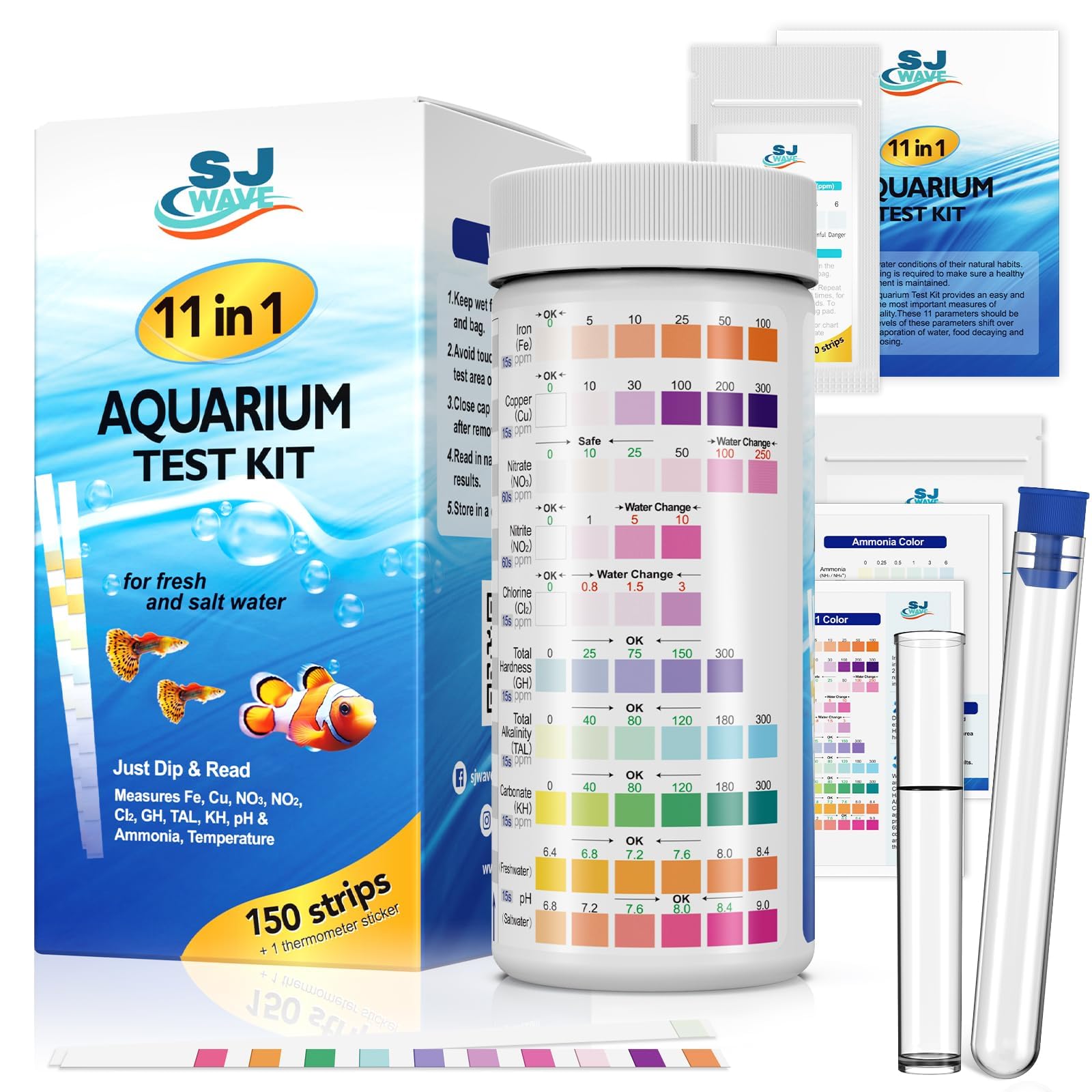
Rating: 4.5 ★ | Price: Budget | Parameters: 11 parameters incl. ammonia, copper, iron | Test Method: Dip-and-read test strips | Water Type: Freshwater and saltwater | Tests per Kit: 150 strips (50 ammonia separate)
This strip kit covers 11 water parameters — including pH, ammonia, copper, and iron — at a cost that suits frequent testing in established tanks. The included ammonia strip extends coverage beyond typical strip kits. However, pH and other readings can vary noticeably compared to liquid reagent tests, so this is better suited for keeping a general eye on trends rather than making precise adjustments. The separate ammonia test adds an extra step and wait time, which may trip up newcomers.
Pros
- Measures 11 parameters including ammonia, iron, and copper — rare for a strip kit.
- 150 strips plus separate ammonia strips deliver good value for frequent monitoring.
Cons
- pH and ammonia readings can deviate from liquid test results, better for trend spotting than precision work.
For budget hobbyists who want broad parameter awareness without committing to multiple liquid kits, this strip set offers wide coverage at a low cost — just don’t rely on it for critical pH decisions.
Best for Budget Ph Only
API pH Test Kit

Rating: 4.6 ★ | Price: Budget | Parameters: pH only | Test Method: Liquid reagent drops | pH Range: 6.0–7.6 | Water Type: Freshwater only | Tests per Kit: 250
The API pH Test Kit delivers 250 liquid-reagent tests at a budget-friendly price, making it an economical choice for checking pH in freshwater tanks. However, its range only covers pH 6.0–7.6, which excludes high-pH setups like African cichlid tanks. The glass test tube is also delicate. This kit works best as a supplement to a master kit for stable tanks.
Pros
- Budget-friendly per-test cost for pH-only testing
- Liquid reagent method gives clear readings within its pH range
Cons
- Narrow pH range (6.0–7.6) limits use to freshwater tanks with stable pH; not suitable for high-pH or African cichlid tanks
Good for those who already own a master kit and only need an inexpensive pH check for stable freshwater tanks, but not a primary test kit for varied setups.
Best for Small Tank Ph Tweaks
API pH Test & Adjuster

Rating: 4.5 ★ | Price: Budget | Parameters: pH + adjusters up/down | Test Method: Liquid reagent + chemicals | pH Range: 6.0–7.6 | Water Type: Freshwater only | Tests per Kit: 250
This kit combines liquid pH testing (6.0–7.6) with pH up/down chemicals in a single budget-friendly package. For tanks under 10 gallons, it’s a simple way to make small corrections. The adjuster bottles hold very little liquid and the pH range is narrow, limiting its practicality for larger tanks or extreme pH needs.
Pros
- Combines pH testing and adjustment in one affordable kit.
- Liquid reagent test is simple to read with clear color matching.
Cons
- The narrow pH range (6.0–7.6) and small adjuster bottles can run out quickly on tanks over 10 gallons.
This is the right pick if you need a cheap entry into pH testing with occasional adjustment for a nano or small desktop tank.
Best for High-Volume Strip Use
HOVIRAN 7-Way Strips

Rating: 4.5 ★ | Price: Budget | Parameters: Chlorine, hardness, alkalinity, nitrate, nitrite, pH | Test Method: Dip-and-read test strips | Water Type: Freshwater and saltwater | Tests per Kit: 125 strips
At roughly six cents per strip, this 125-count kit is the most cost-effective option for frequent water testing in stable tanks. The dip-and-read design is beginner-friendly, but the lack of ammonia detection and occasional difficulty matching pH colors to the chart limit its usefulness as a primary test kit. Nitrate accuracy has also been noted as inconsistent.
Pros
- Lowest cost per test among budget strips for bulk testing
- Simple dip-and-read operation suitable for beginners
Cons
- No ammonia test included; nitrate and pH readings may be unreliable for critical measurements
Best suited for hobbyists who already own a separate ammonia kit and need a low-cost way to monitor pH trends in mature freshwater or saltwater tanks.
Best for Bulk Strip Monitoring
DIPSTIK 7-Way Strips

Rating: 4.5 ★ | Price: Budget | Parameters: Nitrate, nitrite, chlorine, hardness, alkalinity, carbonate, pH | Test Method: Dip-and-read test strips | Water Type: Freshwater and saltwater | Tests per Kit: 100 strips
This 100-strip kit offers low cost per test for quick checks on basic parameters in stable tanks. pH readings can be inconsistent, and color bleed between pads may cause confusion. Without an ammonia test, it’s best as a supplementary tool alongside a liquid master kit for trend monitoring.
Pros
- Very low cost per strip, ideal for frequent testing
- Easy to use with simple dip-and-read design
Cons
- pH readings can be inconsistent, making it better for trend monitoring than precise measurements
Suitable for quick pH checks in established aquariums where exact numbers aren’t needed, but not for critical decisions.
Best for Mature Tank Trends
FUNSWTM 7-in-1 Strips

Rating: 4.5 ★ | Price: Budget | Parameters: Nitrate, nitrite, hardness, chlorine, pH, carbonate, alkalinity | Test Method: Dip-and-read test strips | Water Type: Freshwater | Tests per Kit: 100 strips
This strip set offers a low-cost way to keep an eye on pH, nitrates, and hardness in stable freshwater setups. The dip-and-read method is quick and simple, and the 100-count supply stretches far. However, it omits ammonia entirely, and pH readings can vary between strips — fine for trend checks in mature tanks, but not a substitute for liquid test kits when precision or cycling is needed.
Pros
- 100 strips at a budget-friendly price reduce cost per test.
- Simple dip-and-read method with no mixing or timing hassles.
Cons
- pH and hardness readings can vary between strips, limiting precision for sensitive fish or dosing decisions.
A decent backup strip set for established freshwater tanks where you already have an ammonia test and accept color-matching approximations for pH.
How to Choose
The best aquarium pH test kit is the one that matches how you care for your tank—accuracy demands liquid reagents; convenience favors strips; precision requires digital maintenance.
Number of Parameters Tested
A pH-only kit leaves you blind to ammonia spikes during cycling. Liquid master kits like API cover the five critical parameters—pH, ammonia, nitrite, nitrate, and high-range pH—giving you a complete picture. Strips often add hardness and alkalinity but skip ammonia, which is a critical omission for new tanks.
If you only need pH for an established tank, a single-parameter liquid kit or digital meter suffices. But for most freshwater setups, buying a multi-parameter liquid kit saves money and effort compared to piecemeal tests.
Test Method
Liquid reagent drops are the gold standard for accuracy—each parameter has its own chemical reaction that changes color. The trade-off is time: each test takes a few minutes, and you must compare colors against a chart under good light. Test strips cut that to 30 seconds but suffer from inconsistent color development and lower sensitivity, especially for nitrate and ammonia.
Digital meters give instant numeric readings, but they require weekly calibration and proper probe storage. A dried-out probe or expired calibration solution produces misleading results. For frequent pH checks, digital is convenient; for occasional use, liquid kits are more forgiving.
pH Range and Resolution
Most freshwater pH tests cover 6.0–7.6, which works for typical community tanks. If your tap water is below 6.0 or you keep African cichlids that need pH above 8, you need a broader range. Sera’s liquid test covers 5.0–8.5, and digital meters handle 0–14. Resolution matters too—API’s standard test reads in 0.5 increments, while the Apera PH60 reads to 0.01.
For reef tanks where pH swings of 0.1 can stress corals, digital meters with ±0.01 accuracy are worth the investment. For general freshwater, the 0.5 steps of a liquid kit are fine—just be aware that the color chart can be ambiguous under low light.
Freshwater vs Saltwater Compatibility
Some test kits are specifically designed for freshwater only (like API’s standard pH kit) because saltwater can interfere with the reagents. Others, like digital meters and many strips, work in both environments. Always check the label: using a freshwater-only liquid test on saltwater can give false readings, and the high pH of marine tanks may exceed the kit’s range.
If you keep both freshwater and saltwater tanks, a digital meter or a strip kit labeled for both is the most flexible solution. Liquid tests for saltwater are available but often separate products.
Number of Tests per Kit
Test count determines long-term cost: a kit with 800 liquid tests (like API Master) costs about 4.5 cents per test, while a 25-strip pack of the same brand runs about 52 cents per strip. Bulk strips (100-count) bring the cost down to 10–15 cents per test, but at the expense of accuracy.
Digital meters have no per-test cost, but the initial investment is higher and probes need replacement every 1–2 years ($20–$40). For a keeper with multiple tanks who tests weekly, liquid kits offer the best value. For a single stable tank, strips or a digital meter may be more practical despite higher per-test cost.
FAQ
How often should I calibrate my digital pH meter for aquarium use?
For daily use, calibrate weekly using two standard buffer solutions (pH 4.0 and 7.0 or 7.0 and 10.0). If you notice readings drifting or after storing the probe dry, recalibrate before each use. Neglecting calibration is the fastest way to get misleading results—a meter that hasn’t been calibrated in a month can be off by 0.5 pH or more.
Are aquarium test strips accurate enough for cycling a new tank?
No. During cycling, you need precise ammonia and nitrite readings to track progress. Most strips don’t include ammonia, and those that do often give unreliable color matches. Use a liquid reagent kit like the API Master Test Kit for cycling—it’s the only way to know when the tank is truly ready for fish.
What’s the difference between pH high range and normal range in API test kits?
API’s normal pH test covers 6.0–7.6, while the high-range test covers 7.4–8.8. The Master Test Kit includes both. Use the normal test for most freshwater tanks, and switch to high-range if the color matches the darker blue shades (pH above 7.6). If your tank’s pH consistently exceeds 7.6, the high-range test gives better resolution.
Can I use freshwater test strips in a saltwater aquarium?
Only if the strip packaging explicitly says ‘saltwater.’ Many strips work in both, but some are formulated for freshwater only and may give incorrect readings for pH or alkalinity in saltwater. Digital pH meters and liquid kits designed for saltwater are safer choices for marine tanks.