This post contains affiliate links. We may earn a small commission when you buy through our links — at no extra cost to you.
Many aquarium pH meters promise accuracy but deliver erratic readings within weeks of use. The real challenge isn’t finding a pH meter – it’s finding one that stays accurate long enough to trust for your fish’s health.
Cheap pens often drift after a few calibrations or stop working entirely, while premium models demand careful maintenance. The sweet spot sits in the mid-range: meters with IP67 waterproofing, automatic temperature compensation, and a proven track record of holding calibration.
This guide focuses on which meters actually survive daily splashes and regular use, helping you avoid the cycle of buying replacements every few months. The trade-off between lab-grade precision and everyday value comes down to your tank’s sensitivity – and we’ll show you where to draw the line.
Top Picks
Best for Serious Reef Keepers
Apera PH60 Premium

Rating: 4.5 ★ | Price: Premium | Accuracy: ±0.01 pH | Waterproof: IP67 | Calibration: Auto 1-3 point
The Apera PH60 delivers ±0.01 pH accuracy, a level of precision that matters when a 0.1 shift can stress sensitive reef or planted tank inhabitants. Unlike fixed-probe meters that become e-waste after probe degradation, the PH60’s replaceable glass probe lets you swap in a fresh sensor every one to two years, keeping the instrument in service long after cheaper alternatives would be discarded.
Factory pre-calibration with automatic buffer recognition gets you reading right out of the box, though some users note the calibration procedure requires careful attention to the step order. The IP67 waterproofing holds up under splashes, rain, and accidental drops into the tank, and the LCD display remains readable in varied lighting. Build quality feels substantial — no creaking plastic or loose battery compartments common in budget pens.
This meter suits hobbyists who already understand that pH stability is critical to their setup and are willing to invest in a tool that can last years with proper care. The glass probe is a consumable item — expect replacement every 12–24 months depending on storage conditions and cleaning habits. Beginners who want a simple dip-and-read device may find the calibration routine frustrating; for them, the lower-cost PH20 is a better starting point.
Pros
- ±0.01 pH accuracy for sensitive aquarium setups.
- Replaceable glass probe extends meter lifespan beyond fixed-probe models.
- IP67 waterproofing handles splashes and brief immersion.
- Pre-calibrated with auto buffer recognition for quick start.
- Solid build quality with a professional feel.
Cons
- Calibration procedure can be finicky for new users — following the order of buffer steps is necessary for consistent results.
- Glass probe is a consumable; replacement every 1–2 years depending on care and storage.
For aquarists who need precise pH monitoring and want a meter that can last through probe swaps, the PH60 delivers the accuracy and durability that cheaper alternatives lack.
Best for Value-Conscious Hobbyists
Apera PH20 pH Meter

Rating: 4.4 ★ | Price: Mid-Range | Accuracy: ±0.1 pH | Waterproof: IP67 | Calibration: Auto 1-2 point
For aquarium keepers who prioritize simplicity and a complete out-of-the-box experience, this meter shifts the focus away from lab-grade ±0.01 precision to practical, daily water testing. It offers auto-calibration and waterproof durability while trading the replaceable probe of the top pick for a lower price — a difference that matters most for reef tanks or sensitive planted setups where the tightest accuracy is non-negotiable.
The IP67-rated body handles splashes and brief submersion, and automatic temperature compensation keeps readings stable across the temperature shifts common in fish rooms. The interface guides calibration with clear prompts, and the included buffer solutions and storage liquid remove the need for extra purchases, so a new user can start testing within minutes of opening the kit.
This meter fits hobbyists with freshwater or fish-only saltwater tanks who need quick, dependable checks rather than precision monitoring for delicate corals. Over time, calibration can drift and require re-checking against buffer solutions. If your tank demands ±0.01 accuracy or the long-term flexibility of swapping just the probe, the higher-tier model in this lineup removes those boundaries.
Pros
- Simple auto-calibration with clear on-screen prompts, accessible even for first-time pH meter users.
- Complete kit with calibration buffers and storage solution, eliminating the need for separate purchases — a genuine value at this price.
- Waterproof IP67 housing and automatic temperature compensation hold up to wet environments and temperature swings during water changes.
Cons
- The glass probe can shatter if dropped on a hard surface, a risk near slippery aquarium floors.
- Readings may drift over time, requiring periodic re-calibration with buffer solution to maintain accuracy.
- Because the probe is not replaceable, a sensor failure means the entire device must be replaced; occasional units have been reported to stop working within the first year.
For most freshwater and fish-only saltwater tanks, this meter delivers the accuracy you need without paying for features you won’t use.
Best for Deep Reservoir Users
Bluelab pH Pen

Rating: 4.4 ★ | Price: Premium | Accuracy: ±0.1 pH | Waterproof: Floats | Calibration: 2-point with reminder
The Bluelab pH Pen stands out with its floating design – a practical advantage when working over deep tanks or reservoirs where a dropped meter can disappear. Its double-junction probe and automatic temperature compensation deliver readings quickly, and the backlit screen makes it usable in low-light grow rooms. For aquarists who regularly reach into large open tanks, the float feature alone justifies a look.
Where the Bluelab falls short of the top pick is long-term consistency. Calibration can drift over weeks, requiring recalibration before each use to maintain claimed ±0.1 accuracy. Some owners have reported that after several months the meter stops responding to calibration solutions altogether – a known vulnerability rather than a universal flaw. The premium price does not buy indefinite peace of mind, so this pen suits users who don’t mind annual replacement and who prioritize the float function over multi-year reliability.
Pros
- Floats if dropped in water, preventing loss in deep reservoirs.
- Comfortable grip and fast, stable readings with backlit display.
- Easy two-point calibration with a 30-day reminder indicator.
Cons
- Calibration may become inconsistent; some units cannot be calibrated after a few months.
- In a tank that requires daily pH checks, the need for frequent recalibration adds routine work.
- Probe and casing durability has been noted as variable – occasional cracks or broken pieces.
Buy this if you work over deep water and want a meter that floats; just plan to recalibrate before each session and consider it a yearly purchase.
Best for Ac Infinity Users
AC Infinity pH Pen

Rating: 4.4 ★ | Price: Mid-Range | Accuracy: ±0.1 pH | Waterproof: IP67 | Calibration: Includes solutions
The AC Infinity pH Pen shares the same design language as the brand’s controllers and fans, making it a natural fit if you’re already using their gear. It delivers fast, accurate pH readings with automatic temperature compensation, and the included calibration solutions simplify setup.
Compared to the Apera PH20 — the best-value waterproofer in this set — the AC Infinity pen has fewer user reports to draw on, so its long-term consistency is less documented. Calibration can be finicky on some units, which adds a layer of uncertainty for daily aquarium monitoring.
This meter suits aquarium hobbyists who are building an AC Infinity-controlled system and want a cohesive kit. If you value a well-documented performance record over brand matching, the Apera alternatives offer more established consistency. The calibration quirks mean it’s best for users willing to verify readings periodically.
Pros
- Accurate pH readings with fast stabilization for quick water checks.
- Simple calibration using included 4.00 & 7.00 buffer solutions.
- IP67 waterproof rating allows submersion for tank testing.
Cons
- Calibration can be finicky; some units may not hold calibration or drift quickly.
- Long-term performance is less documented than competing meters, making it a less established choice for consistent monitoring.
For AC Infinity ecosystem users who prioritize matching aesthetics over a well-documented track record, this pH pen delivers the core features needed for aquarium water testing — just be prepared to verify its accuracy regularly.
Best for Multiparameter Growers
Apera PC60 Multi

Rating: 4.5 ★ | Price: Premium | Accuracy: ±0.01 pH | Waterproof: IP67 | Calibration: Easy auto
The Apera PC60 combines pH, EC, TDS, salinity, and temperature into one IP67-rated pen, with automatic temperature compensation and ±0.01 pH accuracy. This makes it a capable tool for aquarium keepers who monitor both freshwater and saltwater parameters. However, the premium price is only justified if you need all four measurements. For those who only require pH, dedicated pH testers like the Apera PH60 offer similar accuracy at a lower cost. Additionally, the probe is a consumable, and some units have shown variable longevity — worth considering alongside a flexible return policy.
Pros
- Accurate multi-parameter readings for pH, EC, TDS, and salinity in one handheld device.
- Professional-grade build quality with an IP67 waterproof rating and backlit display.
- Calibration is straightforward with included solutions and a clear menu.
Cons
- In some cases, the probe may need replacement within a few months of regular use.
- Unit-to-unit consistency varies; occasional erratic readings may occur, making verification against a reference solution worthwhile.
If you manage a mixed freshwater and saltwater aquarium and need a single tool for pH, conductivity, and TDS, the PC60 covers all bases — just budget for eventual probe replacement.
Best for Basic Saltwater Checks
Hofun 5-in-1 pH/Salinity
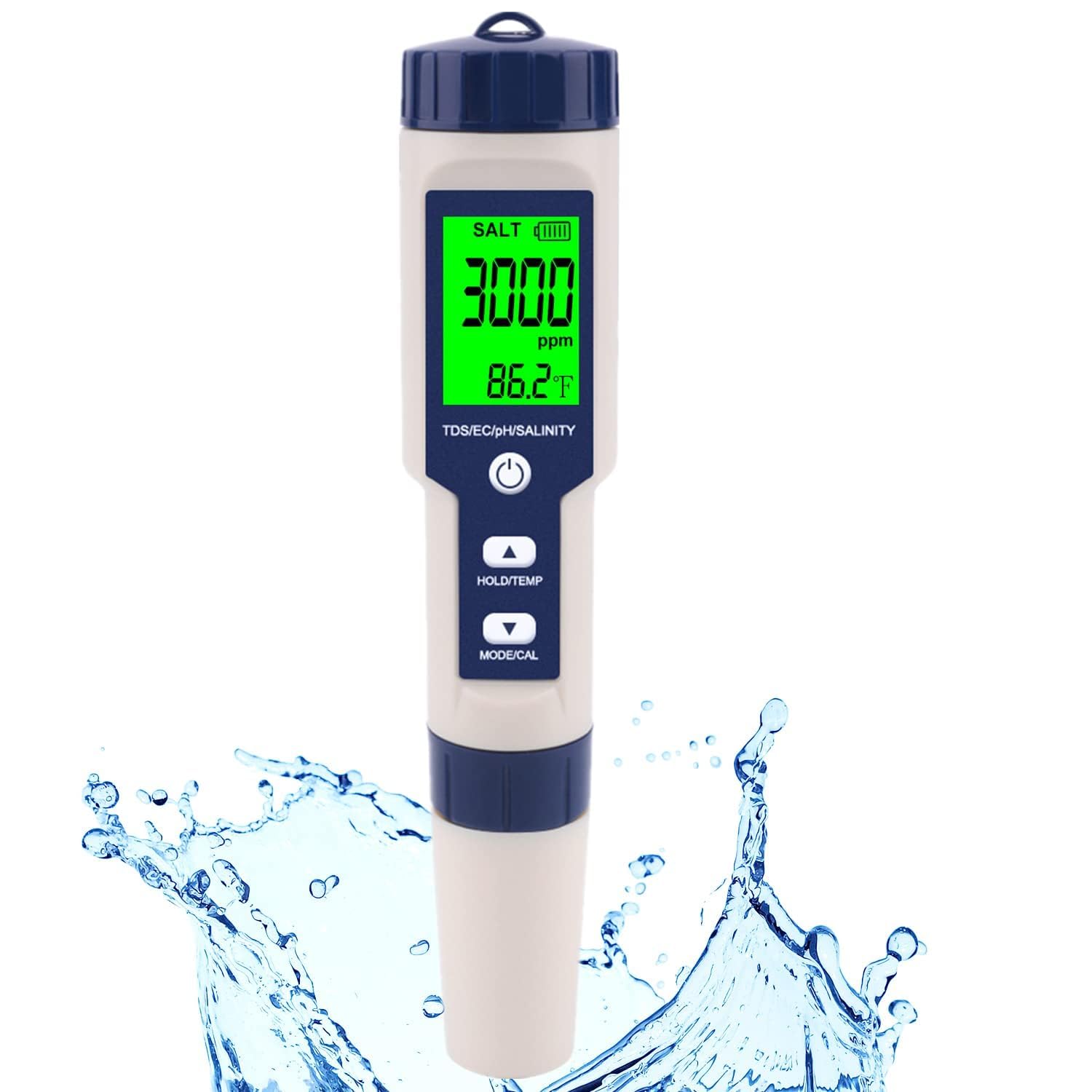
Rating: 4.3 ★ | Price: Budget | Accuracy: ±0.1 (claimed) | Calibration: Factory only
The Hofun 5-in-1 delivers instant digital readings for pH, salinity, EC, TDS, and temperature at a budget-friendly price. Setup is straightforward – dip and read. The catch is pH accuracy: readings can be off by 1 unit or more, and salinity measurements may not align with reference methods. That places this meter firmly in the "quick approximation" category. It suits saltwater pool owners who need a general check on multiple parameters without lab-grade precision, or casual hobbyists who only require a rough idea of water conditions. For serious aquarium pH monitoring, the margin of error is too wide to rely on.
Pros
- Extremely easy to use with instant digital readouts for multiple parameters.
- Good value as a multi-parameter tool for saltwater pools and basic checks.
- Covers pH, salinity, EC, TDS, and temperature in one device.
Cons
- pH readings can be off by 1 unit or more, making it unsuitable for precise aquarium monitoring.
- Salinity measurements may not match reference methods, limiting reliability for critical salt-level adjustments.
A budget-friendly pick for saltwater pool owners who want a quick multi-parameter reference – but not the tool for aquarium water quality management.
Best for Budget Backup
Gain Express pH/Temp

Rating: 4.2 ★ | Price: Budget | Accuracy: ±0.1 pH | Calibration: Auto 1-3 point
The Gain Express pH/Temp meter combines pH and temperature reading with automatic calibration at a budget-friendly price. The temperature display is a handy complement to the pH reading. For temporary checks or as a backup when your primary meter is unavailable, it delivers adequate basic functionality. However, this meter is best limited to occasional use — it is not designed for the consistency required in routine aquarium monitoring.
Pros
- Budget-friendly price for a combined pH and temperature monitor.
- Adequate basic functionality for occasional use.
Cons
- pH readings can sometimes be off by more than the stated ±0.1.
- Accuracy may drift after a few weeks, warranting periodic recalibration.
Best reserved as a low-cost backup or temporary meter for emergency checks, not for daily aquarium pH monitoring.
Best for Occasional Bench Use
Hanna PH Checker

Rating: 4.6 ★ | Price: Budget | Accuracy: ±0.1 (claimed)
The Hanna PH Checker offers an easy digital alternative to color-matching kits for hobbyists already using Hanna reagents. Its single-button operation and clear LCD make pH readings quick, and early reports indicate ±0.1 pH accuracy holds well in controlled conditions. However, this is a bench checker—no waterproof rating means it cannot handle tank splashes or submersion, which is a fundamental gap for aquarium use. With limited long-term data available, accuracy consistency beyond the first few weeks is uncertain.
Pros
- Single-button operation with a large, readable LCD display.
- Reported accurate (±0.1 pH) in early use by a small group of buyers.
Cons
- Not waterproof; cannot survive aquarium splashes or accidental submersion.
- Long-term accuracy consistency is not yet established from field data.
If you need a pH checker for occasional dry-bench testing away from water—and you already use Hanna reagents—this fills that niche. For aquarium use, choose a waterproof model with a longer track record.
How to Choose
A pH meter’s calibration stability matters more than its initial accuracy for long-term reliability.
Accuracy
Meters with ±0.1 pH accuracy are sufficient for most freshwater and saltwater tanks, but reef keepers and planted tank enthusiasts benefit from ±0.01 precision. The catch: higher accuracy sensors are more sensitive to storage and handling, requiring careful rinsing and storage solution to avoid drift.
A ±0.1 meter that drifts to ±0.3 after a month is less reliable than a ±0.01 meter that stays within spec. For discus or coral tanks where pH swings of 0.2 can stress inhabitants, the finer resolution justifies the extra cost.
Waterproof Rating
IP67 waterproofing means the meter survives full submersion up to 1 meter for 30 minutes – essential for accidental drops into a tank. Pens without this rating can die from a single splash. The trade-off: IP67 seals make battery changes harder and often require a special tool.
Floating designs add another layer of safety for deep reservoirs, but the float mechanism adds bulk and can create a weak point where water eventually seeps in. For standard aquariums, IP67 is the practical choice.
Replaceable Probe
A replaceable probe extends the meter’s life from 6-12 months to 2-3 years, as the sensor is the first part to degrade. The hidden cost: replacement probes cost 30-50% of a new meter, so you’re committing to ongoing expense. Non-replaceable pens are cheaper upfront but become e-waste when the probe dies.
If you test water more than once a week, a replaceable probe saves money within the first year. For occasional use, a sealed unit may be simpler.
Calibration Ease
Auto-calibration with buffer recognition simplifies the process to dipping in solution and pressing a button. Manual three-point calibration gives more precision but requires buying separate buffer packets and following a sequence. The real issue: cheap meters often fail to hold calibration at all, so the ease of the interface matters less than the stability of the electronics.
Look for meters that remember the calibration across power cycles and battery swaps. Some budget pens lose calibration every time you turn them off, forcing a re-do before each use.
Additional Parameters
Multi-parameter pens that measure pH, EC, TDS, and salinity in one device save space and money, but they introduce a trade-off: the combined probe may degrade faster because one sensor’s failure renders the whole tool useless. If you only need pH, a dedicated meter is simpler and more reliable.
For hydroponic or saltwater systems that require multiple readings daily, the convenience of a single probe outweighs the risk – provided the probe is replaceable.
FAQ
Why does my pH meter need calibration so often?
pH probes are electrochemical sensors that drift as the glass membrane ages and the internal reference solution changes. Temperature fluctuations, dried-out storage, and exposure to chemicals accelerate drift. Calibrating every two weeks keeps readings accurate; if you need to calibrate more often, the probe may be near end of life or the meter has a stability issue.
Can I use a pool pH meter in my aquarium?
Pool meters are designed for high-pH, low-organic environments and often lack the resolution needed for aquarium water where pH shifts of 0.1 matter. Many pool meters also don’t have Automatic Temperature Compensation (ATC), which introduces error in fish tanks that fluctuate temperature. Use a meter specifically sold for aquarium use for reliable results.
How long does a pH meter probe last before needing replacement?
With proper care – keeping the probe moist in storage solution, rinsing after use, and avoiding drops – a replaceable probe typically lasts one to two years. Sealed meters often fail within 6-12 months because the probe cannot be serviced. If you notice sluggish response or drift between calibrations, it’s time to replace the probe or the entire meter.
Is a floating pH pen better for aquarium safety?
Floating pens protect against accidental loss in deep tanks or reservoirs, but the float mechanism adds a potential failure point. For standard aquarium use where you’re holding the pen, IP67 waterproofing is more practical. Floating designs are primarily useful for hydroponic systems where dropping the pen into a large nutrient tank is common.