This post contains affiliate links. We may earn a small commission when you buy through our links — at no extra cost to you.
The promise of a quick digital reading is appealing, but many testers marketed for ‘saltwater’ are calibrated for pools or offer only general estimates. For a reef tank, small inaccuracies in salinity or alkalinity can stress corals and trigger algae blooms. The right tool eliminates that risk — the wrong one compounds it.
That’s why experienced hobbyists gravitate toward dedicated single-parameter checkers from established marine instrument makers. These devices measure one parameter with proven repeatability, using colorimeter or refractometer technology rather than disposable strips or conductance probes. They cost more upfront but save money on wasted reagents and lost livestock.
This guide focuses on the three most critical measurements for marine aquariums: salinity, alkalinity, and calcium. Each pick is chosen for its accuracy, ease of use, and long-term reliability — so you can trust your readings from day one.
Top Picks
Best for Salinity Measurement
Milwaukee MA887 Refractometer
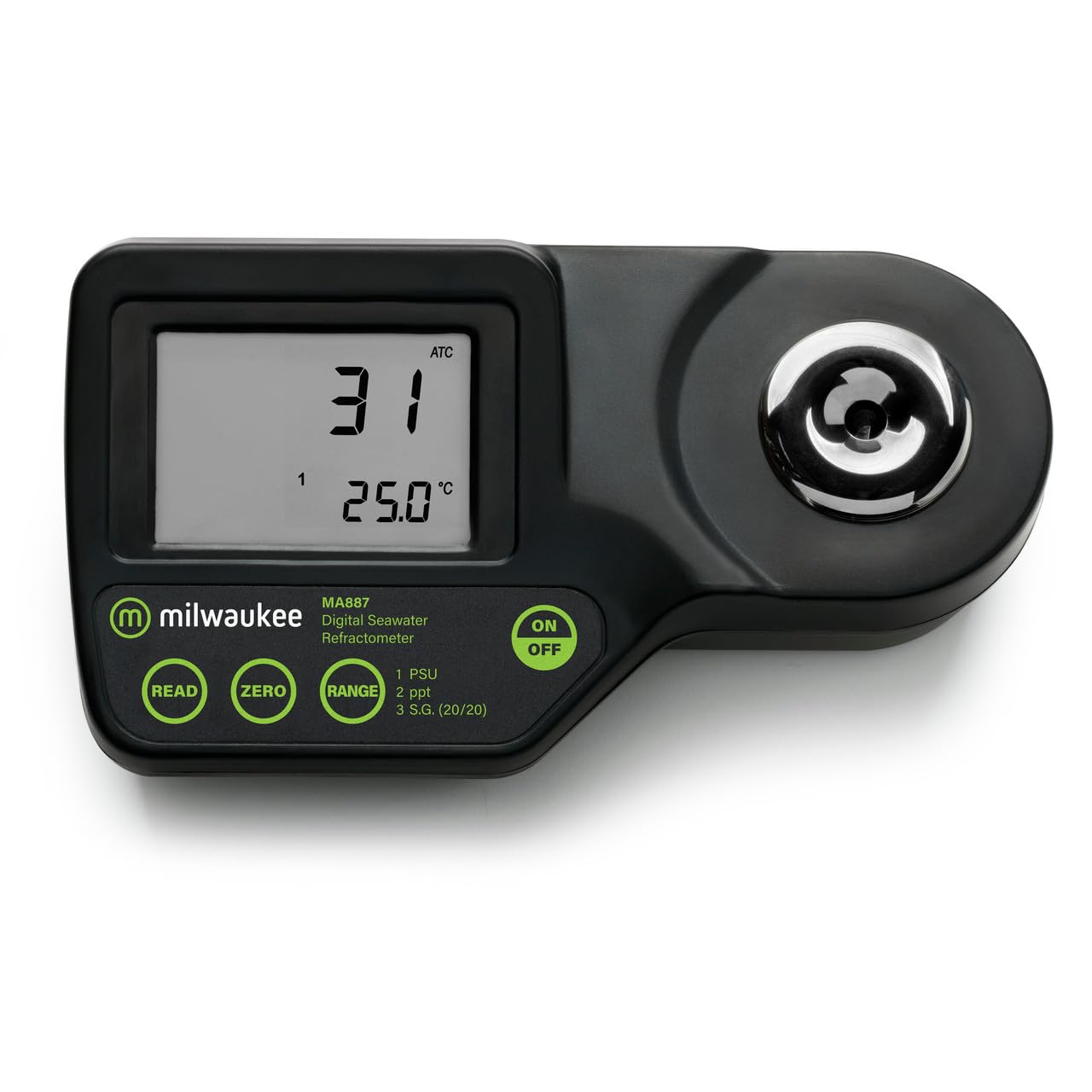
Rating: 4.5 ★ | Price: $$$ | Accuracy & Precision: ±0.001 SG, lab-matched | Parameters: Salinity, temperature | Calibration & Stability: Distilled water, drifts weeks | Cost Per Test: None (distilled water) | Build Quality: Sealed prism, durable
The Milwaukee MA887 reads salinity to three decimal places in 1.5 seconds with automatic temperature compensation — no squinting at a shadow line or hunting for the right light. The sealed flint glass prism resists salt creep and wipes clean easily, and users report consistent results that match professional lab checks over years of use.
This precision does require a periodic check: calibration can drift after a few weeks, so re-zeroing with distilled water every couple of weeks is a sensible habit. The included 1.025 verification solution has also been noted to read slightly off (e.g., 1.027), which can cause confusion, though the meter itself remains accurate if calibrated properly. That small maintenance tradeoff is absorbed easily by any hobbyist already performing regular tank checks.
Pros
- Highly accurate and consistent salinity readings for reef tanks
- Fast digital display works in any lighting, no squinting needed
- Durable build with sealed prism stands up to years of daily use
Cons
- Calibration may drift after a few weeks; periodic re-zeroing with distilled water recommended
- Included 1.025 verification solution can read slightly off, causing confusion about meter accuracy
For anyone serious about reef tank stability, this is the salinity meter that removes the variable — just budget a minute every few weeks to re-zero.
Best for Alkalinity Testing
Hanna HI772 Alkalinity Checker

Rating: 4.7 ★ | Price: $$ | Accuracy & Precision: ±0.1 dKH | Parameters: Alkalinity only | Calibration & Stability: Standard solution required | Cost Per Test: Reagent packets, moderate | Build Quality: Plastic case, limited data
This Hanna Checker delivers precise digital alkalinity readings in about two minutes, eliminating the guesswork of color charts. For reef keepers focused on stable alk levels, it provides repeatable results that support confident dosing adjustments. The included reagent starter pack covers initial use, but refill availability and cost are not fully documented – something to factor in if you test frequently. Anyone prioritizing alkalinity precision over a multi-parameter tool will find this a focused, effective solution.
Pros
- Digital colorimeter removes color-guessing from alkalinity testing.
- Simple button operation yields results in roughly two minutes.
- Consistent readings support reliable dosing adjustments over time.
Cons
- Reagent refills needed after initial starter pack – ongoing cost is not fully outlined.
The Hanna HI772 is the right call for reef keepers who want dedicated digital alkalinity precision and test frequently enough to justify the reagent refills.
Best for Calcium Testing
Hanna HI758 Calcium Checker
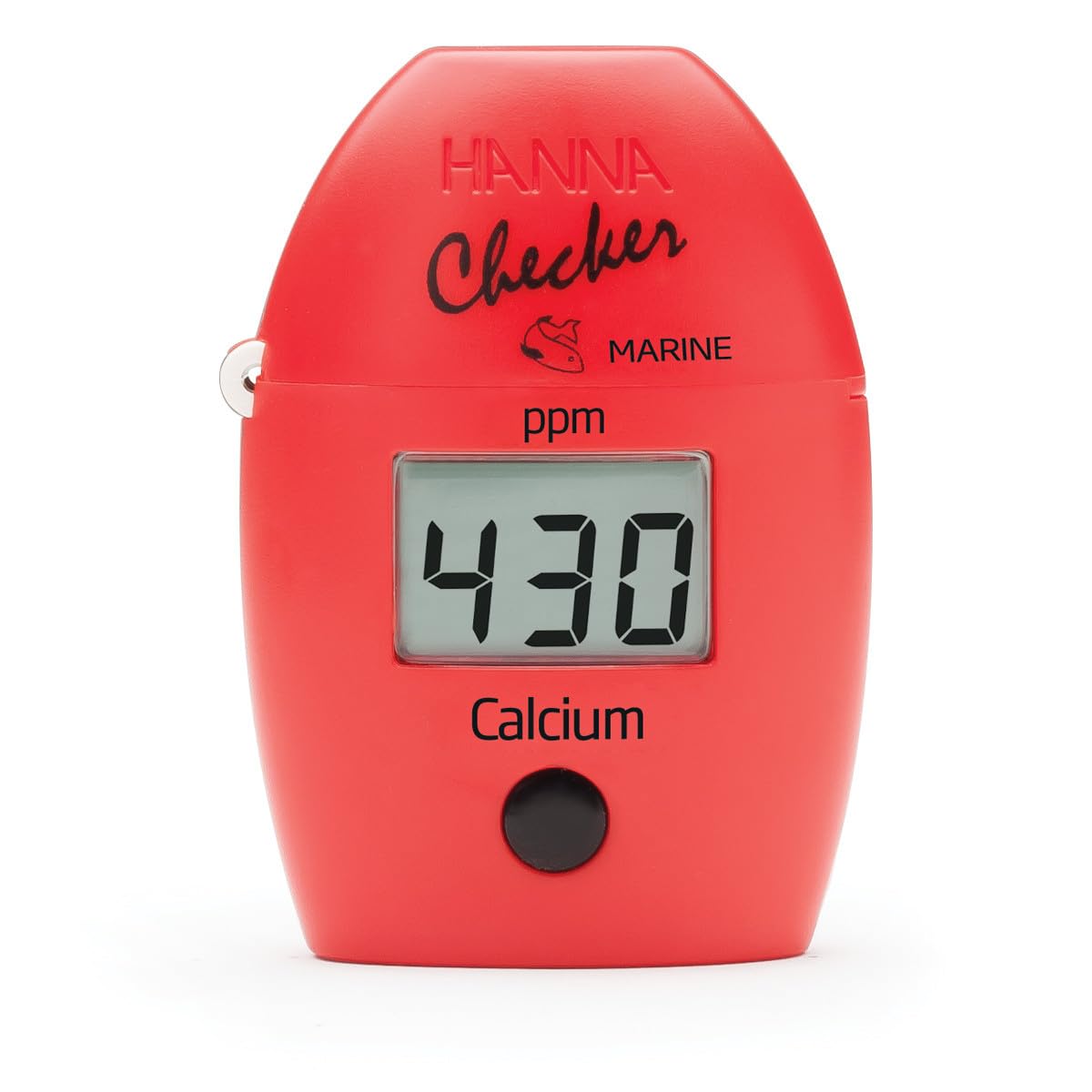
Rating: 4.6 ★ | Price: $$ | Accuracy & Precision: ±6% of reading | Parameters: Calcium only | Calibration & Stability: Factory calibrated, stable | Cost Per Test: Powder packets, ongoing | Build Quality: Sealed case, button wear
Where the top pick handles salinity, the Hanna HI758 delivers dedicated calcium measurement with colorimeter accuracy — a practical tool for reef keepers who track calcium dosing. The three-step process takes about five minutes, and the digital readout eliminates subjective color comparisons. This suits hobbyists who need consistent calcium levels for coral growth and are willing to handle the fiddly powder reagent packets. The button may eventually wear out after years of use, but the sealed case means no user repair.
Pros
- Colorimeter-based readings remove guesswork from calcium testing.
- Complete test in about five minutes with clear step-by-step procedure.
- Device can last several years of regular use before any button issues appear.
Cons
- Powder reagent packets require careful handling to avoid spillage and incomplete transfer.
A dedicated calcium checker that delivers reliable digital accuracy for reef dosing — worth the extra care with reagent packets.
Best for Nitrate Monitoring
Hanna HI782 Nitrate Checker

Rating: 4.5 ★ | Price: $$ | Parameters: Nitrate only | Calibration & Stability: Factory calibrated | Cost Per Test: Reagent packets, costly | Build Quality: Plastic case, average
Accurately measures nitrate from 0–100 ppm, giving reef keepers a clear view of nutrient trends without squinting at color charts. Below 2 ppm the readings lose some precision, so this checker is better suited for monitoring general trends than fine-tuning ultra-low levels.
Pros
- Digital accuracy eliminates color chart guessing for nitrate readings.
- Fast results in a few minutes with simple single-button operation.
Cons
- Ships with only 10 reagent packets; refills are pricey and can be hard to source.
A fit for reef keepers who test nitrate weekly and accept ongoing reagent costs, but not for budget-focused hobbyists or those needing precise low-level readings.
Best for Portable Salinity
Hanna HI98319 Salinity Pen

Rating: 4.4 ★ | Price: $$$ | Parameters: Salinity, temperature | Calibration & Stability: Frequent recalibration needed | Cost Per Test: None, but calibration solution | Build Quality: Plastic, screen issues
Quick dip-and-read salinity testing with automatic stability indicator offers convenient portable saltwater checks. The tradeoff is that accuracy can drift over time, requiring regular recalibration—making it a riskier choice for reef keepers who need consistent precision compared to a digital refractometer like the Milwaukee MA887.
Pros
- Instant salinity readings with automatic stability indicator.
- Compact pen design for portable testing and mixing saltwater.
Cons
- Screen failure or unit may become non-functional within months in some cases.
Fits casual hobbyists who prioritize convenience over long-term accuracy and are comfortable with periodic recalibration.
How to Choose
Digital does not guarantee accuracy – regular calibration with known standards is essential for reliable readings.
Accuracy & Precision
Accuracy determines whether your readings reflect actual tank conditions or just approximate values. Dedicated colorimeters and refractometers (like those from Hanna and Milwaukee) use optical or photometric methods that are inherently more precise than conductance probes found in multi-parameter pens.
For critical parameters like alkalinity and calcium, even a 10% error can lead to dosing mistakes that destabilize coral health. Look for devices that specify a margin of error (e.g., ±0.1 dKH or ±6% of reading) and have user reviews confirming consistent results over time.
Parameters Tested
Single-parameter checkers force you to buy a separate device for each measurement, but they deliver dedicated accuracy without cross-interference. Multi-parameter pens promise convenience but often sacrifice precision on individual readings, especially for salinity and pH.
Serious reef keepers typically invest in dedicated checkers for salinity (refractometer), alkalinity (colorimeter), and calcium (colorimeter). Nitrate and phosphate are less critical daily checks and can be managed with chemical kits or less expensive digital options.
Calibration & Stability
All digital testers drift over time. Refractometers require periodic re-zeroing with distilled water, while colorimeters may need a standard solution to verify the optical path. Ignoring calibration can lead to silent errors that accumulate into parameter swings.
Conductance-based pens (like the Hanna HI98319) are especially prone to drift and may need recalibration every few weeks. If you prefer minimal maintenance, a sealed refractometer like the Milwaukee MA887 offers the best long-term stability.
Cost Per Test
The purchase price is only part of the equation. Hanna Checkers use reagent packets that cost roughly $0.50–$1.00 per test, and refill packs are sold separately. A refractometer has no recurring reagent cost beyond occasional distilled water.
Factor in the number of tests you run per week. A heavy user might spend $50–$100 a year on reagents for a single parameter, while a refractometer pays for itself within months. Digital pens with no reagents (like the HI98319) avoid ongoing expense but may require frequent calibration solution purchases.
Build Quality
Build quality affects both durability and reading consistency. Sealed prisms on refractometers resist salt creep and accidental spills. Plastic-bodied colorimeters are lighter but may develop button failures or screen issues over years of use.
Waterproofing ratings (IP65, IP67) matter if you keep the tester near a saltwater tank. Most dedicated marine testers are splash-resistant, but submerging them can damage internal electronics. A hard case or designated storage spot extends device life.
FAQ
Is a digital refractometer more accurate than a hydrometer for saltwater aquariums?
Yes, digital refractometers with automatic temperature compensation provide more consistent readings than swing-arm hydrometers, which are affected by temperature and bubbles. They require calibration with distilled water every few weeks but offer lab-level precision.
How often should I calibrate my digital salinity meter for a reef tank?
Calibrate with distilled water every 2–4 weeks, or whenever you notice readings drifting from expected values. Temperature changes and probe contamination can shift readings. If you use a conductance-based pen (like the Hanna HI98319), check calibration more frequently.
Can I use a pool salt tester for my marine aquarium?
No. Pool testers are designed for much higher salt concentrations and different chemistry. They often give inaccurate readings that can harm marine life. Use a dedicated marine refractometer or Hanna Checker designed for saltwater aquariums.
Are Hanna Checker reagents interchangeable between different parameter testers?
No. Each Hanna Checker uses unique reagent formulations and cuvette sizes. Using the wrong reagent will produce meaningless results. Always purchase the specific refill pack for your parameter (calcium, alkalinity, nitrate, etc.).