This post contains affiliate links. We may earn a small commission when you buy through our links — at no extra cost to you.
A 125-gallon tank holds roughly 1,000 pounds of water. That much volume demands a heater that can hold temperature against a drafty room or a cold snap. Yet many heaters labeled for large tanks are actually designed for 75-gallon setups, leaving your fish vulnerable to rapid temperature swings.
Scrolling through listings, you’ll find 300W and 500W units marketed for tanks twice their actual capacity. Using an undersized heater means it runs constantly, wears out faster, and still can’t keep the water stable. Splitting wattage across two heaters adds redundancy but doubles the points of failure.
The real choice comes down to raw power versus long-term reliability. An 800W heater can handle a 125-gallon tank on its own, but some budget options sacrifice build quality to hit that wattage. A well-built 500W heater with a proven track record may cost more per watt but could outlast a cheaper alternative by years. This guide identifies the few heaters that genuinely match the tank size they claim to support.
Top Picks
Best for 120-160 Gal
AquaMiracle 800W
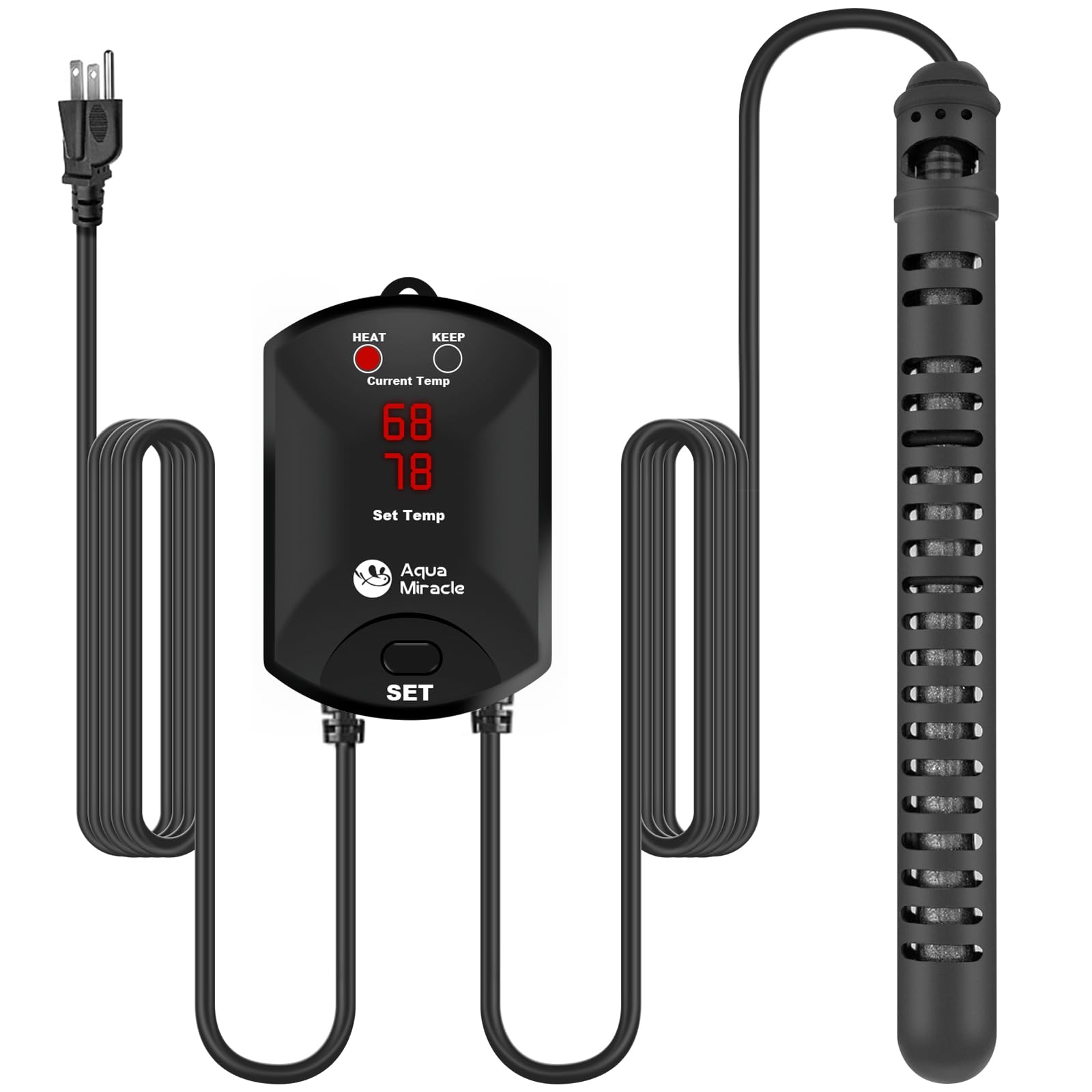
Rating: 4.6 ★ | Price: $ | Wattage: 800W | Tank Size Rating: 120-160 gal | Temp Range: 68-93°F | Safety: Dry-run, overheat shut-off, memory
The AquaMiracle 800W delivers the heating capacity needed for a 125-gallon tank at a price well below comparable heaters. Its external digital controller remembers settings after a power loss, and the built-in dry-run and overheat protection add basic safety layers. For the wattage, no other unit in this price range offers a similar feature set.
This heater is best for budget-focused owners of large tanks who value upfront savings over long-documented reliability. The temperature adjustment requires cycling through the maximum setting before you can decrease it, which slows fine-tuning. Occasional reports of overheating failures exist, but for those comfortable with these boundaries, the AquaMiracle offers exceptional wattage per dollar.
Pros
- 800W output matches the needs of a 125-gallon tank at a very low price point.
- External digital controller with memory function retains settings after power loss.
- Dry-run and overheat shutdown protections provide basic safety coverage.
Cons
- Temperature adjustment requires cycling through the maximum setting before lowering, which slows fine-tuning.
- A small number of units have experienced overheating failures that can harm fish.
For budget-conscious 125-gallon owners, this heater delivers the necessary wattage and a digital controller at a price that leaves room for other gear.
Best for 66-135 Gal
AQQA 500W

Rating: 4.5 ★ | Price: $$ | Wattage: 500W | Tank Size Rating: 66-135 gal | Temp Range: 68-93°F | Safety: Out-of-water shut-off, memory, explosion-proof quartz
The AQQA 500W has a track record of lasting 3–4 years, setting it apart from the top pick which offers higher wattage but fewer long-term reports. You trade thermal headroom for known longevity, and the external LED controller with memory simplifies operation. Temperature accuracy can vary between units, so a separate thermometer is recommended; early failures have been noted in some cases, but the overall build quality and safety features provide confidence. This heater suits aquarists focused on consistent heating for a 125-gallon tank who are willing to pay a premium for proven durability.
Pros
- Track record of lasting 3–4 years in regular use.
- Accurate temperature control after calibration with a separate thermometer.
- Good build quality with auto shut-off and explosion-proof quartz.
Cons
- Temperature accuracy can vary; a separate thermometer is needed for verification.
- Some units may stop working within a year, so a flexible return policy is advisable.
For aquarists who value a track record of years of service, the AQQA 500W justifies its higher price with consistent performance.
Best for 20-80 Gal
MantaMaze 300W

Rating: 4.5 ★ | Price: $$ | Wattage: 300W | Tank Size Rating: 20-80 gal | Temp Range: 63-94°F | Safety: Overheat, out-of-water, memory
Accurate ±1°F temperature control and simple setup make this 300W heater a good fit for smaller tanks up to 80 gallons. Its wattage and rating fall short for a 125-gallon aquarium, and occasional units may show a ~2°F temperature offset.
Pros
- Maintains tank temperature within ±1°F for stable conditions.
- Easy to install with an external digital controller.
Cons
- Temperature reading may be off by about 2°F on some units.
- Rated for up to 80 gallons, not enough as a standalone heater for 125-gallon tanks.
A good option for 20–80 gallon tanks that need a digital controller, but not for a 125-gallon setup.
Best for Up to 40 Gal
Marineland 150W

Rating: 4.3 ★ | Price: $$ | Wattage: 150W | Tank Size Rating: Up to 40 gal | Temp Range: Adjustable dial | Safety: Thermal switch auto shut-off
Holds temperature steady for aquariums up to 40 gallons, backed by Marineland’s established product line. The 150W output cannot heat a 125-gallon tank — use a higher-wattage model instead. Some units may show temperature variation, so early testing is recommended.
Pros
- Holds steady temperature for nano and small tanks up to 40 gallons
- Works in both freshwater and saltwater aquariums
Cons
- Underpowered for tanks larger than 40 gallons, especially 125-gallon setups
This heater fits nano and small aquariums up to 40 gallons, but for a 125-gallon tank, a higher-wattage model (400W+) is necessary.
How to Choose
Many heaters labeled 500W are actually rated for 75-gallon tanks, making wattage the most misleading spec in this category.
Wattage Requirements
For a 125-gallon tank, the standard rule is 3–5 watts per gallon of water. That puts you between 375W and 625W minimum. In practice, an 800W heater gives you a comfortable buffer for cooler rooms or winter drafts.
Lower wattage units will run non-stop to keep up, shortening their lifespan and risking temperature drops during heavy evaporation. A single 800W heater is simpler than running two 400W units, but using two heaters adds redundancy—if one fails, the tank doesn’t crash immediately.
Tank Size Rating
Manufacturers publish a tank size rating (e.g., 40–75 gallons) that often overstates real capacity. A heater’s actual ability to heat a tank depends on room temperature, tank insulation, and water flow. A 500W heater rated for 125 gallons might struggle in a basement or a drafty room.
Always look for a rating that explicitly includes 120–160 gallons, not just a round number. If the listing says ‘up to 125 gallons,’ treat it with skepticism—compare wattage independently.
Temperature Accuracy
Digital controllers are convenient but can drift by 1–3°F from the set point. Many buyers discover this only after a week of unstable tank temperatures. A separate glass thermometer is a small investment that prevents surprises.
Some heaters allow calibration, but most budget models require you to adjust the dial manually. If precise temperature matters (e.g., breeding discus), look for a unit with a fine-tune knob or a separate temperature controller.
Durability and Safety
Heater failures often show no warning—a crack in the glass or a melted plastic cap. Units with explosion-proof quartz and overheat shut-off reduce the risk of shattering, but no sub-$50 heater is immune to failure after years of use.
Check reviews for patterns: recurring reports of ‘smoking,’ ‘melting,’ or ‘cooking fish’ indicate a systemic build issue. A heater that lasts 3–4 years typically uses heavier glass and a sealed controller housing.
External Controller Features
An external digital controller lets you read the temperature without submerging your hands. Memory function is essential—without it, a power outage resets the heater to a default, potentially cooking your fish.
Some controllers only allow increasing temperature, not decreasing, forcing you to unplug and restart. Check the ease of adjustment before buying.
FAQ
Why does my 300W heater fail to keep my 125 gallon tank warm?
A 300W heater supplies roughly 2.4 watts per gallon, well below the recommended 3–5 WPG. Even in a warm room, the heater will run constantly and still drop temperature during water changes or cold spells. Upgrade to at least 500W, ideally 800W.
Can I safely use two 300W heaters in a 125 gallon aquarium?
Yes, two 300W heaters provide 600W total, which is sufficient. Install them at opposite ends of the tank for even heat distribution and use separate controllers. If one fails, the other will slow the temperature drop, but the tank will still lose heat without full backup wattage.
How do I know if my aquarium heater is about to fail?
Signs include erratic temperature swings, visible cracks in the glass, moisture inside the tube, or the heater staying on even after reaching set temp. If you hear a sizzle or see smoke, unplug immediately. Replace any heater that shows physical damage or has been in use over two years.
What wattage heater do I need for a 125 gallon fish tank?
Minimum 400W for a warm room (76–78°F), but 800W is recommended for reliability in cooler rooms or if you keep tropical fish needing steady 80°F. Using two 400W heaters provides redundancy and spreads the load.