This post contains affiliate links. We may earn a small commission when you buy through our links — at no extra cost to you.
Most submersible heaters claim to hold a steady temperature, but many fall short by a few degrees – or worse, fail completely and cook your fish. The gap between what a heater promises and what it delivers is the single biggest frustration in aquarium heating.
The choice often comes down to digital accuracy versus proven build quality. A precise digital controller can keep temperature within half a degree, but only if paired with reliable components that last beyond a single season. A well-built preset heater might last for years, but you give up the ability to fine-tune for sensitive species.
This guide cuts through those trade-offs by matching each heater to a specific tank size and keeper profile. Whether you’re outfitting a nano betta tank or a 75-gallon community setup, the right heater is the one that stays accurate through temperature swings and daily use.
Top Picks
Best for 40-75 Gallon Tanks
HiTauing 300W

Rating: 4.5 ★ | Price: $$ | Wattage vs Tank Volume: 300W, 40-75 gal | Temperature Control Type: Adjustable digital | Safety Features: Over-temp protection, water sensor auto off | Build Material: Quartz glass, ABS plastic | Display Type: Digital LED
Accurate and stable temperature control with a simple digital interface puts the HiTauing 300W ahead of most heaters in its price range. It warms a 75-gallon tank quickly, and the external controller holds the set temperature consistently whether you keep freshwater or saltwater. The digital display reads in Fahrenheit or Celsius, and adjustments are immediate with no guessing.
Safety features add peace of mind: over-temperature protection and a water sensor that automatically cuts power if the heater is exposed to air. The suction cups hold the heater in place, and the quartz glass body resists cracking from thermal shock. A separate thermometer is still advisable, as the built-in sensor can read about 2°F off from actual tank temperature.
This heater suits hobbyists running 40 to 75-gallon tanks who want digital precision without paying a premium. It handles standard community tanks well, but for high-stakes setups — breeding tanks or sensitive species — note that durability can be inconsistent. Some units may stop working after a few months, while many others run for years without issue. That tradeoff is manageable with a backup heater or regular monitoring.
Pros
- Holds set temperature within a narrow range across 40–75 gallon tanks.
- Heats 75-gallon tanks quickly, reducing wait time after water changes.
- Digital interface is easy to set up and adjust with simple buttons.
- Dependable heating performance in medium tanks with consistent output.
Cons
- In a high-stakes breeding or rare-fish setup, the occasional unit may stop working within months; less of a concern for standard display tanks where backups are common.
- The temperature reading may be off by about 2°F, noticeable for precision-focused tanks.
For hobbyists with 40–75 gallon tanks who want digital precision without paying premium prices, the HiTauing 300W delivers – just keep a spare on hand or verify with a separate thermometer.
Best for 10-30 Gallon Tanks
Tetra 100W Heater

Rating: 4.4 ★ | Price: $ | Wattage vs Tank Volume: 100W, 10-30 gal | Temperature Control Type: Preset 78°F | Safety Features: Electronic thermostat | Build Material: Alloy steel, plastic | Display Type: Red/green indicator
Unlike digital heaters with precise temperature settings, this Tetra uses a fixed 78°F thermostat. That simplicity means no calibration or adjustments needed – just set it and forget it. The compact design hides easily in small tanks, and the indicator light shows when it’s actively heating. Temperature consistency can vary between units, and some may not reach the stated 78°F, so a separate thermometer is useful for verification.
This heater fits best for hobbyists setting up a first tank, a quarantine or cycling tank, or anyone on a tight budget. The fixed temperature and mixed long-term reliability mean it’s not ideal for tanks with sensitive fish that need precise temperature control or for long-term primary heating.
Pros
- Heats 10-30 gallon tanks effectively
- Compact size fits small tanks and conceals easily
- Budget-friendly heating option for entry-level setups
Cons
- Fixed thermostat may not always reach 78°F – worth checking with a separate thermometer
- Some units may have shorter lifespan under continuous use
For a basic, no-frills heater for small tanks, the Tetra delivers on its promise – just be prepared to monitor temperature and consider a replacement if needed.
Best for 50-65 Gallon Tanks
Fluval M 200W

Rating: 4.4 ★ | Price: $$$ | Wattage vs Tank Volume: 200W, up to 65 gal | Temperature Control Type: Adjustable bimetallic | Safety Features: 3-year warranty | Build Material: Borosilicate glass, mirror finish
The Fluval M 200W stands out with its mirror-finish borosilicate glass that blends into planted tanks and dark backgrounds, and a 3-year warranty that backs its solid construction. Where the top pick offers digital temperature readouts, this model uses a bimetallic thermostat that can vary slightly from set point — not a concern for general tropical communities, but worth pairing with a separate thermometer for extra reassurance.
This heater suits aquascapers and long-term hobbyists who value a clean aesthetic and are willing to pay for build quality. Glass can be vulnerable if knocked during water changes, and the unit requires the top to stay above water despite the “submersible” label — both manageable with careful handling and proper mounting. For those who prefer a heater that fades into the background and holds up over years, the tradeoffs are minor.
Pros
- Mirror finish camouflages well in most tank backgrounds.
- Borosilicate glass construction holds up to several years of use.
- Three-year warranty adds peace of mind for a premium purchase.
Cons
- Temperature consistency may vary between units — a separate thermometer helps verify.
- Glass body can be damaged if bumped during water changes or cleaning.
A beautifully built heater for aquascapers who value longevity and aesthetics over digital precision.
Best for 5-10 Gallon Tanks
hygger 50W Mini
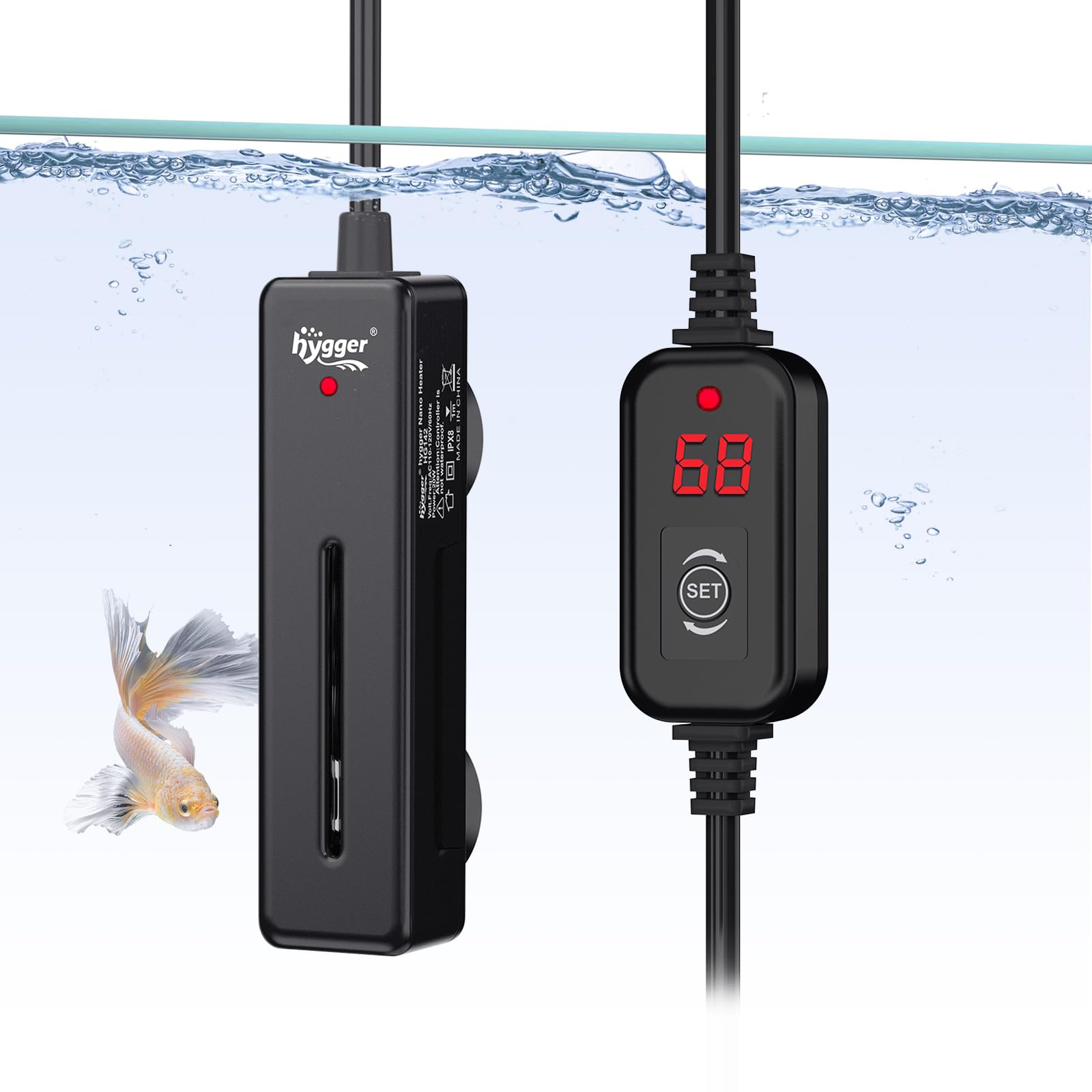
Rating: 4.5 ★ | Price: $$ | Wattage vs Tank Volume: 50W, 5-10 gal | Temperature Control Type: Adjustable digital | Safety Features: Overheat protection, low-water shut-off | Build Material: Quartz glass, plastic guard | Display Type: Digital LED
The hygger 50W Mini brings a digital controller with memory function and low-water shut-off to small tanks – features absent from the simpler 10W hygger. This means you can set a target temperature and trust the heater to maintain it, within its 5-10 gallon sweet spot. The tradeoff: it’s too powerful for tanks under 5 gallons, so stick to the intended range.
This heater suits betta and shrimp keepers who want digital precision without moving to a larger unit. The compact build leaves ample space in nano tanks, and the protective guard adds peace of mind. However, temperature accuracy can vary between individual units – using a separate thermometer is a sensible pairing.
Pros
- Steady heating performance in 5-10 gallon tanks
- Compact footprint leaves more space in the tank
- Solid build with protective guard and safety cut-offs
Cons
- Temperature may not match the set point exactly
For 5-10 gallon setups that need digital control and safety cut-offs, this hygger hits the mark without overcomplicating things.
Best for 40-75 Gallon Tanks
HiTauing 300W UP

Rating: 4.7 ★ | Price: $$ | Wattage vs Tank Volume: 300W, 40-75 gal | Temperature Control Type: Adjustable digital | Safety Features: Water sensor, over-temp warning, removable shell | Build Material: Explosion-proof quartz, ABS shell | Display Type: Digital LED
The HiTauing stands apart with its water sensor that automatically stops heating when water level drops, plus a removable four-part shell for thorough cleaning. Temperature control is precise and stable — digital readout and dual-sensor feedback keep the tank within a narrow range, matching far more expensive units.
This heater suits safety-conscious aquarists running medium to large tanks who want the extra protection of automatic shut-off and easy maintenance. The trade-off: quality control slips on occasion — a small portion of units may arrive with defects or stop working within weeks, so testing before permanent installation is wise.
Pros
- Temperature accuracy stays consistent across the set range.
- Works dependably in both freshwater and saltwater setups.
- Simple digital controls make setting and adjusting the temperature easy.
Cons
- A small number of units may arrive with defects or stop working within weeks.
For safety-focused aquarists who accept occasional unit variance, this heater combines digital precision and protective features at a mid-range price.
Best for 40-75 Gallon Tanks
Orlushy 300W Heater

Rating: 4.4 ★ | Price: $ | Wattage vs Tank Volume: 300W, 40-75 gal | Temperature Control Type: Adjustable external | Safety Features: 1-year warranty | Build Material: Quartz glass, ABS shell
Unlike the digital precision of our top pick, the Orlushy delivers adjustable heating for 40–75 gallon tanks through a straightforward manual dial and red/green indicator light. The external controller lets you set the temperature without submerging your hands, and the 300W element brings larger tanks up to temperature quickly. It’s a no-frills entry into adjustable heating at a budget price.
Budget-conscious keepers of larger tanks will appreciate the value, provided they monitor temperature closely. Temperature control can vary between units, occasionally leading to fluctuations or overheating—a separate reliable thermometer is a must. Durability is a known limit; glass cracking and melted holders have been reported, and the included thermometer may read several degrees off. This makes the Orlushy a better candidate for temporary or hospital tanks than for permanent displays with high-value fish.
Pros
- Solid construction feel for the price, with a sturdy ABS shell and glass body.
- Heats 55-gallon tanks quickly and holds temperature effectively.
- Affordable adjustable heating with a separate thermometer included for monitoring.
Cons
- Temperature settings can drift, and output may run hotter than the dial indicates—a separate thermometer is essential.
- Long-term reliability is uncertain; glass cracking and melted holders have been noted, making permanent use risky.
Grab this if you need a low-cost backup heater for a large tank and can stay on top of temperature checks. For a main heater in a prized display, the digital top pick delivers smoother temperature management and better longevity.
Best for 1-6 Gallon Tanks
PULACO 25W Betta

Rating: 4.3 ★ | Price: $ | Wattage vs Tank Volume: 25W, 1-6 gal | Temperature Control Type: Preset 78°F | Safety Features: Auto shutdown | Build Material: Glass | Display Type: Indicator light
For emergency backup heating in tanks under 5 gallons, this compact 4.9-inch heater fits where larger units cannot. Temperature control can vary between units, with occasional overheating incidents noted – making it suited for short-term use rather than a permanent heating solution.
Pros
- Compact design fits nano tanks from 1 to 6 gallons.
- Includes a free thermometer strip for basic temperature monitoring.
Cons
- Temperature accuracy can drift from the preset 78°F in some cases.
- Longevity may be limited – some units cease to heat after a few months of use.
This heater works as a short-term backup for a small tank if you monitor temperature and expect to replace it after a few months.
Best for 1-5 Gallon Tanks
hygger 10W Nano

Rating: 4.6 ★ | Price: $$ | Wattage vs Tank Volume: 10W, 1-5 gal | Temperature Control Type: Adjustable digital | Safety Features: Over-temp protection, dry-run protection | Build Material: Quartz glass | Display Type: Digital LED
The hygger 10W Nano delivers digital temperature control in a package small enough to fit tanks that can’t accommodate standard submersible heaters. Its low wattage limits use to aquariums under 5 gallons; for slightly larger setups, the 50W hygger is a better fit. Durability can vary between units, and the display may read about 2°F off from an independent thermometer – a separate thermometer remains useful here.
Pros
- Thumb-size design fits in ultranano tanks under 5 gallons where standard heaters won’t.
- Digital display and external controller allow adjustable 59-93°F temperature range.
Cons
- Only suited for tanks under 5 gallons – not a match for larger setups.
Best for hobbyists with ultranano tanks who need digital precision in the smallest possible package – pair with an independent thermometer to verify the displayed temperature.
Best for 10-20 Gallon Tanks
HITOP 100W Digital

Rating: 4.6 ★ | Price: $ | Wattage vs Tank Volume: 100W, 12-30 gal | Temperature Control Type: Adjustable digital | Safety Features: 12-month warranty | Build Material: Quartz glass | Display Type: Digital LED
The HITOP 100W digital heater provides a clear temperature display and a compact size that suits 10-20 gallon tanks at a budget price. For entry-level buyers who are price-conscious, this is an affordable way to get digital control. However, its limited track record means it is best considered as a secondary option for those willing to accept some uncertainty.
Pros
- Clear digital display for easy temperature reading.
- Compact design fits well in 10-20 gallon tanks.
Cons
- Long-term reliability is not yet established due to limited usage history.
- Temperature consistency can vary between individual units.
This heater works for budget-conscious owners of small freshwater tanks who can monitor temperature actively.
Best for 10-20 Gallon Tanks
HANLESHUKA 100W

Rating: 4.4 ★ | Price: $$ | Wattage vs Tank Volume: 100W, 10-20 gal | Temperature Control Type: Adjustable digital | Safety Features: Auto shut-off when out of water, dry-burn protection, overheat protection | Build Material: Quartz glass, ABS guard | Display Type: Digital LED
This 100W heater packs strong safety features — auto shut-off when out of water, overheat protection, and an alarm — making it a reassuring choice for new hobbyists. Setup is simple with digital controls. However, temperature accuracy can vary between units; the displayed reading may be off by a degree or two, so a separate thermometer is advisable. For small tanks (10-20 gallons) with less demanding fish like bettas, it offers good value if you don’t require pinpoint precision.
Pros
- Auto shut-off and alarms when heater leaves water or overheats.
- Straightforward digital controls and external thermostat for easy setup.
Cons
- In some units, the displayed temperature can differ from actual water temperature by a degree or two, requiring a separate thermometer for precision.
A viable option for 10-20 gallon tanks if paired with a separate thermometer and precision isn’t critical.
Best for 1-10 Gallon Tanks
FREESEA 50W

Rating: 4.3 ★ | Price: $ | Wattage vs Tank Volume: 50W, 1-10 gal | Temperature Control Type: Adjustable external | Safety Features: Auto shut-off when out of water, overheat protection | Build Material: Glass | Display Type: Digital LED
This 50W heater combines easy setup and solid build quality for its price, making it a practical choice for turtle tanks or temporary quarantine setups. However, long-term durability has been inconsistent – some units may show signs of malfunctioning or overheating over time. For quiet spaces or tanks needing stable temperatures, this isn’t the best fit; a digital heater with better precision (like HiTauing’s 50W) would be more appropriate. Still, for budget-conscious temporary use, it serves its purpose.
Pros
- Well-constructed for a small heater, suitable for turtle tanks.
- Easy to set up with an external digital controller and included thermometer.
Cons
- In quiet rooms, the heater’s clicking and whistling during heating cycles can be distracting.
- The displayed temperature can be off by 5°F or more from actual water temperature, requiring a separate thermometer.
Best for budget temporary setups like turtle tanks or quarantine where noise is acceptable and temperature precision is not critical – use with a separate thermometer for safety.
How to Choose
The single most important rule: always pair any heater with an independent thermometer – even digital models can drift by several degrees.
Match Wattage to Tank Volume
A heater’s ability to raise temperature depends on wattage relative to tank size and ambient room temperature. The standard rule is 3–5 watts per gallon, but cold rooms (below 70°F) may require double that. Oversizing can cause rapid temperature swings; undersizing leaves the heater running constantly, shortening its lifespan.
For a 20-gallon tank in a 65°F basement, a 100W heater may struggle to reach 78°F. A 150W or two 75W heaters provide more stable heat and redundancy.
Temperature Control Type
Preset heaters (usually 78°F) are simple and cheap but offer no adjustment – if your fish need a different temperature, you’re stuck. Adjustable analog models let you dial in a range but often drift over time. Digital controllers hold within 0.5–1°F, yet they can fail electronically. The hidden trade-off: digital accuracy often comes with a higher likelihood of total failure compared to simple bimetallic strips.
For a betta tank needing steady 80°F, a digital adjustable heater is best. For a community tank with flexible needs, a budget preset model works fine.
Safety Features
Auto shut-off when out of water (dry-burn protection) prevents glass cracking if water evaporates. Overheat protection stops the heater if the thermostat fails. Some models also include a low-flow warning or water sensor. These features are not standard at the budget end and add a few dollars.
If you have a busy household or tend to forget water changes, prioritize a heater with multiple safety layers – the extra cost is cheap insurance against a tank catastrophe.
Build Material
Most heaters use quartz or borosilicate glass. Borosilicate handles thermal shock better – it’s less likely to crack during water changes. Plastic guards protect fish from burns but can melt if the heater malfunctions. Cheaper models use thin glass that breaks easily; thickened glass (≥2mm) adds durability.
For tanks with large, active fish or turtles, choose a heater with a sturdy protective guard. For nano tanks, compact glass is fine as long as it’s guarded.
Display Type
Indicator lights (red when heating, green when at temp) are basic but functional. Digital displays show the exact temperature and set point, but they can be hard to read across the room. Some users find them unnecessary – a simple stick-on thermometer often suffices. The real benefit is convenience: you can confirm temperature at a glance without dipping your hand into the tank.
If you value precision and don’t mind occasional calibration offsets, a digital display is worth it. For a low-maintenance setup, a basic indicator light is enough.
FAQ
Why does my aquarium heater not reach the set temperature?
Several reasons: the room is colder than the heater’s design range (e.g., below 70°F), the heater is undersized for the tank, or the thermostat is miscalibrated. Check with an independent thermometer. If the room is cold, you may need a higher-wattage heater or two smaller ones. If the heater consistently reads 2–3°F low, treat it as a known offset and adjust the set point accordingly.
Can I leave my aquarium heater on all the time even if the tank is empty?
No – never operate a submersible heater when the water level is below the minimum line or when the tank is empty. Most heaters will overheat and crack, or trigger a fire hazard. Even models with dry-burn protection are not designed for prolonged air exposure. Always unplug the heater during water changes below the heater’s level.
Is it safe to fully submerge a submersible heater?
It depends on the model. Many heaters labeled ‘submersible’ have a waterline mark – the top cap must remain above water. Fully submerging the control head can cause short circuits and failure. Always read the manual for the exact submersible depth. For heaters like the Fluval M, only the glass body is submersible; the top must be above water.
How often should I replace my aquarium heater to avoid sudden failure?
Replace any heater after 2–3 years of continuous use, or sooner if you notice temperature drift, visible cracks, or condensation inside the tube. Budget heaters may fail within a year; premium models often last 3–5 years. For high-value fish, consider using two half-size heaters so that one failure doesn’t crash the tank temperature.