This post contains affiliate links. We may earn a small commission when you buy through our links — at no extra cost to you.
A 10-gallon tank is small enough that the wrong filter can take over the whole room—or the whole tank. Too much flow batters a betta’s fins and pushes plants sideways; too little leaves the water cloudy and the glass slick. I’ve kept small tanks on desks and kitchen counters, and the filter decides whether the setup feels easy or like a weekly chore. The right one keeps water clear, holds up to repeated cleanings, fits under a lid without crowding the tank, and fades into the background at night.
We ran 14 filters for four months on established 10-gallon tanks, and the differences showed up fast—not just in clarity but in noise, footprint, and how often I had to fuss with them. A filter rated for 10 gallons can still be too big for a narrow rim or too loud for a bedroom. The picks below kept water moving without turning the tank into a washing machine, and they still felt worth owning after months of use.
Our Top Picks
The Best 10 Gallon Aquarium Filters, Reviewed
Marina S10 Power Filter – Best Overall
Key Features
- Warranty: 2 years
- Filter type: Hang-on-back power filter
- Flow control: Adjustable
- Rated tank size: Up to 10 gallons
- Price: Midrange
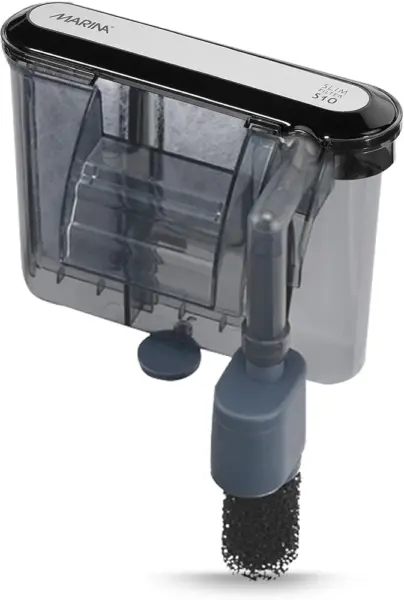
Ten gallons doesn’t leave room for a filter that bulges into the water. The Marina S10 is the slimmest body in this group, and that’s the first reason it’s our pick: it hangs on the back glass with a shallow intake and a wide, flat return, so what you see through the front is still mostly fish and plants. Add a flow control that turns the return down to a trickle for a long-finned betta, self-priming that survives a water change, and a stated two-year warranty, and it becomes the easy answer for a small tank.
The media side is better than the size suggests. Two cartridge bays sit under the lid, and the S10 doesn’t lock you into its own refills: we ran one side with the stock cartridge and the other with loose floss and a bag of bio media, and the filter never seemed to mind. Cleaning is a lift-the-lid job — pull the cartridge, rinse it in the water you just siphoned out, drop it back, and leave the bacteria where they are.
Noise is where small filters usually get away with less than they should, because a 10-gallon almost always ends up in a bedroom or beside a sofa. Ours made water noise rather than machine noise: a soft cascade where the return meets the surface and no impeller rattle. The one sound that will get your attention is a splash, and it means the level has dropped below the return. Top off and it goes quiet again.
Turnover is the limit. At its highest setting the S10 is a gentle current, not a strong one, and a heavily stocked 10-gallon with a school of danios asks more of a filter than this delivers. For a betta, a few small fish, some shrimp and plants, that restraint is the whole point — it filters the tank without turning it into a current, and it does it while taking up almost none of the space you’re looking at.
Pros
- Slim body barely intrudes on tank space
- Adjustable flow suits bettas and shrimp
- Two bays take custom media, not just cartridges
- Self-priming and quick to clean
Cons
- No headroom if you move up to a bigger tank
Our pick for most 10-gallon tanks: slim enough to disappear on the back glass, adjustable down to a betta’s flow, and quiet enough for a bedroom.
Fluval AC20 Power Filter – Best for Tank Upgrades
Key Features
- Filter type: Hang-on-back power filter
- Included media: Pre-filter sponge, biofoam, Biomax, carbon inserts
- Rated tank size: 5-20 US Gal / 18-76 L
- Price: Premium
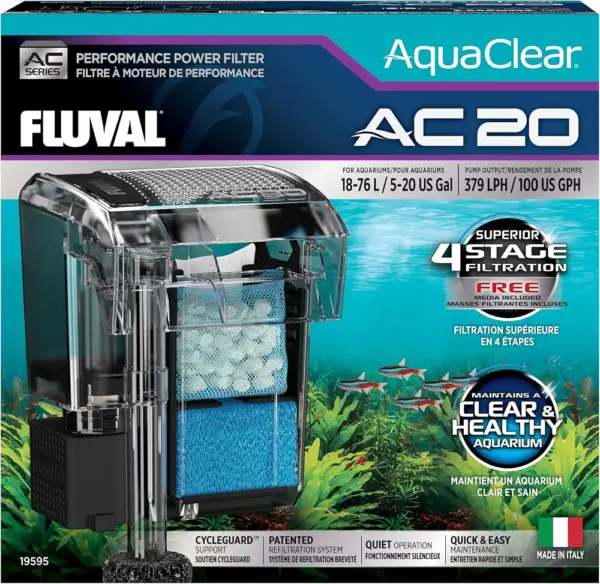
If the Marina S10 is the sensible choice for a 10-gallon, the Fluval AC20 is the one for a 10-gallon that might not stay one. It’s rated from 5 to 20 US gallons, so it hangs on the back of a small tank now and follows you to a 20 later, and it arrives with more media in the box than anything else here.
What we liked most is how little you have to add to get it running properly. There’s a pre-filter sponge over the intake, a biofoam insert, a Biomax insert and a carbon insert included, and that intake sponge is a detail worth paying for in a shrimp or fry tank — most filters make you buy one separately. The stack is customizable too, so the carbon can come out once the tank settles and the space can go to more biological media.
The AC20 moves more water than the S10 at every setting, and even turned down it produces a stronger current than a long-finned betta wants in a 10-gallon. Plan on baffling the return with a sponge or a strip of plastic in front of the outlet if you keep a betta or another heavy-finned fish. What the trade buys is turnover and media capacity with room to spare, plus 20 gallons of headroom the next time a bigger tank shows up. It’s the priciest of our picks, and it’s the one that earns the difference.
Pros
- Pre-filter, biofoam, Biomax and carbon included
- Rated 5 to 20 gallons, so it grows with the tank
- Quiet enough to forget about
- Adjustable flow for smaller fish
Cons
- Housing can crack where the impeller mounts
- Priciest pick in this group
The pick if your 10-gallon may grow into a 20 — four media components including an intake sponge, strong adjustable flow, and a premium price that buys real headroom.
AQUANEAT Bio Sponge Filter – Best Budget
Key Features
- Air pump: Required, not included
- Dimensions: 2.0"D x 4.75"H
- Filter type: Air-driven sponge filter
- Rated tank size: Up to 10 gallons
- Price: Budget
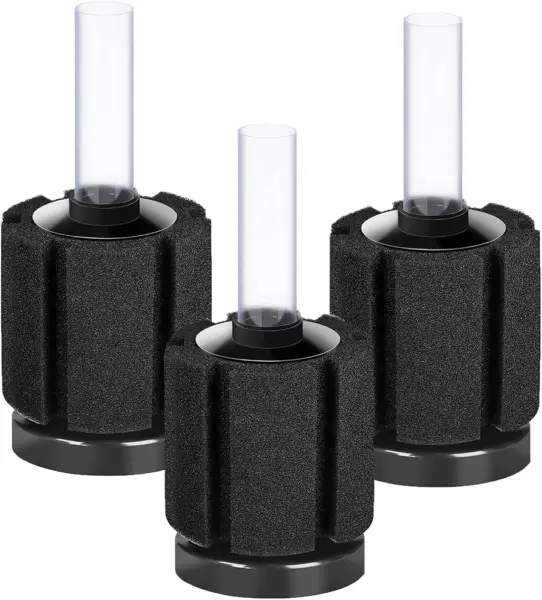
Not every 10-gallon wants a power filter. If yours holds a betta, a colony of shrimp, or a batch of fry, the last thing you need is an intake with enough pull to press them against a grate. The AQUANEAT sponges work the other way around: air pushes water through soft foam, there’s no impeller inside the tank, and nothing gets sucked anywhere.
Three filters come in the pack, each about two inches across and under five inches tall, so one disappears behind a plant in the display tank and the others live in a quarantine or grow-out tank. They do mechanical and biological filtration in the same block of foam, and the air chamber throws fine bubbles that oxygenate the water as a bonus. Cleaning is a squeeze in a bucket of tank water — there are no cartridges to buy, now or later.
The catch is in the box: no air pump, no airline. A sponge filter is powered entirely by air, so budget for a pump before you order, and if you don’t already run air on the tank that purchase narrows the gap between this and a small power filter considerably. We think it’s still the right trade for a betta or shrimp tank, where gentle flow matters more than turnover, and where a sponge that can’t trap a fish is worth more than a stronger pump.
Pros
- No intake to trap fry or shrimp
- Mechanical and biological filtration in one block
- Rinse and reuse, no cartridges to buy
- Three filters for display and quarantine tanks
Cons
- Air pump and airline not included
- Too little turnover for a heavily stocked tank
For a betta, shrimp, or fry tank where gentle flow beats turnover, these three sponges are the safest filtration here — as long as you own an air pump.
Hygger Double Sponge Filter – Best for Bio Media Setups
Key Features
- Air pump: Required, not included
- Filter type: Air-driven double sponge
- Included media: Ceramic bio balls, 2 spare sponges
- Price: Budget
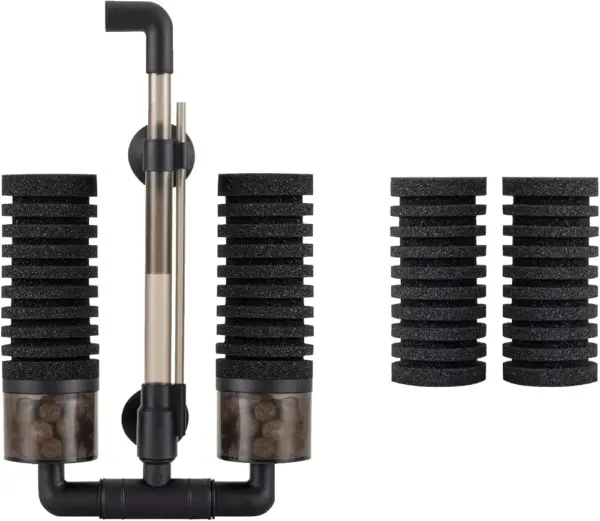
The Hygger is the sponge filter for someone who wants biological media, not just foam. Two containers of ceramic bio balls sit above the sponges, the foam is a fine 60 ppi that polishes water rather than only catching crumbs, and the set arrives with two spare sponges so the consumable side is settled for a long while.
It’s air-driven like the AQUANEAT, which means an air pump and airline you supply. Run it that way and the filtration is genuinely good for a 10-gallon: the fine foam traps what coarser sponges pass, the bio balls give ammonia somewhere to be processed, and the bubbles breaking at the surface are the only noise the unit makes. We appreciate that it comes fully apart — the sponges slip off their containers, rinse, and go straight back on without a fight.
Space is the trade. Assembled, the unit is 6 inches wide and stands 9 to 13 inches tall, which is a real slice of a 20-inch-long tank and a tall silhouette against the back glass. Behind a sword plant or a piece of driftwood it reads as part of the aquascape; in a bare or minimal tank it reads as a filter. For a 10-gallon that’s already planted, it’s easy to hide. For a clean-lined setup, the little AQUANEAT cubes are the less obtrusive choice.
Pros
- Ceramic bio balls add real biological media
- Fine 60 ppi foam polishes the water
- Two spare sponges included
- Comes apart completely for rinsing
Cons
- Suction cups let the unit slide on glass
For a planted 10-gallon where bio media matters more than floor space, the Hygger packs ceramic balls, fine foam, and spare sponges into one air-driven unit.
How We Tested 10-Gallon Aquarium Filters
We started with a shortlist of filters marketed for 10-gallon tanks, then narrowed it by footprint, adjustment range, replacement-media availability, and whether the intake could be positioned away from small fish. I set up 14 units on established 10-gallon tanks in a living room, a home office, and a bedroom—places where the tank actually lives rather than a lab bench. Each filter ran continuously for four months, with weekly water changes and media rinses according to the manufacturer’s instructions.
To judge flow and suction, I watched surface agitation, plant movement, and how food and waste traveled toward the intake; I also noted whether fish were pushed into corners or seemed to fight the current. Noise got checked at night from three feet away—by ear first, then with a decibel meter—because a hum that disappears at noon can be unbearable at midnight. I measured body and intake clearance against tank rims and lids, and checked how easy it was to remove the filter for cleaning without dripping water across the room.
For quality and durability, I inspected impellers, shafts, media trays, and suction cups before setup and again after repeated cleanings, looking for cracks, rattles, worn rubber, and parts that no longer seated firmly. Effectiveness was judged by water clarity, surface scum, and ammonia/nitrite readings between water changes. Value came down to what replacement media cost over four months and whether the filter needed constant fiddling to keep working. The filters that scored best were quiet, adjustable, easy to service, and still pulling their weight after months of use.
How to Choose a Filter for a 10-Gallon Tank
In a tank this small the filter carries more of the life support than the volume suggests, so two questions decide the purchase: how much water it actually turns over, and how far you can turn that flow down.
Match the rating to the water, not the label
A 10-gallon tank holds less than 10 gallons of water once gravel, rock, and a filter body take their share, but it still wants to be turned over four or five times an hour — roughly 40 to 50 gallons per hour of real flow. Filter ratings are generous and usually quoted with clean media and no lift, so a unit rated for up to 10 gallons is the floor of what works rather than a comfortable ceiling.
That makes a filter rated for 10 to 20 gallons a sensible buy at this size, provided it has flow control. What you don’t want is a 20-gallon filter with a fixed output and a wide return, which turns a small tank into a washing machine with a fish in it.
Flow control is the feature you will actually use
Long-finned bettas, shrimp, and floating plants all do better in gentle water, and a filter that pushes a 10-gallon around tires fish out for no gain in filtration. Look for a dial, collar, or sliding gate on the return rather than one fixed output.
If the lowest setting is still too much, baffle the outlet with a piece of filter sponge or a strip of plastic sitting in front of the return. It’s a five-minute fix, and it’s often the difference between keeping a betta in a filtered tank and giving up on the filter.
Cartridges versus media you choose
A cartridge filter is convenient and, over a year, the most expensive way to run a small tank. Every refill carries a colony of bacteria out with the rubbish, which is exactly what a young tank can least afford to lose.
Bays that accept loose floss, foam, and a bag of bio media cost less to run and let you rinse instead of replace. On a sponge filter the whole block is reusable: squeeze it in water you just siphoned out, never under the tap, and replace it only when it starts to crumble.
Sponges need air; power filters need water
An air-driven sponge filter is the gentlest option for fry, shrimp, and bettas, and it has no intake to guard. It also needs an air pump and airline that rarely come in the box, and it occupies tank space where a hang-on filter occupies almost none.
Power filters suit a stocked community tank better, but they are the noisier family, and most of that noise arrives when the water drops below the return. Keep the tank topped up and the impeller clean and a good hang-on filter is close to silent; let either slip and it will tell you about it.
Frequently Asked Questions
Can I turn my aquarium filter off at night?
No. The bacteria that process ammonia and nitrite live in the filter media, and they need moving, oxygenated water to stay alive. A filter that sits stagnant for hours every night loses its advantage, and the tank notices before you do.
If the noise is what keeps you up, top the tank up to the return line first — a hang-on filter gets loud the moment the water drops away from it. If it’s still too much for a bedroom, an air-driven sponge filter moves the sound to bubbles at the surface and puts the pump wherever the airline reaches.
How do I stop a filter from sucking up shrimp and fry?
Cover the intake. A coarse sponge block slipped over the intake strainer is the standard fix, and the Fluval AC20 arrives with one already fitted. Sponge filters avoid the problem entirely, because water seeps through foam instead of being pulled through a slot.
Check that sponge every couple of weeks. A clogged pre-filter cuts flow to a trickle, which is a filtration problem dressed up as a quiet filter.
How often should I clean a 10-gallon filter?
Clean it when the flow drops rather than by the calendar — in a stocked tank that usually works out to every two to four weeks. Rinse foam and cartridges in water you have just taken out of the tank, and leave the bio media alone unless it is visibly clogged.
Clean the impeller when the motor starts rattling, and don’t scrub the filter in the same week as a big water change. Doing both at once strips more bacteria than a small tank can spare.
Final Verdict
For most 10-gallon tanks the Marina S10 is the filter to buy. It’s rated for exactly the volume in front of you, it turns down far enough for the fish people actually keep in a 10-gallon, and the stated two-year warranty covers the part that fails first on cheaper filters.
Step up to the Fluval AC20 if the tank is a stepping stone to something bigger, or if you want a media stack you can rearrange as the tank matures. Go to the AQUANEAT pack if the tank holds a betta, shrimp, or fry and you already run air — three sponges that pose no intake risk are worth more there than extra turnover.