This post contains affiliate links. We may earn a small commission when you buy through our links — at no extra cost to you.
A canister filter for a large aquarium is an investment in water quality and peace of mind. But many models that look good on paper develop seal leaks or motor issues within months, leaving you with a wet cabinet and a stressed fish room.
This guide focuses on filters that earn their keep through years of consistent performance—not just impressive flow charts. We highlight the trade-offs between price, quietness, and long-term reliability so you can pick the one that matches your tank size and maintenance tolerance.
The real choice isn’t between cheap and expensive; it’s between a filter that fits your routine and one that fights you at every cleaning. The picks below reflect that balance.
Top Picks
Best for Large Tank Value
Penn-Plax Cascade 1200

Rating: 4.3 ★ | Price: $$ | Flow Rate: 315 GPH | Media Capacity: 4 stackable baskets | Ease of Maintenance: Stackable baskets with handles
Four stackable media baskets and a 315 GPH flow rate give the Cascade 1200 the capacity to handle heavy bioloads and keep large tanks clear. At a mid-range price, it delivers the kind of filtration volume that typically costs significantly more, making it a sensible choice for budget-conscious aquarists with 75–150 gallon setups. Setup is straightforward with clear instructions, and the canister primes and runs without fuss.
For owners of large tanks who want affordable, consistent water clarity, this filter delivers. The real tradeoff to know: a small number of units have developed cracks in the plastic pump housing or experienced motor failure within the first year. While the overall durability record is solid for most buyers, those who prefer maximum longevity may want to inspect the housing periodically during cleanings. The noise level is generally acceptable for most living spaces, though it may be noticeable in an otherwise quiet room.
Pros
- Strong value for the flow rate and media capacity
- Simple setup with clear instructions and quiet operation
- Effectively clears water quickly in large tanks
Cons
- Plastic pump housing may develop cracks in some units
- Motor can cease operation prematurely in isolated cases
If you need cost-effective, high-volume filtration for a 75–150 gallon tank and are comfortable with the minor durability variance, the Cascade 1200 is a strong performer that leaves more expensive options in the dust.
Best for Quiet Operation
Fluval 407 Canister

Rating: 4.5 ★ | Price: $$$ | Flow Rate: 383 GPH | Media Capacity: EZ-Lift baskets | Ease of Maintenance: EZ-Lift center handle
Exceptional noise isolation and EZ-Lift baskets make this the easiest canister to maintain in its class — quieter than the Cascade 1200 with simpler media access. The 407 suits owners of 40–75 gallon planted tanks who value near-silent operation in a living area. It requires careful assembly of the lid seal to maintain a watertight connection.
Pros
- Near-silent operation keeps a living room or bedroom peaceful.
- EZ-Lift baskets allow quick media changes without wrestling with clips.
- Effective mechanical and biological filtration for planted and community tanks.
Cons
- Lid seal may leak if O-ring is not perfectly seated or replaced over time.
- Motor or impeller failure has been noted in some units within the first year.
A premium-priced canister that delivers on quiet performance and easy maintenance, but the leakage risk demands careful assembly — best for those who want silence over media volume.
Best for Hob Simplicity
Seachem Tidal 110 HOB

Rating: 4.4 ★ | Price: $ | Flow Rate: 110 GPH adjustable | Media Capacity: Large removable tray | Ease of Maintenance: Self-priming, easy maintenance
Self-priming and high media capacity make the Tidal 110 a genuine alternative to canisters for 55–90 gallon tanks. It holds more media than typical HOBs and restarts after power outages without priming. The tradeoff is audible pump and skimmer noise, especially at lower water levels, so it’s better suited to living areas than quiet bedrooms.
Pros
- Large media basket holds more filter media than typical hang-on-back filters
- Self-primes after power outages—no manual restart needed
- Adjustable flow handles 75–110 gallon tanks with active fish
Cons
- Pump and surface skimmer noise can be noticeable, especially if water level drops—less suitable for bedrooms
Best for aquarists who want near-canister filtration without the plumbing and can accept some operational noise in a living area.
Best for Extra-Large Tanks
Fluval FX4 Canister
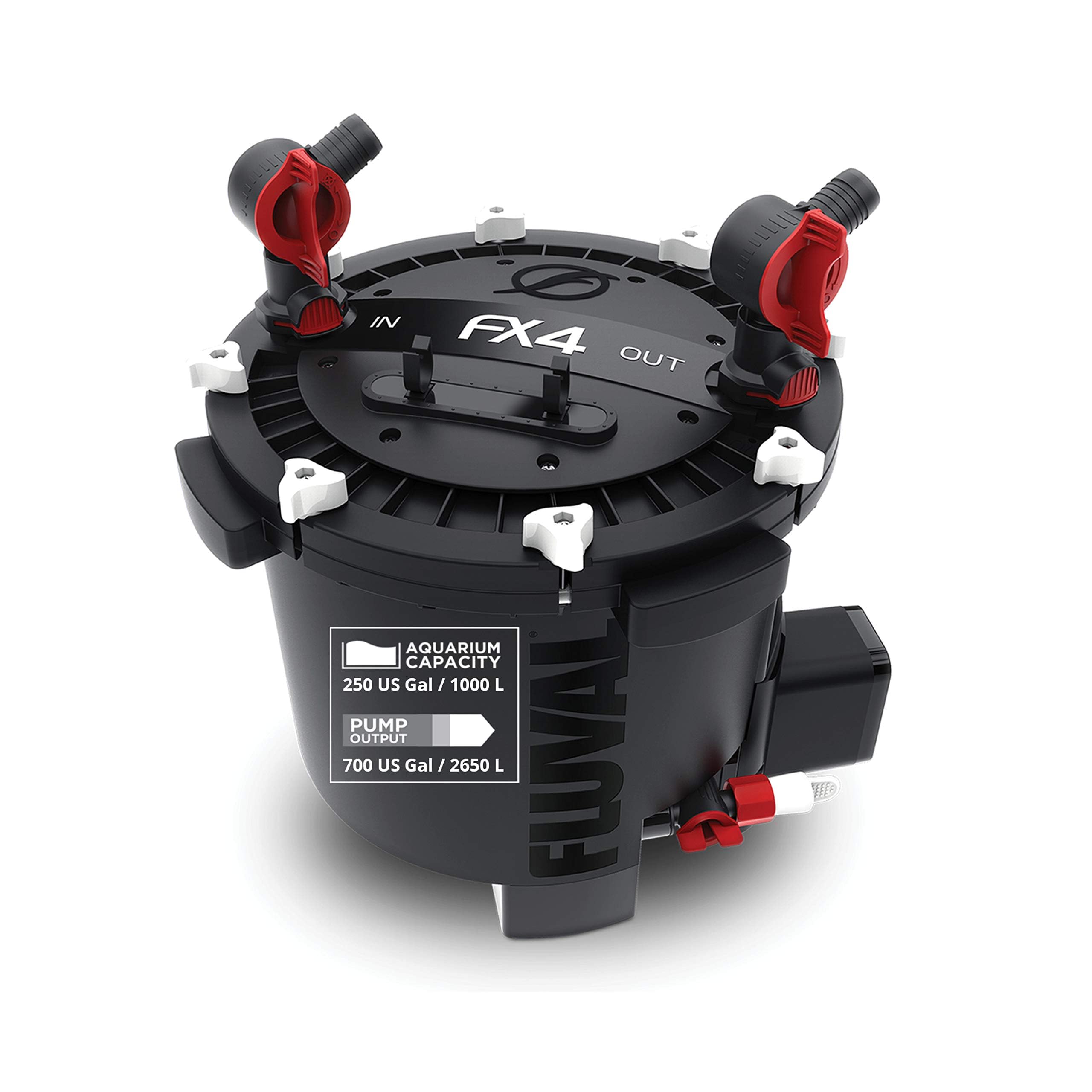
Rating: 4.5 ★ | Price: $$$ | Flow Rate: 700 GPH | Media Capacity: 1 gal total volume | Ease of Maintenance: Wrench required for hoses
The FX4 moves 700 gallons per hour, clearing heavily stocked 200-gallon tanks faster than any other canister in this roundup. It trades the easier maintenance and whisper-quiet operation of the Fluval 407 for raw pumping power and self-priming that handles air pockets automatically.
This filter suits keepers of 125–250 gallon aquariums who prioritize water turnover over ease of maintenance. Note that some units may see reduced pump output after a year of continuous use; this is less of a concern for heavily stocked tanks that benefit from the high flow rate.
Pros
- 700 GPH flow rapidly clears large, heavily stocked aquariums.
- Self-priming Smart Pump automatically evacuates air and restarts after power loss.
- Crystal-clear water results within hours of installation.
Cons
- Hose disconnection requires a wrench, making media cleaning more involved than other canisters.
Best for monster-tank owners who need maximum flow and self-priming; those with 75–150 gallon tanks will find the Cascade 1200 more practical.
Best for Turtle Tanks
TARARIUM Internal Filter

Rating: 4.5 ★ | Price: $ | Flow Rate: 290 GPH adjustable | Media Capacity: 3-stage sponge/bio | Ease of Maintenance: Top lid access
Quiet operation and easy top-access cleaning make this filter a convenient choice for small tanks with low water levels, such as turtle or reptile enclosures. However, water clarity can be inconsistent in setups with heavier bioloads, and the unit is not designed to handle the demands of a large, heavily stocked aquarium. Best used as a backup or for tanks at the smaller end of the 75-gallon range.
Pros
- Quiet operation suitable for living spaces
- Easy top-access cleaning simplifies media changes
Cons
- Water clarity can be inconsistent in tanks with heavy bioloads
A budget-friendly option for small turtle tanks or as a backup filter, but not a reliable primary filter for 75-gallon aquariums.
How to Choose
Advertised flow rates are measured without media, so real-world flow is about half—plan accordingly.
Flow Rate vs. Tank Size
The number on the box (GPH) assumes an empty filter. Once you add sponges, ceramic rings, and bio-media, resistance cuts flow by 40–60%. A filter rated for 300 GPH may only push 150–180 GPH with media.
For a 75-gallon tank, aim for a filter that delivers 200–300 GPH after media loading. For 150 gallons, 400+ GPH is safer. Over-filtering (a bigger unit than needed) gives you headroom for heavy stocking and maintenance gaps.
Media Capacity
More media volume means more surface area for beneficial bacteria and longer intervals between cleaning. Stackable baskets let you organize mechanical, chemical, and biological media separately.
A single large tray is easier to remove but limits customization. Multiple baskets cost more to fill but allow you to swap out mechanical layers without disturbing the bio-media. For planted tanks, a dedicated pre-filter sponge saves hours of maintenance.
Noise Level
Quiet operation depends on impeller design and vibration damping. Canisters inside cabinets are generally quieter than HOBs, but not all canisters are equal. Rattling often comes from trapped air or a misaligned impeller.
Over time, impeller wear introduces noise. Filters with ceramic shafts or magnetic drives tend to stay quiet longer. If the filter sits in a living room, prioritize models with high positive noise feedback (85%+).
Reliability and Leak Prevention
Leaks typically originate from lid gaskets, hose connections, or cracked pump housings. Overtightening clamps can warp the seal as much as under-tightening. A few manufacturers use double O-rings or screw-lock lids that reduce risk.
Motor failures often appear after 12–18 months in some designs. Check replacement part availability before buying—a cheap filter with unobtainable O-rings becomes a paperweight. Models with thousands of reviews give a clearer picture of long-term durability.
Ease of Maintenance
Canister filters require periodic disassembly to clean media and rinse hoses. Quick-release valves let you disconnect without spilling water; models without them mean you’ll need to clamp hoses or drain the filter first.
Filters with tool-free basket removal save time. Some premium units require a wrench to detach hoses, which adds frustration if you clean often. For most owners, a filter that takes 15 minutes to service every 4–6 weeks is ideal.
FAQ
Why does my Fluval 407 leak after cleaning even when I tighten the clamps?
The lid seal can shift out of position during reassembly. Make sure the O-ring is seated evenly in its groove and that you tighten the clamps in a cross pattern (one side, then the other) to apply even pressure. If the leak persists, the O-ring may be damaged or flattened; replacing it usually solves the issue.
How often do I need to replace the UV bulb in an aquarium green killing machine?
UV bulbs lose output over time—most are rated for 6–12 months of continuous use. Replace the bulb annually to maintain algae-killing effectiveness. If the unit is used only during blooms, the bulb may last longer, but do not expect it to work beyond 18 months.
Can I use a canister filter designed for 150 gallons on a 75-gallon tank without overwhelming the fish?
Yes, as long as the filter has an adjustable flow valve or you can diffuse the output with a spray bar. Without adjustment, the high turnover can create excessive current that stresses bettas, tetras, or discus. Point the outlet toward a wall or decor to break the flow, or downgrade to the next size down.
Is a hang-on-back filter sufficient for a 100-gallon tank or do I need a canister?
A high-capacity HOB like the Seachem Tidal 110 can handle a 100-gallon tank with moderate stocking, especially if you run two units. For heavy bioloads (cichlids, goldfish) or planted tanks needing CO2 diffusion, a canister offers more media volume and cleaner equipment lines. HOBs are simpler to maintain but louder and less customizable.