This post contains affiliate links. We may earn a small commission when you buy through our links — at no extra cost to you.
Many aquarium air pumps promise whisper‑quiet operation, but after a few months noise often climbs and budget models can stop working entirely. The frustration is real, but the right pump depends on matching your tank’s depth, size, and noise tolerance—not just the sticker claims.
The core trade‑off you face is between versatile quiet pumps that handle medium tanks well and deep‑water specialists that trade multiple outlets for high back‑pressure performance. Neither is universally better; the best choice depends on whether you need to aerate a tall tank or run several airstones in a living room setup.
Knowing your tank’s water height and how much sound you can tolerate is the first step to avoiding a pump that becomes a constant annoyance.
Top Picks
Best for Medium Tanks
AQQA Tubby 3W

Rating: 4.7 ★ | Price: $$ | Airflow: 100 GPH | Outlets: 2 | Adjustability: Dial
The AQQA Tubby runs quietly enough for a bedroom aquarium — one of the few pumps that won’t add a hum to your ambient noise. The adjustable dial lets you dial in anything from a gentle trickle to a strong current, and the dual stainless steel outlets resist corrosion better than plastic alternatives.
This pump suits medium tanks (20–80 gallons) where you want fine control without sacrificing peace and quiet. The airflow tops out at 100 GPH, so it won’t handle very large tanks or multiple high-demand devices like heavy-duty sponge filters. If you need deep-water performance for a tall tank, a specialized single-outlet pump is a better match.
Pros
- Extremely quiet operation — barely audible in a quiet room.
- Adjustable airflow from low trickle to strong current.
- Stainless steel outlets resist rust and wear.
Cons
- Airflow may be insufficient for large tanks or running multiple high-demand devices simultaneously.
If you prioritize a quiet room and adjustable output for a medium tank, this is the pump to buy.
Best for Deep Tanks
Tetra Deep Water Pump

Rating: 4.6 ★ | Price: $$$ | Airflow: 2.5 L/min | Outlets: 1
Powerful and quiet enough for deep tanks up to 8 feet, the Tetra Whisper Air Pump delivers strong aeration where lesser pumps fade. It holds pressure without the buzzy roar common to many high-output units, making it a practical choice for tall aquariums in living areas. Unlike the top pick, which sacrifices deep-water reach for ultra-silence and dual outlets, this Tetra stays focused on depth and includes a lifetime limited warranty.
The single outlet means you’ll need a splitter for multiple airstones or sponge filters — a minor workaround for the niche it serves. Durability reports have been mixed; some units have shown early failure, though the lifetime warranty provides a safety net. This pump suits aquarists with tanks over 24 inches deep who prioritize quiet pressure over multi-outlet convenience.
Pros
- Exceptionally quiet operation for a pump of its power
- Delivers consistent air pressure in tanks up to 8 feet deep
- Solid construction backed by a lifetime limited warranty
Cons
- Single outlet limits setups to one airstone unless a splitter is added
- Durability can be inconsistent; early failure has been reported in some cases
The deep-water specialist that runs quiet enough for living spaces; just plan on a splitter if you need more than one airstone, and be aware that durability can vary.
Best for Nano Tanks
NICREW Nano Pump

Rating: 4.5 ★ | Price: $ | Airflow: 0.3 L/min | Outlets: 1
Piezoelectric technology delivers near-silent operation—a genuine advantage for betta or shrimp tanks where noise matters. Unlike the top pick, this pump is not designed for sponge filters or tanks over 10 gallons, and some units may have a shorter operational lifespan. Best suited for nano aquarium owners who prioritize silence over power and accept a limited service life.
Pros
- Remarkably quiet – virtually silent
- Compact and easy to mount
- Good for nano tanks and bettas
Cons
- Not powerful enough to run a sponge filter
- Durability may be limited in some units
A smart choice for nano tanks where silence is paramount, provided you’re prepared for a potentially shorter service life.
Best for Large Tanks
Pawfly 254 GPH Pump
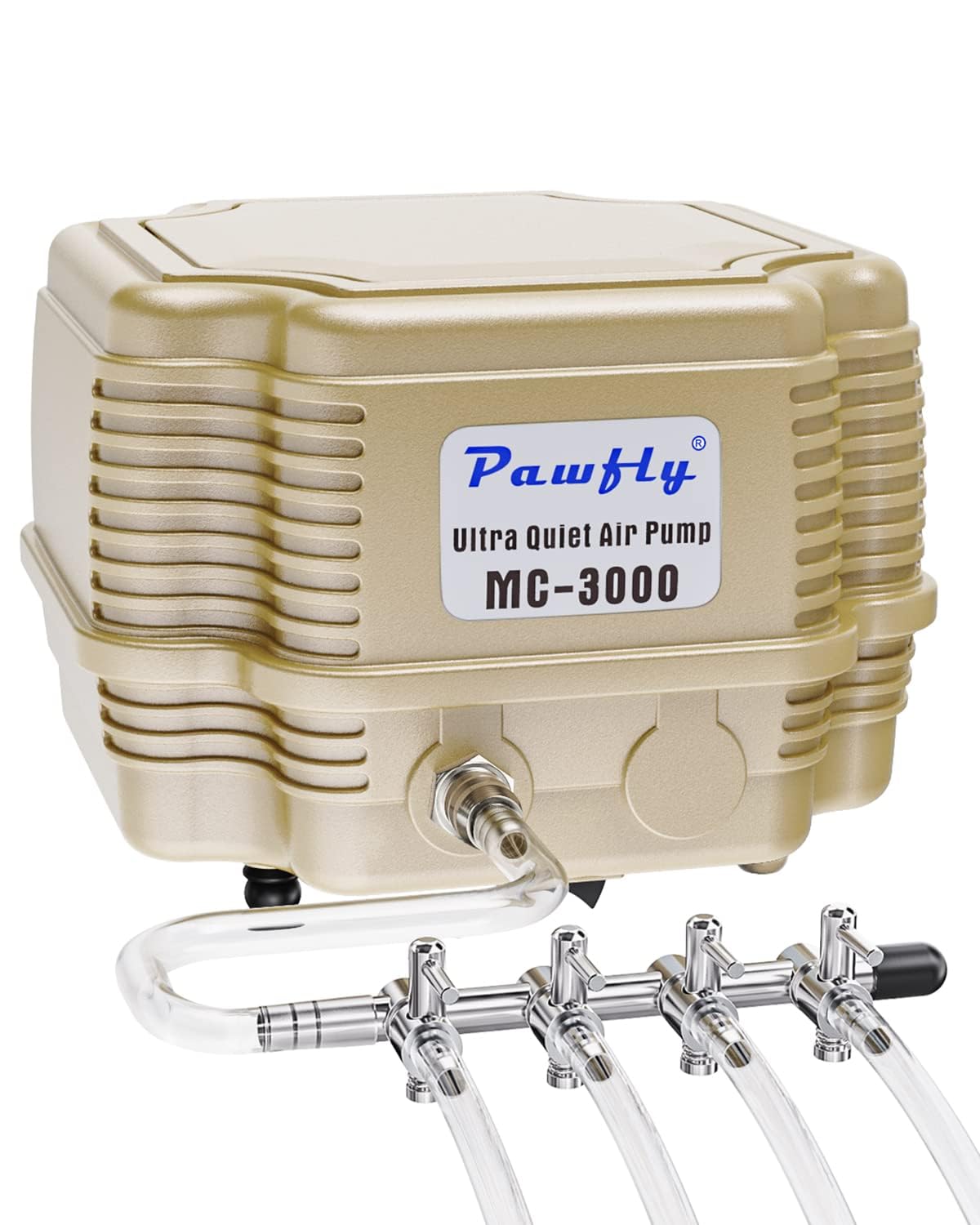
Rating: 4.5 ★ | Price: $$$ | Airflow: 254 GPH | Outlets: 4 | Adjustability: Hi/Lo switch
This 254 GPH pump delivers strong airflow across four outlets while keeping noise levels lower than many high-capacity alternatives. It’s a practical fit for large tanks or multi-filter systems where quiet operation matters.
Pros
- Quiet operation for a high-output pump — suitable for living spaces.
- Four adjustable outlets provide airflow where you need it, from sponge filters to air stones.
- High capacity at a competitive price point.
Cons
- The pump’s larger size requires generous cabinet or stand space.
- Durability can vary between units — some owners report issues after extended use.
A strong choice for large tanks where quiet multi-outlet airflow is the priority.
Best for Small Tanks
Uniclife Dual Outlet Pump

Rating: 4.5 ★ | Price: $ | Airflow: 64 GPH | Outlets: 2 | Adjustability: Rotary knob
The Uniclife Dual Outlet Pump delivers adjustable airflow and whisper-quiet operation for small to medium tanks up to 40 gallons. Compared to the top pick, it offers a more budget-friendly entry point with included accessories, but longevity can be variable—some units may require attention within months. This makes it a sensible choice for budget-conscious aquarists who are willing to accept some uncertainty in exchange for low upfront cost and quiet performance.
Pros
- Ultra-quiet operation for noise-sensitive spaces
- Adjustable airflow via rotary knob for fine control
- Includes accessories, offering budget-friendly value
Cons
- Airflow may be insufficient for tanks over 40 gallons or multiple air stones
- Longevity can vary; some units may need replacement sooner than expected
A quiet, adjustable dual-outlet pump that makes sense for small tanks on a tight budget—just plan for possible early replacement.
Best for Multi-Tank
Active Aqua 4-Outlet

Rating: 4.5 ★ | Price: $$$ | Airflow: 15 L/min | Outlets: 4 | Adjustability: Knob
This pump’s main advantage is its four individually adjustable outlets, letting you tailor airflow to each tank without splitters or extra valves. Build quality is consistent across units, and the 15 L/min output handles multiple air stones or sponge filters in a fish room or hydroponic setup. The tradeoff is size and noise: at higher settings the hum is noticeable, and the large footprint demands dedicated shelf space. Best suited for utility areas like garages or basements rather than quiet living spaces. Compared to the quieter 4-outlet alternative, this model prioritises output adjustability and proven durability over silence.
Ideal for owners running multiple tanks in a dedicated fish room, hydroponic growers, or anyone who values output control over near-silent operation. If your setup is in a living area, consider a smaller or quieter pump.
Pros
- Four independently adjustable outlets for precise airflow per tank
- Solid build quality that holds up to daily use
- 15 L/min output supports multiple air stones or sponge filters
Cons
- At higher settings the pump hum is noticeable – fine for utility areas, less so for quiet living rooms
- Physical footprint is substantial; requires dedicated shelf or floor space
A capable multi-outlet pump for fish rooms and hydroponics that trades quiet operation for output adjustability and build consistency.
Best for Medium Tanks
Tetra Whisper Air Pump

Rating: 4.5 ★ | Price: $$ | Airflow: 100 GPH | Outlets: 2
Strong dual-outlet performance for 60-100 gallon tanks at a mid-range price. The compressor hum may be noticeable in quieter spaces, and durability can vary between units. For those willing to accept these tradeoffs, it’s a solid option, but the top pick offers quieter operation and adjustable flow.
Pros
- Strong airflow for medium to large tanks up to 100 gallons.
- Good value for the price from a well-known brand.
Cons
- Compressor noise may be noticeable in quiet rooms – not whisper quiet.
Ideal for medium-large freshwater tanks where noise is secondary to budget and brand trust.
Best for Budget Builds
HITOP Dual Outlet Pump

Rating: 4.5 ★ | Price: $ | Airflow: 5 L/min | Outlets: 2 | Adjustability: Yes
The HITOP Dual Outlet Pump offers adjustable airflow and a full accessory kit at a budget price, making it appealing for cost-conscious setups. However, the design requires extra attention to tubing connections, so it’s best for DIYers willing to secure them.
Pros
- Includes a variety of accessories for immediate setup in small to medium tanks.
- Adjustable dual airflow allows fine-tuning oxygen levels for tanks up to 100 gallons.
Cons
- Air tubes can detach from the pump during use, requiring user intervention to reattach.
A functional budget pick for DIY aquarists who don’t mind securing tubing — but those wanting a hassle-free setup should look at alternatives.
Best for Nano Tanks
Pawfly Compact Air Pump

Rating: 4.4 ★ | Price: $ | Airflow: 30 GPH | Outlets: 1
The Pawfly Compact Air Pump fits a narrow niche: nano tanks between 3 and 10 gallons where budget is the priority. Its small footprint and budget price make it a practical emergency backup. The motor is audible in quiet rooms, and some units may develop issues within the first few months — worth considering if you can tolerate noise and are comfortable with a short-term pump.
Pros
- Compact design fits tiny tanks and tight spaces
- Budget-friendly cost for occasional use
Cons
- Motor noise noticeable in quiet environments
Ideal as a low-cost backup for a nano tank when noise is not a concern and you’re okay with the possibility of early replacement.
Best for Small Tanks
AQQA 3.5W Dual Outlet

Rating: 4.6 ★ | Price: $ | Airflow: 3 L/min | Outlets: 2 | Adjustability: Yes
The AQQA 3.5W pump delivers quiet, adjustable airflow for small tanks at a budget price. However, the tubing can detach from the outlets, and some units may stop working within weeks. This makes it best for temporary setups or hobbyists who don’t mind occasional fiddling.
Pros
- Operates very quietly in small tanks.
- Compact size with adjustable airflow for precise control.
Cons
- Tubing can pop off the outlets during use.
A reasonable pick for budget-conscious owners of small tanks who are willing to secure the tubing and accept the possibility of early replacement.
Best for Nano Tanks
hygger Mini 1.5W

Rating: 4.4 ★ | Price: $ | Airflow: 420 ml/min | Outlets: 1
The hygger Mini 1.5W delivers very quiet operation in a small package, making it a natural fit for nano tanks up to five gallons. It has a slightly lower rating and less output than the NICREW model, which makes this a budget-friendly pick for smaller, simpler setups.
Pros
- Very quiet for a small pump
- Compact and easy to mount
Cons
- Only suitable for air stone setups – not compatible with sponge filters, and some units may show reduced airflow over time.
Works well for nano tanks (1–5 gal) where quiet operation is a priority and you only need an air stone.
Best for Entry-Level
AquaMiracle Air Pump

Rating: 4.5 ★ | Price: $ | Airflow: 50 GPH | Outlets: 1 | Adjustability: No
The AquaMiracle All-in-One Air Pump delivers quiet operation and everything needed for a small tank right out of the box. Setup is straightforward, making it a low-fuss option for first-time owners. Airflow is fixed — no control knob — and durability can vary between units, so it’s best suited for casual tanks where precise flow isn’t required.
Pros
- Quiet enough for a bedroom or desk setup
- Includes tubing, check valve, and air stone for immediate use
Cons
- No airflow adjustment — fixed output may oversaturate very small tanks
Best for absolute beginners with a tank under 10 gallons who want a simple, quiet kit and don’t need adjustable flow or long-term durability guarantees.
Best for Large Tanks
INCLY 7W 4-Outlet

Rating: 4.5 ★ | Price: $$$ | Airflow: 245 GPH | Outlets: 4 | Adjustability: Hi/Lo + valve
The INCLY delivers strong, quiet airflow across four independently adjustable outlets — a solid fit for large aquariums or hydroponic systems where multiple airstones or sponge filters are needed. At its price point, it competes directly with the Pawfly 254 on output and noise. However, longevity has been less consistent; some units may show durability issues within months, making the Pawfly 254 a more predictable choice for those prioritizing long-term use.
Pros
- Very quiet for a high-output pump
- Four independently adjustable outlets suit large tanks and hydroponics
Cons
- Long-term durability can be less consistent than competing models
Best for multi-outlet setups where quiet operation matters and a possible replacement within a year is acceptable.
How to Choose
The most important factor is matching airflow to your tank’s depth and aeration needs, because a pump that’s too weak won’t oxygenate and one that’s too strong may be noisy and waste energy.
Airflow (GPH or L/min)
Airflow determines how much oxygen your tank receives and whether the pump can drive airstones or sponge filters. For a standard 20‑gallon tank, 50–100 GPH is usually sufficient. Deeper tanks or multiple outlets require higher flow.
The hidden trade‑off: pumps with higher airflow often produce more vibration and noise, especially at full power. A pump that claims 250 GPH may be louder than three smaller pumps combined. Match flow to your real water volume—not the maximum tank size listed.
Number of Outlets
More outlets let you run separate airstones, sponge filters, or even multiple tanks from one pump. Dual‑outlet models are common, but many struggle to deliver equal airflow to both ports. If you only need one line, a single‑outlet pump is simpler and often quieter.
The practical consequence: a dual‑outlet pump running two stones may push less than half its rated flow per port. For consistent aeration, consider a pump with independent valve control or use a Y‑splitter on a single outlet.
Noise Level
Noise is a leading complaint, yet manufacturer claims like ‘whisper quiet’ mean little. Actual noise depends on pump type (diaphragm vs. piezoelectric), build quality, and placement. Piezoelectric pumps are nearly silent but only work for very low flow applications.
The real‑world trade‑off: even well‑rated pumps can develop a hum after months of use as rubber diaphragms stiffen or vibrate against the housing. Placing the pump on a soft pad or hanging it reduces transmitted noise, but the pump’s inherent sound signature rarely improves over time.
Adjustability
Adjustable airflow lets you fine‑tune bubble output to your tank’s needs—useful when you want gentle surface agitation for a betta or heavy aeration for a planted tank. Non‑adjustable pumps run at full power constantly.
The catch: adjustability adds a valve mechanism that can clog or leak over time, and some knobs are too sensitive. Pumps with a dial are easier to set precisely than those with only a hi/lo switch.
Durability
Budget pumps under $15 often stop working within a year, and even mid‑range models from reputable brands have inconsistent track records. The culprit is usually the diaphragm or internal motor bearings wearing out.
A key sign of poor durability: early reviews mention units arriving dead or failing within weeks. Spending a little more on a pump with better materials (stainless steel outlets, metal valve components) and a longer warranty reduces the odds of early failure.
FAQ
Why is my aquarium air pump so loud after a few months?
The internal rubber diaphragm stiffens with age, causing the pump to vibrate more against its housing. Placement on a soft surface or rubber feet can dampen the noise, but eventual diaphragm replacement or pump replacement is the only permanent solution for many budget models.
Can I use a dual outlet air pump for a single sponge filter?
Yes, you can plug one outlet or cap the unused port. However, running a single line from a dual‑outlet pump may cause the pump to push more air than needed, creating excessive bubbles. Many dual‑outlet pumps have a dial to reduce flow, but some lack any adjustment.
How deep can a Tetra Whisper deep water air pump work?
The Tetra Deep Water pump is rated to push air down to 8 feet (2.4 meters). It uses a high‑pressure design that outperforms standard pumps in tall tanks. For tanks over 24 inches deep, it is one of the few reliable choices.
Why does my air pump keep popping the tubing off?
This usually happens when the tubing is too wide for the outlet barb or when the barb lacks a retaining ridge. Using tubing with the correct inner diameter and securing it with a cable tie or zip tie prevents detachment. Some budget pumps are especially prone to this issue.