This post contains affiliate links. We may earn a small commission when you buy through our links — at no extra cost to you.
The tap water that’s fine for you can be rough on fish—chlorine and chloramine burn gills, and heavy metals build up quietly. A water conditioner is the cheap insurance that makes tap water safe before it ever hits the tank. But the shelf is crowded, and the differences aren’t cosmetic: some formulas are so concentrated a capful treats a whole 40-gallon tank, while others are mostly water and need half a bottle per change. That matters for value, but it also matters for how easy it is to overdose a small betta tank.
Over the past four months, my team and I put 16 conditioners through weekly water changes on freshwater community tanks, a betta setup, and a quarantine tank. We watched fish for stress after dosing, checked water clarity the next morning, sniffed each dose for harsh odors, and kept notes on which bottles leaked or cracked in the cabinet between uses. A few stood out; the rest are not worth your money.
Our Top Picks
The Best Aquarium Water Conditioners, Reviewed
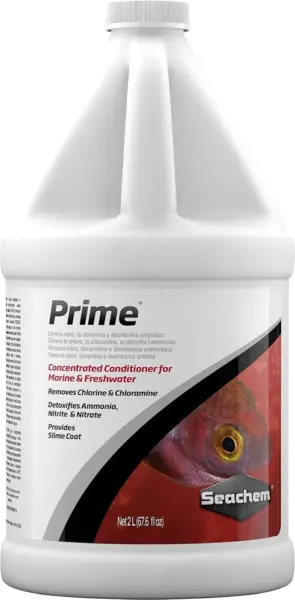
Seachem Prime – Best Overall
Key Features
- Extra: Detoxifies ammonia, nitrite, nitrate
- Treats: Chlorine, chloramine, heavy metals
- Tank type: Freshwater and marine
- Bottle size: 2 liters
- Price: Premium
Chlorine is the easy half of a water conditioner. Prime is the pick here that also goes after ammonia, nitrite and nitrate — holding them in a form that is easier on fish while leaving them available to the bacteria your filter is trying to grow — and that second job is why we put it first. A stalled cycle, a quarantine tank with one fish and too much food, a snail you cannot reach behind the rock: those are the moments this bottle earns its price.
The two-liter bottle looks like the expensive choice and then quietly stops being one. Seachem labels it concentrated, and the dose is small next to the volume in the jug, so a single bottle covers a long run of weekly changes. The one fiddly part is measuring a small dose out of a big jug; decant some into a dropper bottle and the annoyance disappears. It is also labeled for marine and freshwater, so one bottle covers both tanks on the rack.
Then there is the smell. Prime has a sulfurous, low-tide odor that arrives the moment the cap comes off, and it is the most consistent complaint about the product. It is the formula rather than a spoiled bottle, and it does not follow the dose into the tank, but if the aquarium sits in a small room or you are sensitive to smells, know that before you open it.
For a stable, long-running tank where all you need is chlorine and chloramine handled, a plain dechlorinator like API TAP does that job with nothing extra. Prime is the bottle we keep for the weeks when the water is not settled yet.
Pros
- Detoxifies ammonia, nitrite and nitrate
- Concentrated, so the 2-liter bottle lasts
- Labeled for freshwater and marine tanks
- Also binds heavy metals
Cons
- Strong sulfur odor when the cap opens
We recommend Prime as the one bottle to keep on the shelf: it handles tap water and detoxifies ammonia in the same dose, which is what a tank in trouble needs.
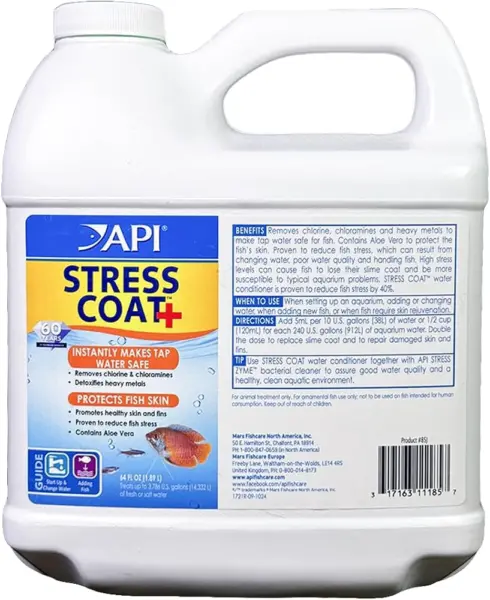
API Stress Coat – Best for New or Stressed Fish
Key Features
- Treats: Chlorine and chloramines
- Use when: New fish, water changes, illness
- Slime coat: Aloe vera extract
- Bottle size: 64 fluid ounces
- Price: Midrange
API’s pitch with Stress Coat is the slime coat itself: aloe vera extract, meant to stand in for the protective layer fish lose to netting, bagging, shipping and the general indignity of being moved. That makes it a different product from a straight dechlorinator, and it is the whole reason this bottle has a place in the group.
Where it earns its spot for us is stocking day and the sick tank. Dropping new fish into freshly conditioned water is the moment the label is written for, and a fish that comes out of a fight with a torn fin is the other. The dual-action formula removes chlorine and chloramines while the aloe does its work, so you are not juggling two bottles while a bag is floating.
The 64-ounce bottle is big for the money and the dose is small, which makes it a reasonable thing to keep on hand even if you only use it a few times a year. If your tank is cycled and the only job is chlorine and chloramine, this is more product than the task requires — the additive is the point, and if you want nothing extra in the water, plain API TAP is the better fit.
What we have not seen it do is cover ammonia. A tank mid-cycle still needs Prime in the cupboard; think of Stress Coat as the handling-and-healing bottle rather than the one for a water emergency.
Pros
- Aloe vera supports the slime coat
- Removes chlorine and chloramines
- Made for new, sick or injured fish
- Large 64-ounce bottle goes a long way
Cons
- Slime-coat additives are extra for routine changes
Buy it for stocking day and for a fish with a torn fin: the aloe formula is aimed squarely at handling stress, and it is the bottle we reach for before a bag gets floated.
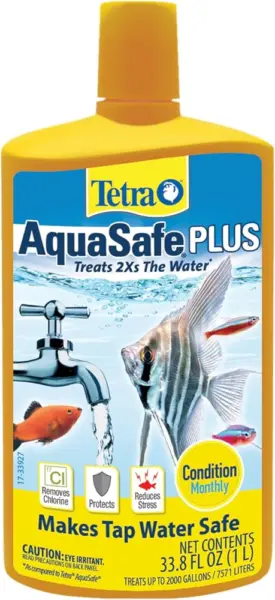
Tetra AquaSafe Plus – Best Value for a Single Tank
Key Features
- Treats: Chlorine, chloramines, heavy metals
- Tank type: Freshwater and marine
- Slime coat: Biopolymers, vitamins, minerals
- Bottle size: 33.8 fluid ounces
- Price: Budget
AquaSafe Plus is the bottle for the person with one tank and a water-change routine they actually keep. It handles chlorine, chloramines and heavy metals, adds natural biopolymers with vitamins and minerals for the slime coat, and Tetra says it treats twice the water of its standard AquaSafe — so a middle-size bottle goes further than the size suggests. Nothing here is exotic; it is a complete, unfussy conditioner at the budget end of this group.
The label lists evaporation top-off alongside new setups and monthly changes, and that is the detail we like most. The water you add between changes needs conditioning too, and one product that is explicitly for both jobs makes the routine simpler than remembering which bottle is for what.
Against Prime, it stops short of the ammonia job, which is the difference between a routine conditioner and an emergency one. Against API TAP, it trades some simplicity for the slime-coat additives. For a beginner with a 20- or 30-gallon tank and no interest in dosing by the drop, that trade lands in the right place.
Pros
- Covers chlorine, chloramines and heavy metals
- Slime-coat support with vitamins and minerals
- Treats twice the water of standard AquaSafe
- Mid-size bottle suits one tank
Cons
- Some tanks go cloudy after a dose
- Smaller bottle than the others for multi-tank setups
Our pick for a single tank and a monthly routine: it covers the water treatment basics, adds slime-coat support, and the bottle is easy to live with.
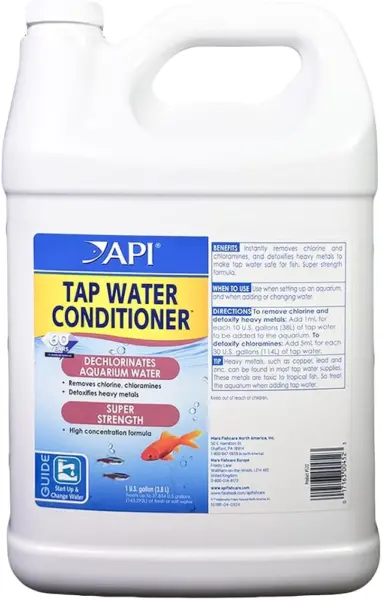
API TAP Water Conditioner – Best for Large Tanks and Ponds
Key Features
- Treats: Chlorine, chloramines, other chemicals
- Formula: Super-strength concentrate
- Tank type: Freshwater and saltwater
- Bottle size: 3.78 liters (1 gallon)
- Price: Midrange
If your water changes are measured in tubs rather than cups — a pond, a stock tank, a rack of 75s — the arithmetic changes completely. API’s TAP conditioner arrives in a gallon, and it is concentrated enough that the dose is counted in drops per gallon rather than capfuls, so one jug rides out a whole season of big changes.
It is a plain dechlorinator by design. Chlorine, chloramines and the other tap chemicals that damage gills and tissue, with nothing added for the slime coat and no ammonia claim on the label. In a mature, well-filtered tank that is exactly right: you are paying for water treatment, not for additives you did not ask for, and the label covers freshwater and saltwater both.
The gallon is what sells it to us. A concentrated jug is how pond keepers and multi-tank households stop rationing the stuff on a big change day, and the plain formula means there is nothing to double up on when you are already using a stress product on the same water.
It is a five-pound jug, so pouring straight into a small tank is a two-hand job. Decant into a 16-ounce bottle with a good cap and park the gallon on the floor of the fish room — that is the whole learning curve.
Pros
- Drops per gallon, so it goes very far
- Neutralizes chlorine, chloramines and other chemicals
- Listed for freshwater and saltwater
- Gallon bottle suits ponds and tank rooms
Cons
- Plain formula adds no slime-coat support
The one we want for ponds and multi-tank setups: a concentrated gallon that doses by the drop and asks for nothing but the water treatment itself.
Aqueon Water Conditioner – Small Tank Starter
Key Features
- Extra: Detoxifies ammonia
- Dosing: Measuring cap included
- Treats: Chlorine, chloramines, heavy metals
- Bottle size: 16 fluid ounces
- Price: Budget
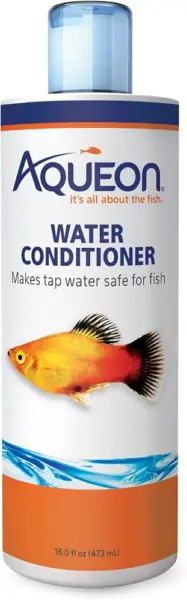
The cap is the thing to know about. Aqueon ships this bottle with a measuring cup built into the lid, which is genuinely useful on a small tank, but the seal is the weak point — these bottles turn up leaking often enough that it is worth opening the box over a sink and standing the bottle upright on a shelf rather than on carpet.
At 16 ounces it is the bottle here that fits a nano or a single small tank without asking you to store a jug, and the label claims more than we expect at the budget end: heavy metals and ammonia from fish waste, not just chlorine and chloramines. The measuring cap means no guessing on a 10-gallon change, which is where most new keepers get dosing wrong.
It is not the pick for a room full of tanks or a pond, and the small bottle empties faster than you think once you are conditioning water weekly. Fill the cap over the sink, not over the tank — a habit that saves a lot of small mistakes.
Pros
- Sized right for small and nano tanks
- Measuring cap takes the guesswork out of dosing
- Label claims ammonia and heavy-metal detox
Cons
- Can leave bubbles or residue on the surface
A sensible first bottle for a 10-gallon tank: easy to measure, inexpensive, and the label claims ammonia and metal detox along with the usual chlorine removal.
How We Tested Aquarium Water Conditioners
We built the shortlist by scanning labels for chlorine and chloramine removal, comparing dose sizes per gallon, and filtering out formulas that only addressed heavy metals. From about 30 options sold in fish stores and online, we bought 16 full-size bottles—no samples—and ran them for four months in three home setups: a 40-gallon freshwater community tank, a 10-gallon betta tank, and a 5-gallon quarantine tank. Each bottle got used for at least three consecutive weekly water changes.
For every water change, we measured the dose for the actual tank volume rather than eyeballing a capful, then added it to replacement water before it went in. We tested free chlorine and total ammonia with a liquid kit 24 hours later, and we wrote down whether the water stayed clear or turned hazy. We also sniffed each dose straight from the cap—some smell faintly of sulfur or medicine—and noted any odor that lingered in the room.
Fish behavior got the same attention: we watched for clamped fins, gasping at the surface, or unusual hiding in the hours after a dose, and compared that to the days between changes. Bottle durability and leakage were tracked in storage—caps that cracked, seals that seeped, or measuring cups that dribbled down the side after a few weeks. Concentration played into value directly: a bottle that treats 50 gallons per capful lasted the whole test, while a watery one disappeared in a month. We also looked for sediment or separation in the bottle, since that’s a quality issue you can see.
How to Choose an Aquarium Water Conditioner
The right conditioner matches your tap water and your worst week, not the longest feature list on the shelf.
Find out whether your water has chloramine
Most problems start here. Chlorine gasses off if a bucket stands overnight; chloramine does not, and it carries ammonia with it. If your utility treats with chloramine — ask them or read the annual water quality report — a bottle that only says chlorine is not enough.
Look for wording that names chlorine and chloramine both, which every pick here does. It is the one line on the label worth reading twice before you pay, and it is why a cheap bottle from a hardware shop is not a substitute.
Decide whether you need ammonia detox
Taking chlorine out of tap water and taking ammonia out of a tank are separate jobs. The second one matters in a new cycle, a quarantine tank, after a fish dies behind the rocks, or after a heavy feeding. Prime is the pick here whose label pairs ammonia with nitrite and nitrate; Aqueon’s label also claims ammonia detoxification.
Treat any of that as borrowed time. The ammonia comes back, so use the window to test and do a water change rather than skipping one.
Read the dose, not the bottle price
A small bottle of a weak mix can cost more per water change than a big bottle of a concentrated one. Compare how much water a given volume treats, then compare bottles — a concentrate measured in drops per gallon is the reason a gallon jug makes sense for a pond and is overkill for a 10-gallon tank.
The trap is judging by what sits in front of you on the shelf. API TAP is dosed by the drop; a slime-coat formula at a similar bottle size is not.
Slime-coat additives are for handling stress, not routine changes
Aloe vera and biopolymer formulas such as Stress Coat and AquaSafe Plus are aimed at fish that have been netted, bagged, shipped or nipped. That means stocking day, a move, or an injury — not every bucket.
For a settled tank and a weekly change, a plain dechlorinator does the essential job with nothing extra. Our position: keep a slime-coat product for the weeks that call for it and don’t pay for the additive on every bucket of replacement water.
Think about the bottle, not just the contents
A concentrated formula wants a syringe, a pipette or a small decanted bottle, because pouring a precise dose out of a two-liter jug or a five-pound gallon is the fiddly part of the routine. Store big bottles upright on the floor, not on a shelf above the tank.
Caps are where good conditioner gets wasted: a screw-top with a measuring cup is handy right up until the seal gives out in transit or in a cupboard.
Frequently Asked Questions
Do I need a water conditioner if my tap water comes from a well?
Well water has no chlorine or chloramine for a conditioner to neutralize, so the main reason to use one disappears. A bottle can still be useful for heavy metals, but test the well water first — hardness, iron and nitrate are the common well problems, and a conditioner does nothing for those.
Will a water conditioner clear up cloudy tank water?
No, and it can occasionally be the cause. Cloudiness is usually a bacterial bloom or fine suspended particles, and some formulas leave a tank milky or bubbly for a while after a dose. Cut back on feeding, do a partial water change and check the filter before adding anything else to the water.
Can I use the same conditioner in a saltwater tank?
Only if the label says marine or saltwater. Prime and API TAP both list it; not every conditioner does. Mix the dose into the replacement water before it goes in, and dose for the volume you are adding rather than the whole system.
Final Verdict
Seachem Prime is our default. It makes tap water safe and detoxifies ammonia in the same dose, which covers the two things that actually go wrong in a home aquarium, and that is worth a premium if your tank is new, small or still cycling.
If your tank is settled and you only need chlorine and chloramine handled, API TAP in the gallon is the plain, economical answer for a pond or a room full of tanks. Add API Stress Coat for stocking day and torn fins, and keep a small Aqueon bottle for the nano on the desk.