This post contains affiliate links. We may earn a small commission when you buy through our links — at no extra cost to you.
Many aquarium test strips promise convenience but deliver inconsistent readings. The real trade-off isn’t brand loyalty—it’s deciding whether you value low per-test cost or the comfort of a decades-old reputation. This guide cuts through the noise to help you match the right strip to your tank’s actual needs.
Another critical gap: most strips skip ammonia testing, yet ammonia is the most dangerous parameter for fish. While strips are great for quick weekly checks, they are not a substitute for liquid kits when exact numbers matter. The best approach is to use strips for trend tracking and a liquid master kit for confirmation.
Whether you’re cycling a new tank or maintaining a planted aquarium, the right strip saves time and money. This guide focuses on strip count, parameter coverage, and real-world reliability so you can test with confidence.
Top Picks
Best for Weekly Monitoring
Tetra 6-in-1 100-Pack

Rating: 4.6 ★ | Price: Mid-Range | Parameters: 6 | Ammonia Test: No | Strip Count: 100 | Compatibility: Fresh & salt
The Tetra EasyStrips deliver 100 test strips at a per-test cost that undercuts the category leader’s 25-pack by a wide margin, while adding a chlorine reading that most 6-in-1 strips skip. Dipping and reading takes under a minute with a clear color chart, making frequent testing painless.
This is the right choice for hobbyists who test weekly across multiple tanks and want to keep costs low. Those tracking ammonia during cycling or needing lab-grade precision for pH or nitrate should plan to supplement with a liquid kit – these strips excel at trend detection, not absolute accuracy.
Pros
- 100 strips at a per-test cost well below standard 25-packs
- Quick dip-and-read process with minimal setup
- Six parameters covered on one strip saves time over individual tests
Cons
- In cases where precise pH or nitrate values are needed, readings can deviate from liquid test results
- No ammonia test means a separate kit is required for cycling or spike detection
For routine weekly checks on multiple tanks, this pack offers the best balance of cost and convenience – just keep a liquid ammonia kit on hand for the missing parameter.
Best for Established Tanks
API 5-in-1 25-Pack

Rating: 4.6 ★ | Price: Mid-Range | Parameters: 5 | Ammonia Test: No | Strip Count: 25 | Compatibility: Fresh & salt
API’s 5-in-1 test strips offer the simplest dip-and-read convenience, backed by more cumulative user feedback than any other aquarium strip. The catch is a 25-count box that makes each test pricier than Tetra’s 100-pack, and no ammonia test is included. This combo works best for weekly checks on mature tanks where ammonia is stable and you don’t need precision – beginners will appreciate the ease, but those cycling a new tank or requiring exact numbers should look elsewhere.
Pros
- Dip-and-read design takes seconds – no counting drops or shaking bottles.
- Large community of users attests to consistent quality over the years.
Cons
- Box contains only 25 strips, so each test costs more than many 100-count competitors.
- Ammonia is not measured – you’ll need a separate test for new tank cycling.
API’s strips suit established tank owners who prioritize convenience over cost per test. For ammonia tracking or frequent testing, choose the top pick instead.
Best for Cycling New Tanks
SJ WAVE 11-in-1 150-Pack
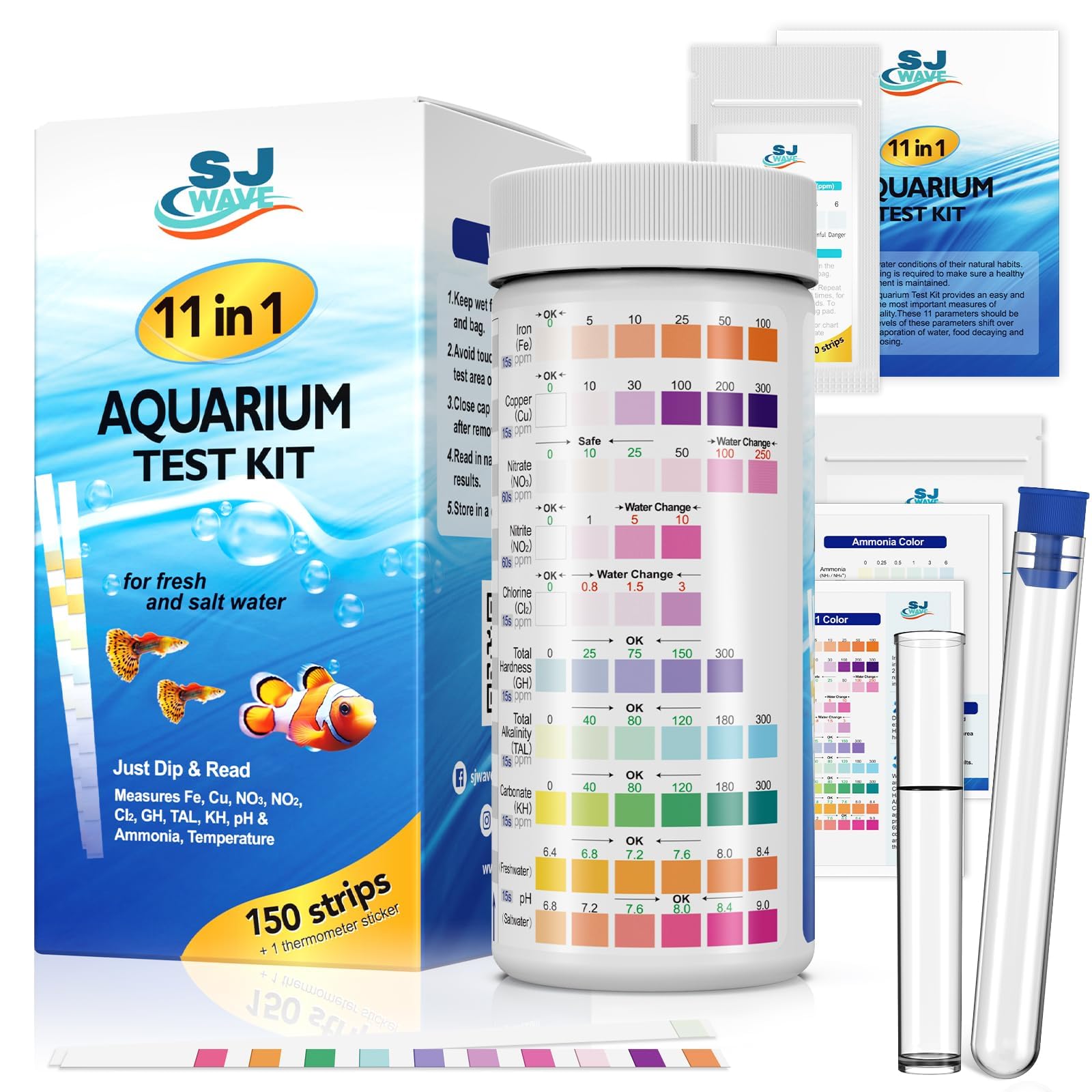
Rating: 4.5 ★ | Price: Mid-Range | Parameters: 11 | Ammonia Test: Yes (separate) | Strip Count: 150 (50 ammonia) | Compatibility: Fresh & salt
This kit stands apart by including 50 separate ammonia strips alongside 100 multi-parameter strips, covering 11 total parameters — something no other strip pack in this comparison offers. That makes it a natural fit for beginners who need to track ammonia spikes during a tank cycle without buying a separate liquid ammonia test. The trade-off: the ammonia test lives on its own strip and takes three minutes to develop, and occasional discrepancies with pH and general hardness readings mean critical levels are best double-checked with a liquid kit. For anyone prioritizing parameter breadth over speed or lab-level precision, this is the most complete strip option available.
Pros
- Includes 50 dedicated ammonia strips plus 100 multi-parameter strips for 11 total parameters
- Clear color charts make the dip-and-read procedure simple, even for first-time users
- Works in both freshwater and saltwater setups, with a stick-on thermometer included
Cons
- pH and general hardness readings may not always match liquid kit results, worth cross-checking critical parameters
- Ammonia test requires a separate strip and a three-minute wait, adding time to routine checks
For hobbyists cycling a new tank who want one kit to track ammonia alongside other parameters, this is the most complete strip option — just keep a liquid kit handy for confirmation of critical readings.
Best for Shrimp & Planted
Anniple 9-in-1 100-Pack

Rating: 4.4 ★ | Price: Mid-Range | Parameters: 9 | Ammonia Test: No | Strip Count: 100 | Compatibility: Fresh & salt
Anniple’s 9-in-1 strips include copper and iron detection — parameters rarely found in other all-in-one kits — making them especially useful for shrimp tanks or planted setups where trace metals matter. The same lack of an ammonia test limits their use during tank cycling, and occasional deviations in pH and nitrate readings mean these strips work best as a routine check tool rather than a precision instrument.
These strips suit established freshwater or saltwater tanks where the goal is regular monitoring, not pinpoint accuracy. Hobbyists who need copper and iron checks without buying separate liquid kits will find this a practical choice.
Pros
- Includes copper and iron tests — rare in multi-parameter strips at this price.
- Simple dip-and-read procedure works for both freshwater and saltwater.
- 100 strips offer good value for the number of parameters tested.
Cons
- No ammonia test — cannot be used for cycling new tanks or diagnosing ammonia spikes.
- pH and nitrate readings can deviate from liquid kit results, making them less reliable for precise adjustments.
A solid choice for keepers who want copper and iron monitoring without buying separate kits, but verify critical readings with a liquid test kit.
Best for Backup Testing
JNW Direct 9-in-1 100-Pack

Rating: 4.3 ★ | Price: Mid-Range | Parameters: 9 | Ammonia Test: No | Strip Count: 100 | Compatibility: Fresh & salt
The JNW Direct 9-in-1 strips test nitrate, nitrite, pH, hardness, alkalinity, and chlorine—more parameters per strip than the top pick—with a bulk count that keeps per-test cost low. However, pH and nitrate readings can deviate from liquid kit results, and color pads may bleed together, making interpretation harder.
Experienced aquarists who have a liquid test kit for verification will find this pack a useful supplementary tool for quick visual scans between precise measurements. New hobbyists depending on exact numbers should look to strips with tighter accuracy.
Pros
- Good value for a 9-parameter strip at a reasonable price
- Clear chart and simple instructions make testing quick and easy
Cons
- Color pads can bleed, making interpretation difficult
- pH and nitrate readings may be inaccurate compared to liquid test kits
These strips work for quick, rough checks when paired with a liquid kit for verification, but new aquarists needing dependable readings should prioritize accuracy over parameter count.
Best for Copper/iron Checks
Wutest 9-in-1 150-Pack

Rating: 4.5 ★ | Price: Mid-Range | Parameters: 9 | Ammonia Test: No | Strip Count: 150 | Compatibility: Fresh & salt
This 9-parameter pack brings copper and iron testing – a rare find for shrimp tanks – in a 150-count supply. Accuracy can vary, so cross-check critical readings with a liquid kit. No ammonia test included. The brand is newer with limited feedback, making this best as a supplemental tool.
Pros
- Includes copper and iron tests, rarely found in this price range.
- 150 strips provide good value for frequent testing.
Cons
- Results for pH, nitrate, and alkalinity may show deviations from liquid kit readings.
For shrimp keepers who need copper and iron monitoring on a budget, this pack works as a secondary check – but rely on a liquid kit for accurate pH and nitrate readings.
Best for Basic Ph Checks
AAwipes 8-in-1 50-Pack
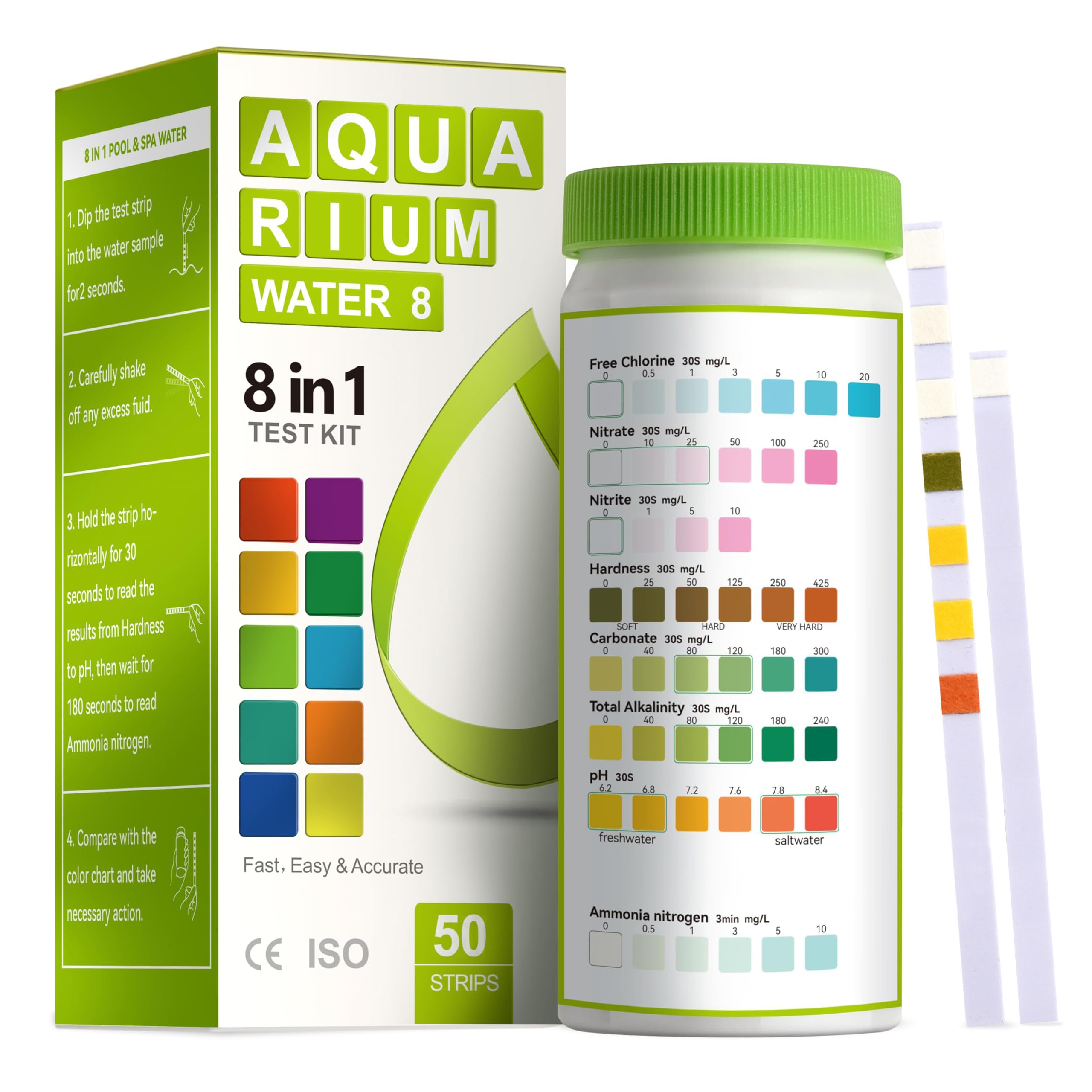
Rating: 4.4 ★ | Price: Budget | Parameters: 8 | Ammonia Test: Yes | Strip Count: 50 | Compatibility: Fresh & ponds
The AAwipes 8-in-1 offers the lowest per-strip cost among packs including an ammonia test – but the ammonia pad may not change color, effectively reducing it to a 7-in-1. Experienced keepers with a separate liquid ammonia kit will appreciate the value for pH, hardness, and alkalinity checks.
Pros
- Budget-friendly 50-pack covering 8 parameters.
- Easy dip-and-read process with clear instructions.
Cons
- Color accuracy on some pads can deviate from expected values.
A cost-effective backup for routine parameter checks when ammonia monitoring is already covered separately.
Best for Iron for Planted
Aqueon 7-in-1 50-Pack
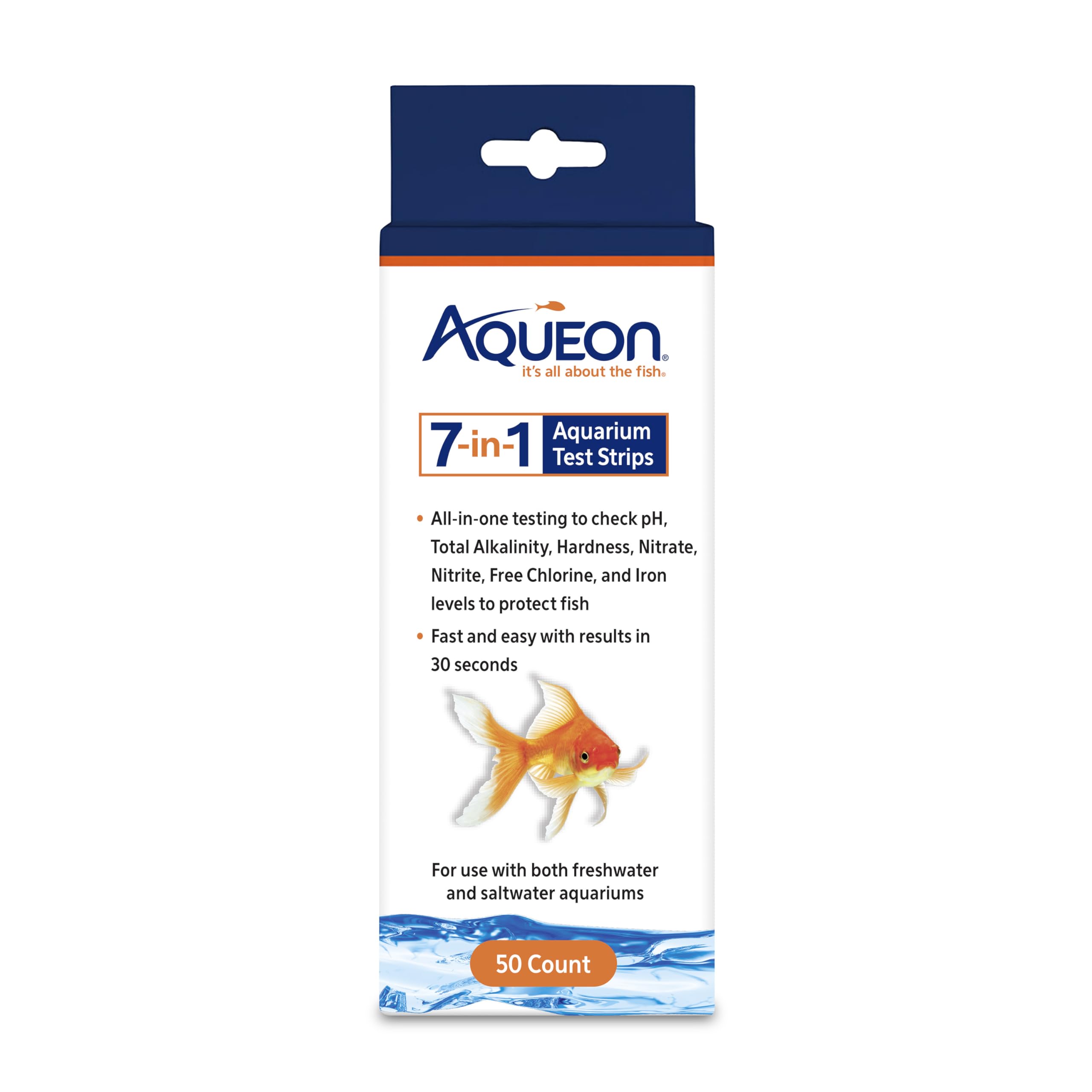
Rating: 4.3 ★ | Price: Budget | Parameters: 7 | Ammonia Test: No | Strip Count: 50 | Compatibility: Fresh & salt
These strips include a rare iron test that planted tank owners will find useful, with pads that are easy to read. But the nitrate and nitrite pads may not show any color change in some cases, limiting their usefulness for full parameter checks. They suit occasional iron monitoring rather than routine testing.
Pros
- Includes an iron test for planted tank owners
- Easy-to-read pads with fast results
Cons
- Nitrate and nitrite pads may fail to show any color change, making full parameter checks less dependable
Best for planted tank owners who need occasional iron monitoring and can cross-check other parameters with a liquid kit. For consistent multi-parameter testing, other options are more dependable.
Best for Basic Parameters
FUNSWTM 7-in-1 100-Pack

Rating: 4.5 ★ | Price: Mid-Range | Parameters: 7 | Ammonia Test: No | Strip Count: 100 | Compatibility: Fresh & salt
This 100-pack covers nitrate, nitrite, hardness, chlorine, pH, carbonate, and alkalinity. Without an ammonia test, it’s best for established tanks where ammonia levels are stable. For routine monitoring on a budget, it gets the job done — just not as reliably as the Tetra option at a similar price.
Pros
- 100 strips for a low price — strong per-test value.
- Clear chart and fast results, easy to interpret.
Cons
- Accuracy can vary between strips — suited for trend monitoring, not precise adjustments.
A functional budget option for basic parameter checks, but if you need ammonia testing or more consistent readings, the Tetra 100-pack is a better bet.
Best for Ultra-Budget
HOVIRAN 7-in-1 125-Pack

Rating: 4.5 ★ | Price: Budget | Parameters: 7 | Ammonia Test: No | Strip Count: 125 | Compatibility: Fresh & salt
At under $8 for 125 strips, this is the cheapest way to get a rough read on water parameters. The tradeoff: detection of nitrate and nitrite can be inconsistent, and ammonia is not included. It works for non-critical trend monitoring in stable tanks, but not for cycling or sensitive setups.
Pros
- 125-test pack at a budget-friendly price — lowest cost per strip in the category.
- Simple dip-and-read process with clear printed instructions for beginners.
Cons
- Ammonia parameter is not measured; a separate test is required for cycling or sensitive setups.
- Nitrate and nitrite pads may not develop color consistently, limiting reliability for precise readings.
Worth considering as a cost-effective backup for established tanks where exact numbers aren’t required, but not suitable as the primary test kit.
How to Choose
The most important buying insight is that no test strip matches the precision of liquid kits, so prioritize strip count and parameter coverage for routine checks.
Number of Parameters Measured
More parameters don’t always mean better results. Strips that test 9–11 parameters often sacrifice accuracy on individual pads, especially pH and nitrate. The extra parameters—copper, iron—are useful only for specific setups like shrimp or planted tanks.
For most hobbyists, a 6- or 7-in-1 strip covering pH, nitrite, nitrate, hardness, and alkalinity is sufficient. Adding ammonia is critical for new tanks, but many multi-parameter strips have unreliable ammonia pads. Prioritize the parameters you actually need.
Inclusion of Ammonia Test
Ammonia is the most toxic compound in an aquarium, yet many popular strips omit it entirely. Strips that do include ammonia often use a separate pad that takes longer to develop and is prone to false negatives. Several budget brands have ammonia pads that never change color, effectively making the test useless.
If you are cycling a new tank or have sensitive fish, a dedicated liquid ammonia test kit is far more reliable. Use strips for regular monitoring after the cycle is established.
Strip Count Per Bottle
Strip count directly impacts cost per test. A 25-count bottle like API’s costs roughly the same as a 100-count Tetra bottle, making the per-test price four times higher. If you test weekly, a 100-count bottle lasts nearly two years, while a 25-count lasts only six months.
Strips also expire—typically within 1–2 years after opening if stored properly. Buying a larger bottle minimizes waste and ensures you always have fresh strips on hand.
Compatibility
Most test strips claim compatibility with both freshwater and saltwater, but the color charts are often calibrated for freshwater ranges. Saltwater tanks have different target values for pH, alkalinity, and hardness, so the readings may fall outside the chart’s range. For reef tanks, dedicated saltwater strips or liquid kits are a safer bet.
Pond strips are a separate category—they often test for different parameters like phosphate. Stick to strips labeled for your specific water type.
Readability of Color Chart
Color accuracy varies widely between brands. Some strips have pads that bleed into each other, making it impossible to match the chart. Others use pastel shades that are hard to distinguish under yellow light. The best strips have clearly separated, saturated pads with a laminated chart that resists fading.
Store strips in a cool, dry place away from direct sunlight. Humidity can cause the pads to darken prematurely, skewing future readings.
FAQ
Do aquarium test strips expire and how should I store them?
Yes, test strips typically expire 1–2 years after opening if stored properly. Keep the bottle tightly capped in a cool, dark place away from humidity and direct sunlight. A moist environment can cause the pads to darken, leading to false readings. Check the expiration date printed on the bottle and discard any strips that have changed color.
Why do my test strips show different readings than my liquid test kit?
Test strips are less precise than liquid kits because they rely on color matching and have a wider tolerance. Strips are designed for trend spotting, not exact numbers. If you suspect a problem, always confirm with a liquid master test kit. Differences of 5–10 ppm for nitrate or 0.2 pH units are common and not a sign of a defective product.
Can I use freshwater test strips in a saltwater tank?
Most freshwater strips will work in saltwater, but the color charts are calibrated for freshwater ranges. Saltwater has higher alkalinity and different pH targets, so the strip may show readings outside the chart’s range. For saltwater tanks, look for strips specifically labeled for marine use or stick to liquid kits designed for reef aquariums.
Which test strips include an ammonia test?
Few multi-parameter strips include ammonia. The SJ WAVE 11-in-1 comes with separate ammonia strips, and some budget brands (AAwipes, DaToo, SaySummer) claim to test ammonia, but user reviews consistently report that the ammonia pad fails to change color or gives false negatives. For reliable ammonia detection, use a dedicated liquid ammonia kit instead.