This post contains affiliate links. We may earn a small commission when you buy through our links — at no extra cost to you.
A planted tank lives or dies by what sits under the roots. The wrong substrate clouds the water every time you plant and can quietly change your water chemistry. The right one gives roots something to grip, keeps the water clear, and looks like a riverbed rather than kitty litter. I’ve chosen by color swatch before and watched a carpeting plant sulk for weeks in a substrate that compacted like wet cement. A good substrate fixes the foundation: it holds plants, clears quickly, and stays chemically predictable.
Over five months, we’ve run 14 substrates through planted tanks — planting stems, replanting rosettes, and doing weekly water changes. We watched how each bag rinsed, whether the water stayed clear or took on a tea tint, and how root mass and leaf color changed. Appearance matters, but so does what happens when the tank is full: a substrate that looks great dry can shift color underwater or turn into a dust storm at the first disturbance. The picks below are the ones that made planting easier and the water easier to read.
Our Top Picks
The Best Substrate for Planted Aquariums, Reviewed
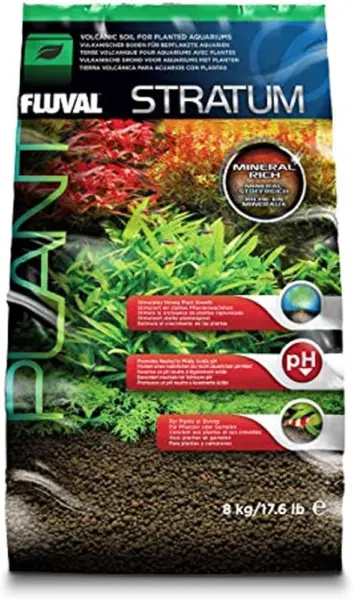
Fluval Plant & Shrimp Stratum – Best Overall
Key Features
- pH effect: Neutral to slightly acidic
- Bag weight: 17.6 lb
- Grain form: Porous granules
- Price: Midrange
A 17.6-pound bag of aqua soil is a lot of substrate, and it gives you room to build real depth instead of scraping by with a thin layer. Fluval’s Stratum is made of porous granules, and the bag states a neutral-to-slightly-acidic pH range. Those are the right fundamentals for a freshwater planted tank, especially one with shrimp and small community fish.
That combination is why this is our top pick for most planted tanks. The granules let roots push through rather than sit on the surface, the pH range stays in a useful middle ground, and the large bag means you can plant a proper bed without ordering a second one. It is the safest default here for someone setting up a first aqua soil; it does not demand the fine-grain fuss of the Bio Stratum or the deliberate inertness of Flourite.
Cloudiness is the thing to plan for. The bag can turn the water murky at setup, and multiple rinses are the usual fix; after that, mechanical filtration clears the rest. Once it settles, it is easy to push stems into, and the porous structure gives shrimp and bacteria more surface area.
Pros
- Large 17.6-pound bag for real depth
- Porous granules support root penetration
- Neutral to slightly acidic pH range
- Works for shrimp and community fish
Cons
- Light granules shift while planting
We recommend Fluval’s Stratum as the default aqua soil for a first planted tank: a large bag, a useful pH range, and a porous bed that roots and shrimp can use.
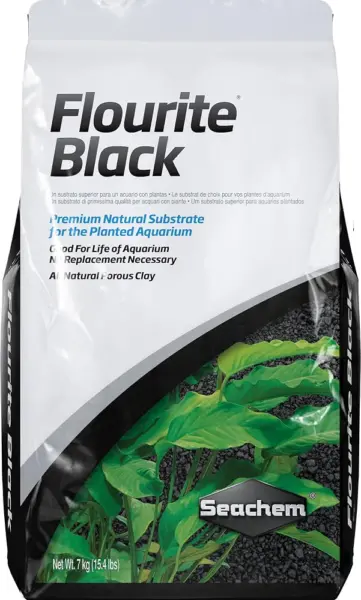
Seachem Flourite Black – Best for Stable Water Chemistry
Key Features
- Material: Porous clay gravel
- Structure: Will not soften or decompose
- Bag weight: 15.4 lb
- Water chemistry: Does not alter pH
- Price: Midrange
Seachem’s Flourite Black is the substrate we choose when the tank’s pH needs to stay where we set it. It is a porous clay gravel, and Seachem says it does not alter pH. That makes it a useful counterweight to the active soils here if you keep fish or plants that prefer stable, harder water, or if you simply don’t want the substrate making chemistry decisions for you.
The gravel holds its shape and will not soften or decompose in the tank, which is the appeal for a long-term bed. It is heavy enough to plant into without the whole slope sliding, and the black color gives green leaves and bright fish a strong backdrop. The bag is pre-washed, but it still needs a thorough rinse; we keep the runoff outside because it is gritty enough to clog a sink trap, and a bowl or plate on the substrate keeps the fill from blasting a crater in the bed.
We recommend it for keepers who want a long-lasting planting medium and are happy to run their own fertilizing routine. It is the least fussy bed here once it is in the tank, and the black finish stays looking deliberate. If you want the substrate to do more than hold roots, this is not the bag for that job.
Pros
- Does not alter pH
- Stable clay gravel resists softening
- Porous bed for planted tanks
- Black color makes plants pop
Cons
- Does not buffer pH for soft-water setups
Flourite Black is the stable, non-buffering choice for a planted tank where you want the substrate to leave pH alone and hold its structure.
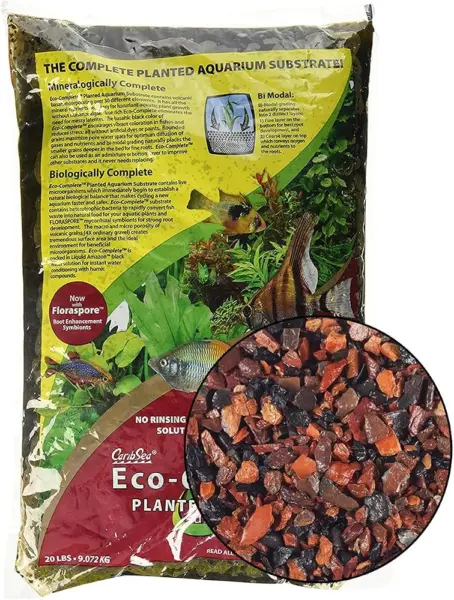
CaribSea Eco-Complete – Best for New Planted Tanks
Key Features
- Rinsing: Do not rinse
- Nutrients: Over 25 elements
- Bag weight: 20 lb
- Live bacteria: Contains live microorganisms
Eco-Complete arrives with live microorganisms and a nutrient load already in the bag, which is why we treat it as a starter substrate rather than a blank canvas. The 20-pound bag is the largest here, and the porous structure is meant to support both root diffusion and biological filtration. For a new planted tank, that combination is appealing: you are not just adding gravel, you are adding a bed that can begin working with the filter.
The bag says not to rinse, and that is the detail that separates it from the aqua soils here. Pour it in, keep the water level low, and place a bowl or plate to break the flow when you refill; the initial cloudiness should clear with mechanical filtration. For a larger tank, the 20-pound bag is a real advantage: you can build depth without opening a second bag.
The red tone is the real fork in the road: it is warm and natural, but it sets the palette for the whole tank and will not suit every aquascape. If you want a neutral black bed, Seachem’s Flourite Black is the obvious alternative. For a new tank where the priority is getting plants rooted and the biofilter moving, Eco-Complete earns its place.
Pros
- 20-pound bag for larger tanks
- Contains live microorganisms
- Porous for roots and filtration
- No rinsing required
Cons
- Settles flatter than you sculpt
Eco-Complete is our pick for a new planted tank that needs a biofilter head start, especially when you want one large bag and no rinsing.
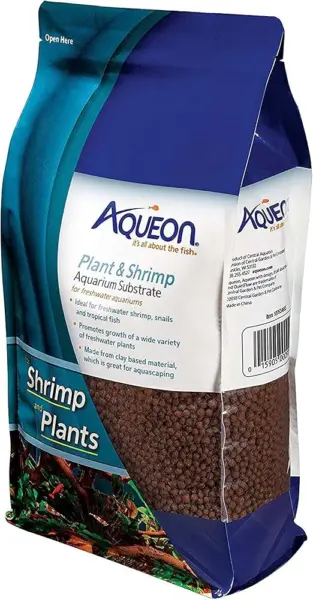
Aqueon Plant & Shrimp – Best for Nano Tanks
Key Features
- Form: Spherical granules
- Material: Clay
- Bag weight: 5 lb
- Price: Budget
The five-pound bag is the first thing to notice about Aqueon’s Plant and Shrimp substrate: this is a nano-tank product before it is anything else. The clay spheres are uniform and hold their shape, and the bag is aimed at plants, shrimp, snails, and small tropical fish. For a small shrimp tank, that makes it easy to try a proper planted substrate without committing to a huge bag.
We think it is the right first substrate for a small shrimp tank. It rinses more easily than the fine powders here, the spheres stay put when you push a stem into them, and the clay material is easy to work around a piece of wood or a small rock. It is not a buffering soil, so it won’t solve soft-water chemistry; it is a planting medium you control with water changes and fertilizer.
One practical annoyance: the spheres can arrive dusty, so rinse them well before they go in; after that, they settle quickly and are easy to vacuum. We also kept the bag for small rescapes, where a handful is enough to top up a bare corner.
Pros
- Small bag suits nano tanks
- Uniform clay spheres hold shape
- Easy to rinse and vacuum
- Works for shrimp and plants
Cons
- Five-pound bag limits larger tanks
Aqueon’s small clay substrate is our pick for nano shrimp and plant tanks where a five-pound bag is enough and easy cleaning matters.
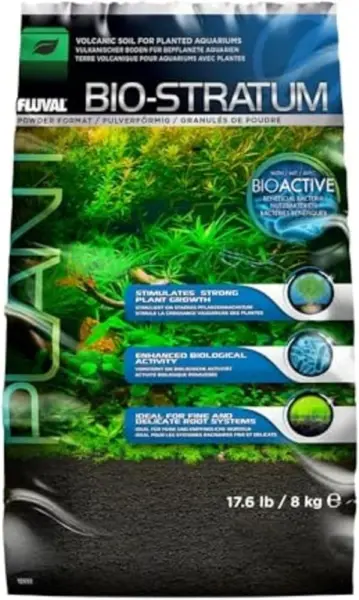
Fluval Bio Stratum – Best Fine-Grain Soil
Key Features
- Bag weight: 17.6 lb
- Grain size: 1 mm powder
- Bio activity: Infused with nitrifying organisms
- Price: Premium
Fluval’s Bio Stratum is a 1 mm powder, and that fineness is the whole argument for it. The granules are small enough for delicate roots to push through and for a carpeting plant to knit into the surface, and the bag is infused with dormant nitrifying organisms that activate when the soil hits water. It is a specialist aquascaping soil, not a general-purpose gravel.
The bio side is the other draw. Fluval says the soil helps reduce ammonia and stabilize water conditions in a new tank, and the porous granules give bacteria more surface area. We treat those as supporting benefits, not a substitute for testing: a new tank still needs time and a test kit before it is safe for fish.
The 1 mm powder is also the reason to hesitate: it is dusty when disturbed and can leave a film on leaves and glass if you are not careful when filling or replanting. That is a maintenance tax, not a dealbreaker, but it is real. We think it is worth it for a fine-root aquascape where the carpet is the point; for a low-tech community tank, the standard Stratum is the easier buy.
Pros
- 1 mm powder suits delicate roots
- Infused with nitrifying organisms
- Porous for biological filtration
- Fine texture for carpeting plants
Cons
- Costs more than standard Stratum
Bio Stratum is the fine-grain specialist: choose it for a carpeted aquascape where root penetration matters, not for a low-tech community tank.
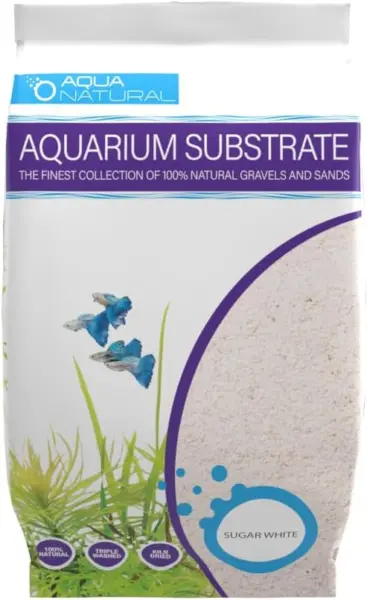
Aqua Natural Sugar White Sand – Best Sand Cap
Key Features
- Color: Off-white
- Bag weight: 10 lb
- Grain size: 0.5 to 1 mm
- Preparation: Triple washed and kiln dried
- Price: Budget
Aqua Natural’s Sugar White Sand is the pick when the look of the tank matters as much as the plant list. The 0.5-to-1 mm grains are dense and free of fines, so they don’t billow around when the filter outlet hits them, and the pale color makes dark fish, shrimp, and green leaves stand out. It is a sand, not a nutrient soil, so we treat it as a cap or a standalone bed for plants that feed from the water column.
The bag is triple washed and kiln dried, and while we still rinse any sand before it goes in, this one settles quickly and does not leave the tank hazy for long. It is also dense enough to hold a slope better than a fine powder. For a bright aquascape over a darker aqua soil, it does exactly what a cap should: it separates the layers visually and keeps the soil from drifting.
Pros
- Dense 0.5–1 mm grains resist blowing around
- Brightens the tank and contrasts with plants
- Triple washed and kiln dried
- Works as a cap over aqua soil
Cons
- Off-white rather than bright white
Sugar White Sand is the sand cap we recommend when you want a bright, stable top layer over soil; it is not a standalone feeding substrate.
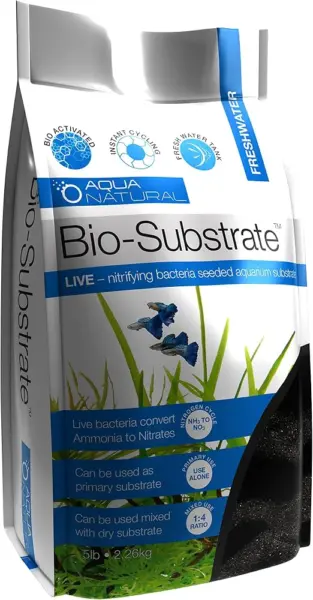
Aqua Natural Galaxy Sand – Best for Nano Bio-Active Tanks
Key Features
- Color: Black
- Rinsing: Do not rinse
- Bag weight: 5 lb
- Bio activity: Live nitrifying bacteria
- Price: Budget
A wet bag of sand seeded with nitrifying bacteria is an appealing shortcut for a nano tank, but it asks you to trust the bag. The Galaxy sand is a five-pound bio-substrate, and the directions are explicit: do not rinse it. That is the opposite of the usual sand routine, and it is the first thing to get right.
The live bacteria are the reason it exists. Aqua Natural says the sand cycles an aquarium instantly, which we take as a head start rather than a guarantee; the tank still has to be tested before fish go in. The black color gives shrimp and plants a strong backdrop, and the wet, heavy texture makes it easier to place without a dust cloud than a dry fine sand.
It is still a sand, not a full aqua soil. Plants that feed mainly from the water column or from root tabs do fine; heavy root feeders want a nutrient layer underneath.
We think it earns a place as a starter sand for a small shrimp tank, provided you follow the no-rinse instruction and don’t expect it to replace testing. The five-pound bag is a nano-tank quantity, and the price per pound is higher than the plain Sugar White Sand, so a larger or heavier planted tank gets better value from one of the bigger soils.
Pros
- Live nitrifying bacteria in the bag
- No rinsing required
- Black sand makes shrimp and plants pop
- Five-pound bag suits nano tanks
Cons
- Can still cloud despite no-rinse directions
Choose Galaxy Sand for a nano shrimp tank where a live-bacteria head start is worth the small bag and the no-rinse routine.
How We Tested Planted-Aquarium Substrates
We started with a shortlist of 14 substrates drawn from aquarium-specialty brands, planted-tank forums, and the bags that keep showing up in local club auctions. We filtered for grain size, whether the substrate claimed to be inert or buffering, bag volume, and how easy it was to find refills. Then each one went into a real setup: nano tanks on a kitchen counter, a 40-gallon community tank, and a low-tech shrimp tank. Testing ran for five months, through weekly water changes, replanting sessions, and the usual midweek fussing.
On fill day, I rinsed each substrate in a bucket and counted how many water changes it took before the water ran clear; then I filled the tank and checked clarity at one hour, 24 hours, and again after the first week. I noted whether the water looked colorless, tea-stained, or milky, and whether a light pass with a siphon sent dust back into the column. Water quality got checked with pH and hardness tests before setup and every two weeks after, so we could see whether a substrate was quietly buffering or staying neutral.
Plant health mattered most. I planted the same mix of stem plants, rosettes, and epiphytes attached to rock, then noted whether stems stayed put after a gentle tug, whether roots spread into the grain or sat on top, and how much new growth appeared by week four and week ten. Appearance got judged wet, under both daylight and tank LEDs, because a bag that reads charcoal-brown in the hand can look rusty or washed out underwater. I also watched how each substrate aged: whether it compacted, floated, or broke down into mud when disturbed. The ones that moved forward stayed stable, held plants without strangling them, and kept the water clear between maintenance days.
How to Choose a Substrate for a Planted Aquarium
The right planted substrate is the one that matches your plants, your water, and the way you maintain the tank, not simply the one with the longest nutrient list.
Start with the job: soil, gravel, or sand
An aqua soil is the closest thing to a planted-tank foundation: it is made to hold roots and, in many cases, to shift pH slightly. Choose it when you are setting up a new tank around root feeders and want the substrate to do some of the early work. A porous clay gravel such as Seachem Flourite Black is the better call when you want a stable bed that leaves water chemistry alone. Sand is a cap or a specialist bed, not a replacement for soil under heavy root feeders.
Think about the plants first. Carpeting plants and delicate roots want a fine, open substrate; big rosette plants and stems can grow in coarser gravel. If you plan to keep digging fish, a light aqua soil may be the wrong choice because it shifts easily. The substrate should support the way the tank is stocked, not fight it.
Read the water-chemistry claim before the bag
Two substrates can look similar and behave very differently. Fluval’s Stratum lists a neutral-to-slightly-acidic pH range, while Seachem’s Flourite Black is designed not to alter pH. Neither is universally better: the first suits many community and shrimp setups, and the second gives you a stable baseline you adjust yourself. If you keep fish that need consistent hard water, an active soil that pulls pH down can be the wrong tool.
Check the bag for a pH claim and decide whether you want the substrate to influence chemistry. If you are unsure, test your tap water first and choose a substrate that moves it in a direction you can live with. Do not buy an active soil for the nutrient label alone if you are not prepared to manage the buffering effect.
Plan for dust, rinsing, and the first fill
Cloudiness is the shared headache of this category. Some products are pre-washed but still dusty, some are bio-active and say not to rinse, and some aqua soils need several rinses before the water clears. Follow the bag: rinsing a no-rinse bio-substrate can wash away the bacteria you paid for, while a gritty clay gravel may need several changes of water.
Fill slowly and put a bowl or plate on the substrate so the water does not drill a crater into the bed. Expect some haze even when you do it right; mechanical filtration usually clears it. If the water stays cloudy for days, check your rinse technique and the filter rather than adding more chemistry.
Size the bag to the tank, then choose the grain
A five-pound bag is a nano-tank quantity; a 15- to 20-pound bag is what lets you build real depth in a larger setup. The bag size matters as much as the grain because a beautiful substrate spread too thin will not hold plants. Buy for the bed you want, not the smallest bag that gets the tank wet.
Grain size decides how the tank plants and cleans. Fine powders suit carpets and delicate roots but cloud more easily and demand careful filling. Coarse gravel is easier to vacuum and holds stems, but it can be hard on tiny roots. Sand is the middle path for appearance and support, provided you keep it shallow over soil or choose plants that feed from the water column.
Frequently Asked Questions
Do bio-active substrates cycle a new tank on their own?
No. They add live nitrifying bacteria, which can shorten the cycle, but they do not replace testing. Add fish slowly and test ammonia and nitrite until both stay at zero. Aqua Natural’s Galaxy Sand and CaribSea Eco-Complete are the bio-active picks here.
Does black substrate make fish and plants look better?
It increases contrast, especially with green plants and bright fish, but it is an aesthetic choice rather than a growth one. Seachem Flourite Black and Aqua Natural Galaxy Sand give you the dark look; Aqua Natural Sugar White Sand does the opposite.
How do I know when aqua soil needs replacing?
There is no universal replacement date. Watch the plants and the bed: if the substrate compacts, turns muddy when disturbed, or roots stop spreading, it is time to re-scape. Seachem Flourite Black is designed not to soften or decompose; active soils are the ones to monitor more closely.
Final Verdict
For most planted tanks, start with Fluval Plant and Shrimp Stratum. It gives you a large bag, a pH range that suits many community and shrimp setups, and a porous bed that roots can move through. That is the combination most first-time planted-tank buyers need, and it is the easiest of these to recommend without a list of caveats.
If you want the substrate to leave pH alone, Seachem Flourite Black is the better buy. For a nano tank, Aqueon’s small bag is easier to justify. The choice changes when your water chemistry or tank size changes, not because one bag is universally better.