This post contains affiliate links. We may earn a small commission when you buy through our links — at no extra cost to you.
Goldfish are among the messiest freshwater fish – they produce far more waste per gallon than most tropical species. A filter designed for a 40-gallon community tank often can’t keep up with a single goldfish’s bioload. The result? Cloudy water, frequent cleaning, and premature pump burnout.
Many manufacturers rate filters based on a low-bioload assumption, not the reality of goldfish. A filter ‘up to 50 gallons’ may struggle with a 30-gallon goldfish tank. The missing piece is turnover rate and media volume.
This guide focuses on finding a filter that actually matches a goldfish’s waste production. That means oversizing – choosing a unit rated for 1.5 to 2 times your tank’s volume – and prioritizing reliability over flashy features.
Top Picks
Best for Goldfish 30-50 Gal
Fluval AquaClear 70
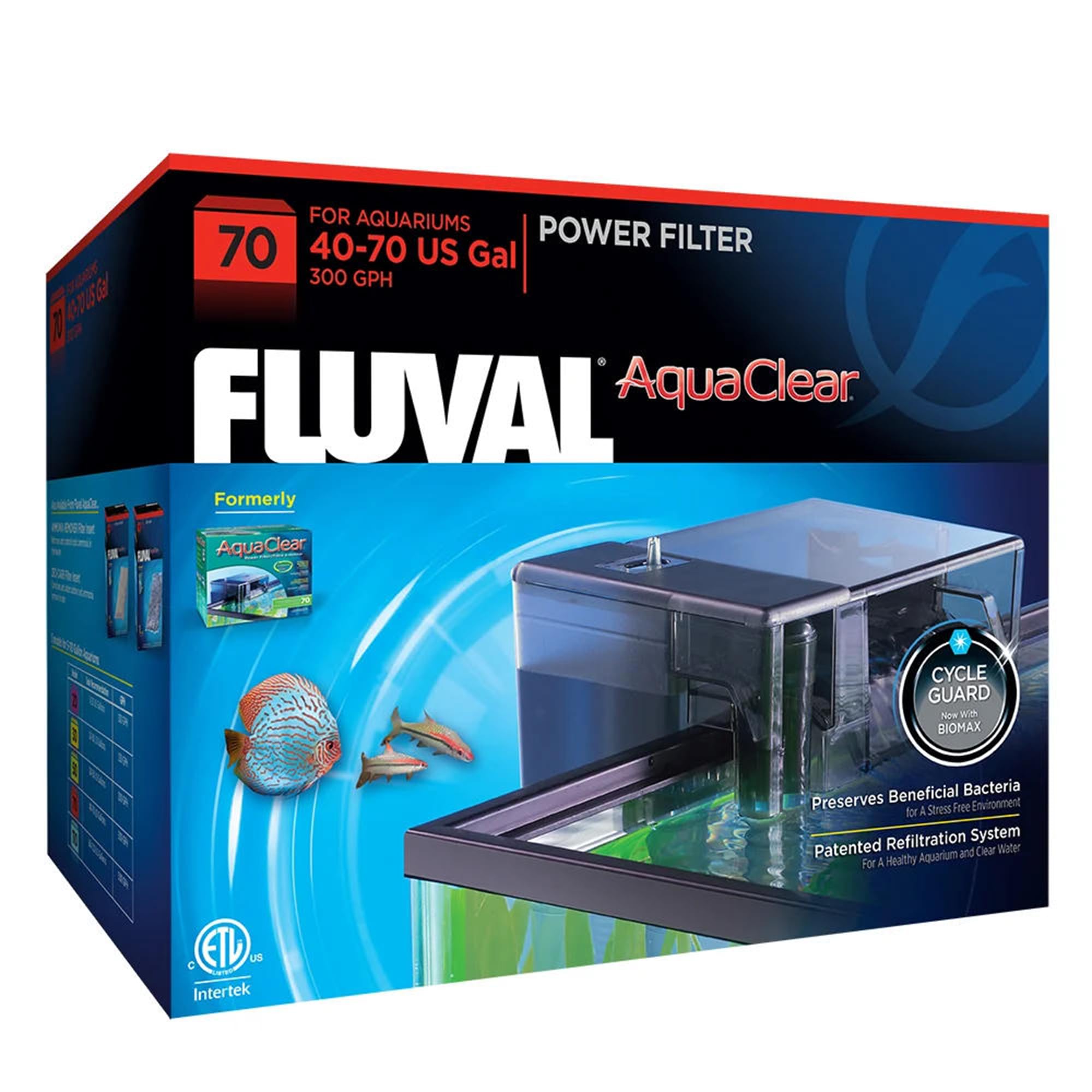
Rating: 4.4 ★ | Price: $$ | Flow Rate: 300 GPH | Filter Type: HOB large basket | Media Capacity: 7x larger basket | Suitable Tank: 30-50 gal
The AquaClear 70’s media basket holds roughly seven times more volume than comparable hang-on-back filters, giving goldfish keepers room to customize with sponge, bio rings, or ceramic for high waste loads. Operation is quiet enough for living spaces, though priming does require manually filling the basket and some units may develop a light rattle after extended use.
This filter is best suited for goldfish keepers with 30- to 50-gallon tanks who want full control over their media and accept a manual priming step and occasional noise checks. For tanks larger than 70 gallons or those seeking a set-and-forget setup, a dual-unit or canister approach is more appropriate.
Pros
- Media basket with roughly 7x the volume of typical HOB filters – room for custom sponge, bio rings, or ceramic.
- Quiet pump operation – the motor hum stays low enough for living areas.
- Consistent mechanical and biological filtration over years of use with routine cleaning.
Cons
- For tanks larger than 70 gallons, a single unit won’t provide enough turnover – plan for a second unit or a canister.
- Requires regular maintenance – the media basket and impeller need cleaning every few weeks to avoid flow drop.
For goldfish tanks in the 30–50 gallon range, the AquaClear 70 offers the most media flexibility in a quiet HOB package – a balanced choice of capability and cost.
Best for Large Tanks Budget
Marineland Penguin 350

Rating: 4.4 ★ | Price: $ | Flow Rate: 350 GPH | Filter Type: HOB bio-wheel | Media Capacity: 4 cartridges | Suitable Tank: 40-70 gal
The Penguin 350 moves 350 GPH at a budget-friendly price, making it the cheapest way to churn through water in a 40–70 gallon goldfish tank. That raw flow is its main reason to consider it over the top pick — but the trade-off comes in two forms: a noticeable motor hum and splashing that will be present in quieter rooms, and a motor that can stop working within the first year in some cases. This filter suits keepers who prioritize upfront savings and don’t mind occasional maintenance or background noise.
Pros
- 350 GPH flow at a price well below comparable HOBs — hard to beat for large goldfish tanks.
- Replacement cartridges are inexpensive and widely available at pet stores.
- Quick setup with multi-stage mechanical, chemical, and biological media in one unit.
Cons
- Motor hum and water splash will be audible in quiet living spaces — fine for a garage or dedicated fish room.
- Some units may lose flow or stop spinning within months; worth buying with a flexible return window in mind.
If you need maximum flow on a tight budget and noise doesn’t bother you, the Penguin 350 delivers. For quieter, more predictable long-term service, the top pick is the safer bet.
Best for 20-30 Gal
Fluval 207 Canister

Rating: 4.5 ★ | Price: $$$ | Flow Rate: 206 GPH | Filter Type: Canister | Media Capacity: Multiple trays | Suitable Tank: Up to 30 gal
Fluval’s 207 delivers near-silent operation that won’t disturb a living room or bedroom — a clear advantage over the hum of an AquaClear 70. Its sealed canister design keeps equipment out of sight, and the removable media baskets simplify maintenance. However, the 206 GPH flow rate is adequate for single fancy goldfish in tanks up to 30 gallons; for larger setups or heavier bioloads, flow becomes marginal. Potential leakage around seals has been noted, particularly if reassembly isn’t precise. This canister suits goldfish keepers who prioritize quiet and aesthetics over maximum flow and who stay within the 20–30 gallon range.
Pros
- Ultra-quiet pump that adds minimal background noise to the room.
- Removable media baskets make cleaning and media swaps straightforward.
- Sealed canister design keeps the filter discreet and out of sight.
Cons
- Seals may leak after cleaning if not re-seated carefully.
For small goldfish tanks where silence and clean lines matter, the Fluval 207 earns its premium price — just keep the tank under 30 gallons and check seals after maintenance.
Best for 20-30 Gal
Fluval AquaClear 50
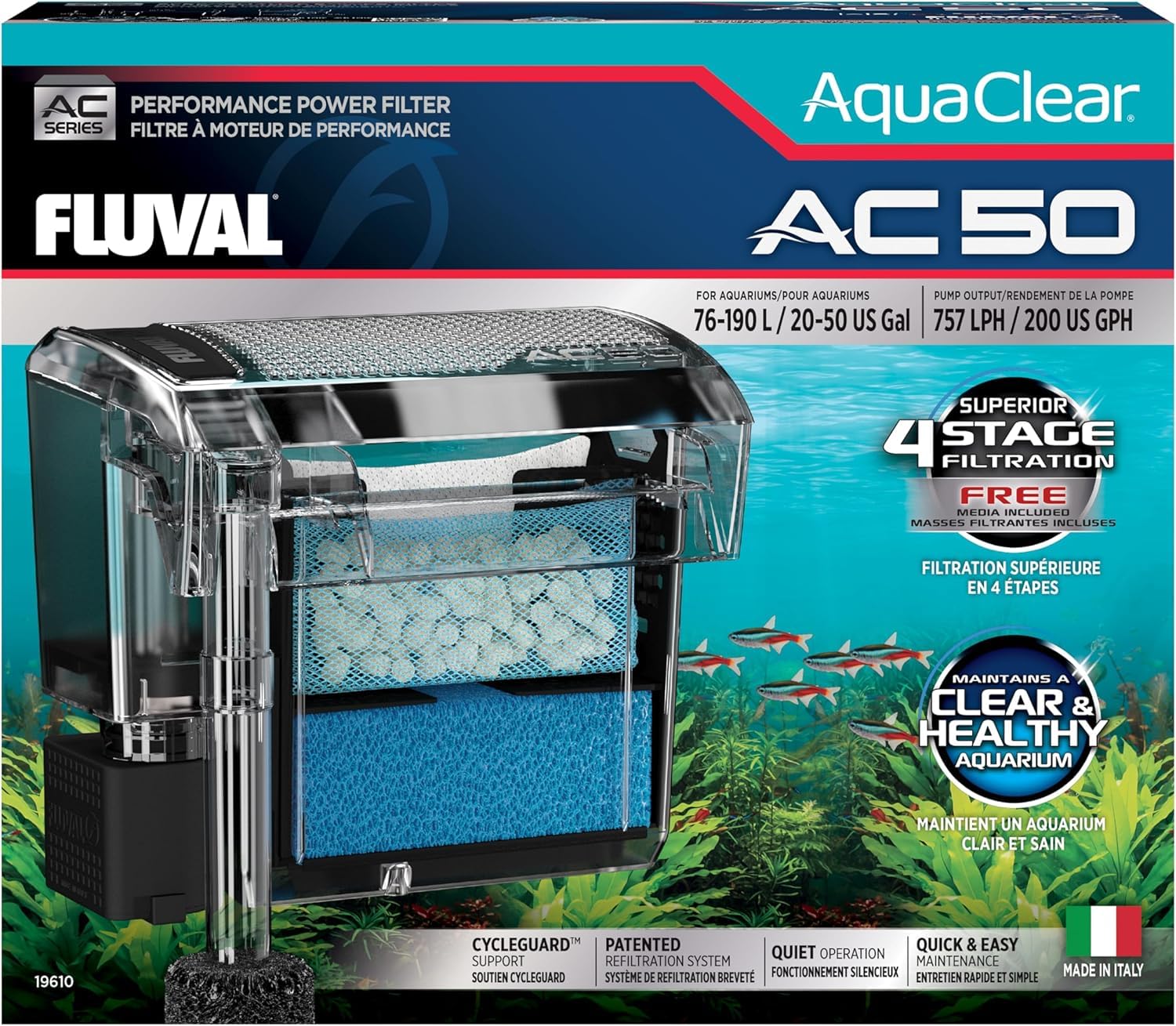
Rating: 4.2 ★ | Price: $$ | Flow Rate: 200 GPH | Filter Type: HOB large basket | Media Capacity: 7x larger basket | Suitable Tank: 20-30 gal
The Fluval 50 packs the same oversized media basket as the top pick into a smaller footprint, suiting goldfish tanks up to 30 gallons where flow and biological capacity handle moderate waste loads. Noise can develop if the impeller isn’t cleaned regularly, and motor longevity varies between units — best for keepers who want AquaClear media flexibility in a compact setup and are comfortable with periodic maintenance.
Pros
- Large media basket accepts custom filter media for tailored biological filtration.
- Simple disassembly for routine cleaning — no tools needed.
Cons
- In quiet rooms, the pump may produce noticeable noise if the impeller is not cleaned periodically.
- Motor longevity can vary; some units may require replacement within the first year.
A capable compact HOB for 20–30 gallon goldfish tanks when media flexibility matters more than absolute silence or long-term motor reassurance.
Best for Medium Tanks Budget
Tetra Whisper EX 70

Rating: 4.2 ★ | Price: $$ | Flow Rate: 250-300 GPH | Filter Type: HOB cartridge | Media Capacity: Cartridge-based | Suitable Tank: 30-50 gal
Setup is simple and the filter keeps water clear in medium goldfish tanks. Noise level can vary between units – some find it noticeable in quiet rooms, others don’t. Motor reliability has been inconsistent, with some units stopping work within a few months. This makes it a better fit for temporary setups or for keepers who can replace it without hassle, rather than a long-term primary filter.
Pros
- Easy setup and quiet enough for most rooms
- Effective water cleaning – keeps tanks clear
Cons
- Noise level can vary between units – noticeable in quiet rooms for some
- Motor may stop working within a few months in some units
Works well when it works – ideal for temporary use or as a backup, not for long-term goldfish keeping without a replacement plan.
Best for 20-30 Gal
Marineland Penguin 200

Rating: 4.3 ★ | Price: $ | Flow Rate: 200 GPH | Filter Type: HOB bio-wheel | Media Capacity: 2 cartridges | Suitable Tank: 20-30 gal
At 200 GPH, this is the lower-flow version of the Penguin 350 — aimed at goldfish tanks in the 20–30 gallon range where every dollar counts. Mechanical filtration clears water quickly, but the bio-wheel can stop spinning if not aligned properly, and the motor noise will be present in quiet rooms.
Best suited for keepers on a tight budget who are willing to monitor the bio-wheel and accept some background hum. Not recommended for tanks above 30 gallons or anyone who wants a silent filter — the motor and wheel noise is part of the package at this price.
Pros
- Good value for money – affordable and effective for smaller goldfish tanks.
- Clears water quickly via strong mechanical filtration.
Cons
- Motor and bio-wheel can produce noticeable noise in quiet spaces.
- Bio-wheel may stop spinning, reducing biological filtration unless adjusted regularly.
A capable budget option for small goldfish setups, provided you’re comfortable with the noise and occasional wheel adjustments.
Best for Supplemental Bio
hygger Sponge M

Rating: 4.4 ★ | Price: $ | Flow Rate: Air-pump dependent | Filter Type: Sponge air-driven | Media Capacity: Foam & ceramic | Suitable Tank: 15-55 gal
The hygger Sponge Filter M provides effective biological filtration with foam and ceramic media, and is simple to set up and clean. For goldfish tanks, the foam can clog quickly from solid waste, making it best suited as a supplemental biological filter rather than a primary mechanical filter.
Pros
- Effective biological filtration and gentle water flow.
- Simple to set up and clean.
Cons
- Suction cups may not hold well over time, causing the filter to shift or float.
Buy this if you need a gentle biological boost alongside a primary mechanical filter in a goldfish tank – not meant to handle solid waste alone.
Best for Supplemental Bio
hygger Sponge S

Rating: 4.4 ★ | Price: $ | Flow Rate: Air-pump dependent | Filter Type: Sponge air-driven | Media Capacity: Foam & ceramic | Suitable Tank: 10-40 gal
This small sponge filter provides gentle biological filtration with its foam and ceramic media, making it a useful add-on for fry or shrimp in goldfish tanks. For a goldfish setup, it lacks the mechanical capacity to handle heavy waste as a standalone unit, and the suction cups may lose grip over time.
Pros
- Good biological filtration with gentle water flow
- Comes with extra sponges and ceramic media
Cons
- Not adequate as a standalone filter for goldfish – mechanical capacity too limited for heavy waste
Best used as a secondary biofilter in small goldfish tanks (10–20 gallons) where a primary HOB or canister handles the heavy mechanical work.
Best for Temporary Nano
Tetra Whisper IQ 20

Rating: 4.2 ★ | Price: $ | Flow Rate: 130 GPH | Filter Type: HOB internal pump | Media Capacity: Cartridge | Suitable Tank: 20 gal
The Whisper IQ delivers quiet operation and tool‑free setup, making it a practical choice for small tropical community tanks. For goldfish, however, the 130 GPH flow rate is marginal even for a single fancy in a 20‑gallon, and some units may leak from the motor compartment or stop working within months. It works best as a temporary or supplemental filter with heavy maintenance.
Pros
- Quiet sound‑shielded design suitable for living spaces
- Simple tool‑free installation and cartridge changes
Cons
- 130 GPH flow rate can leave waste accumulating in goldfish tanks without rigorous maintenance
This filter works well as a secondary or backup for a well‑maintained fancy goldfish tank, or as a primary for low‑bioload tropical tanks up to 20 gallons.
Best for Small Tropical
Aqua-Tech Ultra Quiet

Rating: 4.3 ★ | Price: $$ | Filter Type: HOB cartridge | Suitable Tank: 20-40 gal
The Aqua-Tech Ultra Quiet filter stays below 40 dB with its decoupled motor, and the easy-clean cartridge maintains water clarity. However, its design prioritizes quiet operation over the heavy-duty demands of goldfish tanks. This filter is best used as a temporary solution for small tropical aquariums where noise reduction is a priority.
Pros
- Quiet enough for a bedroom setup with dampened motor noise.
- Cartridge is simple to clean and keeps water clear.
Cons
- Water flow can vary between units, which affects its ability to handle goldfish waste loads.
Best used as a temporary filter for small tropical tanks where noise sensitivity outweighs long-term dependability.
Best for Shrimp/betta Nano
AQUANEAT Sponge S

Rating: 4.7 ★ | Price: $ | Flow Rate: Air-pump dependent | Filter Type: Sponge air-driven | Media Capacity: Sponge & ceramic | Suitable Tank: Up to 10 gal
At a budget-friendly price, this air-driven sponge filter delivers gentle flow and biological filtration ideal for shrimp, betta, or fry tanks up to 10 gallons. The sponge catches debris without sucking in small inhabitants. However, its 10-gallon rating means it cannot manage the waste load of even a single goldfish — this is a nano-tank tool, not a goldfish filter. For the right small-scale setup, it’s an unbeatable value.
Pros
- Very low cost for an effective sponge filter in small tanks
- Gentle water flow safe for fry, shrimp, and bettas
Cons
- 10-gallon rating is insufficient for goldfish waste — meant for nano tanks only
For shrimp, betta, or fry tanks under 10 gallons, this is a budget-friendly choice; goldfish keepers need a filter rated at least 20 gallons larger.
Best for Nano Tank
Marina S10

Rating: 4.4 ★ | Price: $ | Filter Type: HOB | Suitable Tank: Up to 10 gal
The Marina S10 delivers self-priming convenience and adjustable flow in a slim HOB package under $30. Owners note quiet operation and a sleek profile that suits small tanks. However, its 10-gallon maximum capacity means it cannot handle the waste load of any goldfish – this filter belongs with bettas or shrimp, not goldfish.
Pros
- Quiet operation with a slim, unobtrusive design.
- Adjustable flow control useful for bettas that prefer gentle current.
Cons
- Maximum 10-gallon capacity is inadequate for goldfish waste.
Choose the S10 for a planted nano tank or shrimp habitat – for goldfish, look to larger filters.
Best for Uv Clarifier
COODIA UV Filter

Rating: 4.2 ★ | Price: $$ | Filter Type: UV sterilizer | Suitable Tank: Up to 75 gal
This unit effectively clears green water algae in established goldfish tanks up to 75 gallons. However, it lacks mechanical and biological filtration — it must be used alongside a proper filter. For goldfish keepers needing a full filtration solution, this is a supplementary tool, not a primary filter.
Pros
- Effectively eliminates green water algae in established goldfish tanks.
- Rated for tanks up to 75 gallons as a UV treatment device.
Cons
- UV bulb may fail within months and replacement is difficult.
Best used as a targeted treatment for green water outbreaks in an already filtered goldfish tank.
Best for Betta/shrimp Nano
Tetra Whisper 10i
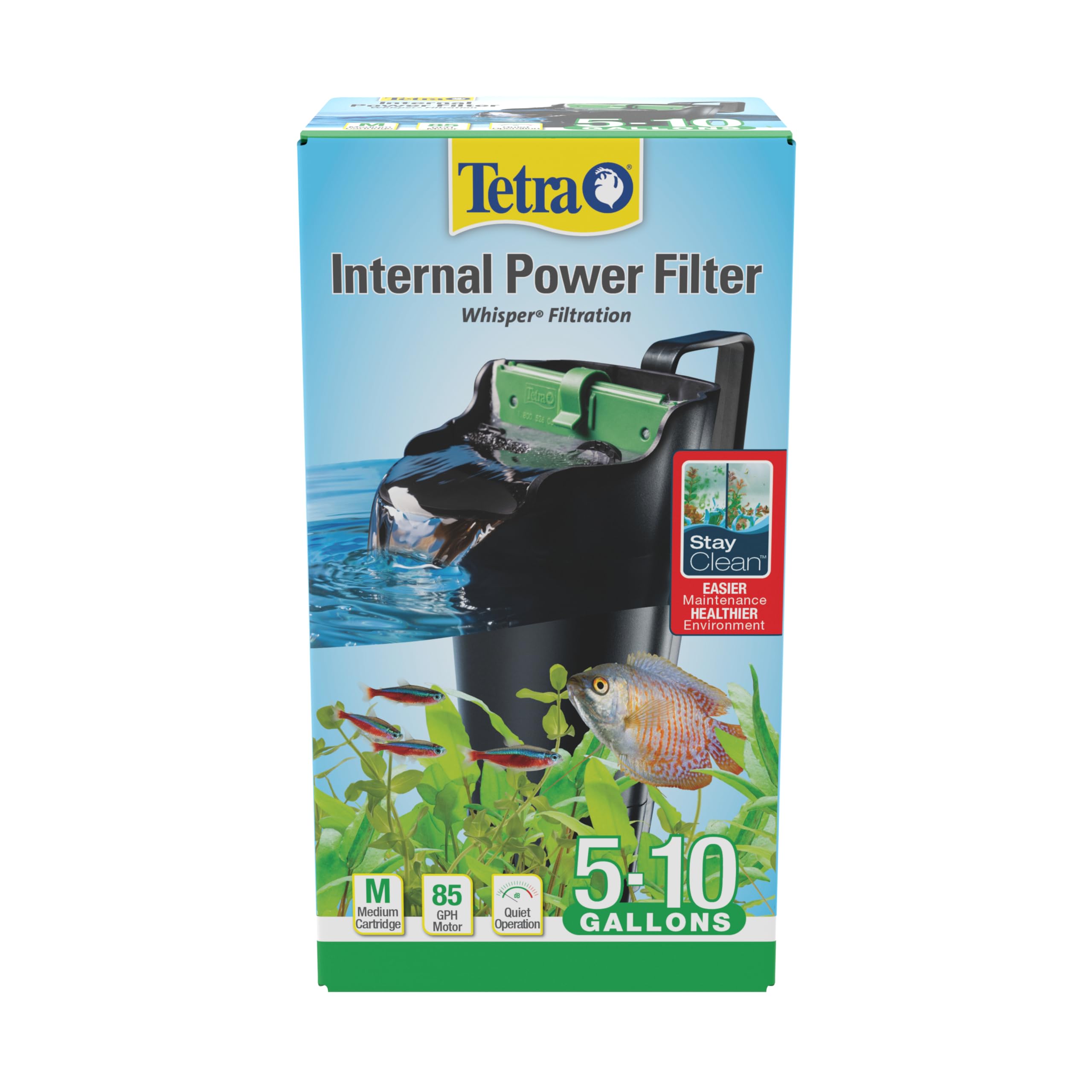
Rating: 4.3 ★ | Price: $ | Flow Rate: 80 GPH | Filter Type: Internal submersible | Media Capacity: Cartridge | Suitable Tank: 5-10 gal
This filter offers whisper-quiet operation and easy setup at a budget price, making it a solid choice for nano planted tanks or shrimp setups. However, its 10-gallon maximum tank rating makes it unsuitable for any goldfish – even a single fancy goldfish requires more water volume and filtration capacity.
Pros
- Very quiet – well-suited for bedrooms or small tanks
- Simple to install and maintain with cartridge-based media
Cons
- 10-gallon tank limit – not sufficient for any goldfish; hard boundary
For betta or shrimp keepers on a budget, this is a fine choice – goldfish owners should look at larger HOB filters.
How to Choose
Goldfish produce 2–3 times more waste than tropical fish; a filter rated for your tank size is often insufficient – choose one rated for 1.5–2x the volume.
Flow Rate
Flow rate (GPH) determines how many times per hour the tank water passes through the filter. Goldfish need 5–10x turnover per hour – double the recommendation for most tropical fish. A 30-gallon tank therefore needs at least 150 GPH, preferably 300 GPH.
Higher flow also helps suspend waste so it can be captured before settling. Undersized flow leads to debris buildup, ammonia spikes, and frequent water changes.
Filter Type
Hang-on-back (HOB) filters are the most popular for goldfish tanks because they combine mechanical, chemical, and biological filtration without taking up tank space. Canister filters offer superior biological capacity and keep the tank rim clean, but cost more and require careful priming.
Sponge filters are excellent for biological filtration and gentle flow, but their mechanical capacity is too weak for goldfish waste unless used as a secondary filter. Internal filters are generally too small for goldfish tanks.
Media Volume
Media volume directly affects how much beneficial bacteria can colonize, which is critical for processing ammonia from goldfish waste. Filters with large, customizable media baskets (like the AquaClear series) allow you to pack sponges, bio rings, and ceramic media to increase capacity.
Cartridge-based filters limit media choices and require frequent replacements, driving up long-term costs. A larger media basket also extends time between cleanings – important for busy keepers.
Noise Level
Goldfish tanks are often in living rooms or bedrooms, so noise matters. HOB filters with spinning bio-wheels or poorly designed impellers can produce hum, rattle, or water splash. Canister filters are generally quieter because the pump is submerged inside the cabinet.
Noise can also indicate improper maintenance – a dirty impeller or low water level. However, some filters are inherently louder than others; reading user feedback helps identify which models stay quiet long-term.
Reliability
Motor failure within weeks to months is a common complaint among budget HOB filters. Goldfish keepers cannot afford a sudden pump death – waste buildup can crash water quality quickly. Look for filters with a track record of years of service and available replacement parts.
Warranty length and brand support matter. Fluval and Marineland have wider part availability than smaller brands. Spending $20–30 more upfront on a known reliable model often saves money and frustration in the first year.
FAQ
Why does my goldfish filter stop working after a few weeks?
The most common cause is undersized flow and media for goldfish waste. The motor works harder, debris clogs the impeller, and the pump burns out. Also, many budget filters use low-quality motors that fail quickly. Choose a filter rated for 1.5–2x your tank volume and clean the impeller and intakes monthly to extend life.
Is a canister filter better than a hang-on-back for goldfish?
Canister filters excel at biological filtration and are quieter, but they cost more and require careful priming and seal maintenance. For large goldfish tanks (50+ gallons), a canister is often worth the investment. For smaller tanks (20–40 gallons), a quality HOB like the AquaClear 70 can deliver better value and easier maintenance.
How much flow rate do goldfish really need in a filter?
Goldfish need a turnover rate of 5–10 times the tank volume per hour. For a 30-gallon tank, that means a filter rated for at least 150 GPH, ideally 250–300 GPH. Oversizing by one model tier above the tank’s rating is the safest bet to keep water clean and reduce maintenance.
Can I use a sponge filter as the main filter for goldfish?
Only in a small quarantine or fry tank with very low bioload. Sponge filters provide excellent biological filtration but are weak at mechanical filtration – goldfish solid waste will clog the foam within hours. A sponge filter works best as a secondary biological supplement alongside a HOB or canister.