This post contains affiliate links. We may earn a small commission when you buy through our links — at no extra cost to you.
Many aquarium water test kits claim to check multiple parameters, but the most critical one—ammonia—is often missing from the label. That leaves new tank cyclers and sensitive fish owners guessing at water quality issues. This guide cuts through the confusion to match you with a kit that actually covers what matters.
The real divide is between convenience and precision. Test strips are quick but frequently inaccurate for ammonia and nitrate. Liquid drop kits take more time but deliver readings you can trust. We’ve sorted through the options to highlight which trade-offs are worth making for your specific setup.
Picking the right kit means understanding what each one actually tests—and what it leaves out. That knowledge alone can save you from chasing false readings or missing a dangerous ammonia spike.
Top Picks
Best for Serious Freshwater Hobbyists
API Master Test Kit

Rating: 4.8 ★ | Price: Mid-Range | Ammonia Test: Yes | Test Method: Liquid drops | Test Count: 800 | Parameters: 5 | Ease of Use: Requires time, clear instructions
This liquid drop kit provides precise readings for the four essential freshwater parameters across 800 tests – enough for years of routine monitoring. Liquid reagents consistently outperform test strips for critical values like ammonia and nitrite, making this the go-to choice for tank cycling and sensitive fish care. The included booklet and clearly labeled bottles make the step-by-step testing process easy to follow, though each test takes a few minutes to complete.
This kit suits serious freshwater hobbyists who want a single solution for cycling and ongoing water quality checks. It covers pH, high range pH, ammonia, nitrite, and nitrate – but not general hardness (GH) or carbonate hardness (KH). You will need a separate API GH & KH Test Kit if those parameters matter for your setup. The nitrate color chart uses subtle shade differences that can be tricky to read at certain levels, so a controlled light source helps. For the price per test, this remains the most accurate option for the parameters it includes.
Pros
- Exceptional accuracy for critical parameters – considered more consistent than test strips
- Excellent value for long-term use – far more economical per test than strips
- Comprehensive coverage of five vital parameters – includes everything needed for routine freshwater monitoring
Cons
- Does not include GH/KH hardness tests, requiring a separate purchase for complete water monitoring
- Nitrate color chart shades can be difficult to differentiate at certain levels, making readings less precise
For freshwater aquarists who demand reliable data for cycling and sensitive species, this kit delivers unmatched accuracy per test dollar – just be prepared to add the separate GH/KH kit if hardness matters.
Best for Budget-Minded Aquarists
SJ WAVE 11-in-1 Strips
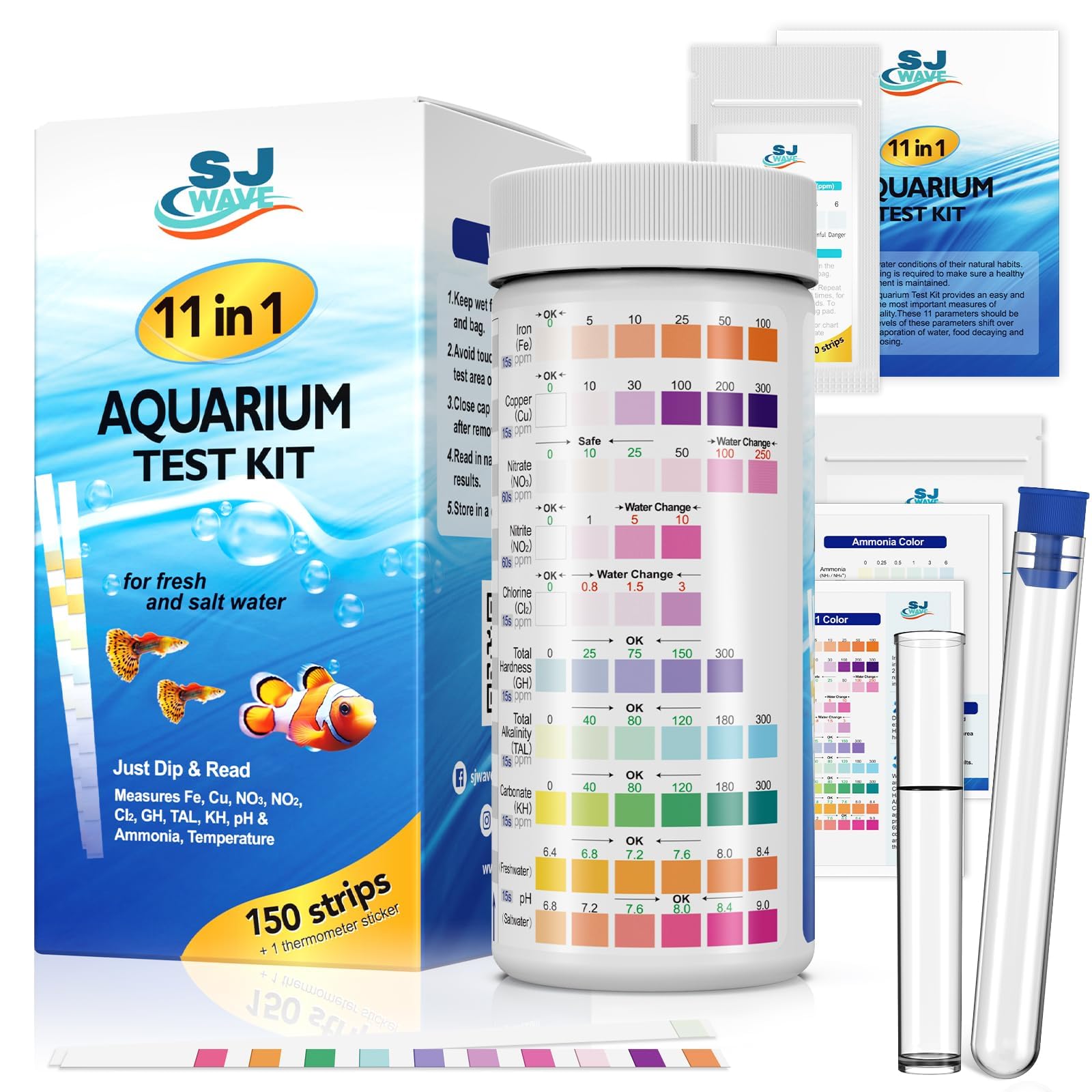
Rating: 4.5 ★ | Price: Budget | Ammonia Test: Yes | Test Method: Strips | Test Count: 150 | Parameters: 11 | Ease of Use: Easy except ammonia dip
This 11-in-1 kit covers ammonia, pH, iron, chlorine, hardness, carbonate, nitrate, nitrite, alkalinity, copper, and temperature — parameters most strips skip. The 150 strips (50 ammonia-specific) and included thermometer cost under $20, so per-test cost is low.
Best suited for budget-minded aquarists who need quick checks on established tanks where precise pH isn’t critical. The ammonia test requires 30 dips in 30 seconds — a clumsy step, and pH readings can differ from liquid kits. For sensitive species or cycling a new tank, a liquid kit is more dependable.
Pros
- Covers 11 parameters including ammonia, uncommon in strips
- Simple dip-and-compare operation for most tests
- High test count at a low per-strip price
Cons
- pH accuracy can be inconsistent, especially in soft or hard water
- Ammonia test requires dipping the strip 30 times in 30 seconds
A strong value for casual monitoring on established tanks where absolute precision isn’t needed, but hobbyists cycling a new tank or keeping delicate fish should pair it with a liquid ammonia kit.
Best for Weekly Spot Checks
API 5-in-1 Strips

Rating: 4.6 ★ | Price: Mid-Range | Ammonia Test: No | Test Method: Strips | Test Count: 100 | Parameters: 5 | Ease of Use: Easy and fast
These dip-and-read strips test pH, nitrite, nitrate, KH, and GH in under sixty seconds, offering a quicker alternative to the liquid master test kit’s drop-by-drop method. The speed is ideal for routine checkups, but the absence of an ammonia test means this only works in tanks that have finished cycling.
Best for saltwater and freshwater hobbyists who want weekly parameter snapshots without liquid reagents. If you need to track ammonia during new tank setup or after medication, the top pick’s liquid kit is the necessary addition.
Pros
- Reads five parameters in a single dip that takes under a minute.
- Lower upfront cost than liquid kits, especially for frequent testing.
- Eliminates trips to the pet store for basic water checks.
Cons
- Readings can differ from liquid test results, especially for GH and KH.
- Color pads for GH and KH may be tricky to read in dim light.
An efficient strip for stable tanks that skip ammonia testing, but pair it with a liquid kit for cycling and accuracy cross-checks.
Best for Budget-Conscious Beginners
Tetra 6-in-1 Strips

Rating: 4.6 ★ | Price: Budget | Ammonia Test: No | Test Method: Strips | Test Count: 25 | Parameters: 6 | Ease of Use: Easy and fast
These strips are simple to use with a quick dip-and-read method that delivers results in 60 seconds, and the Tetra name comes at a budget-friendly price. The missing ammonia test is a critical gap — it means you cannot monitor cycling or detect early signs of stress in a new tank. That makes this kit suitable only for occasional checks on established, stable freshwater or saltwater tanks where you already know ammonia is not an issue and you just need a quick read on pH and hardness.
Pros
- Dip-and-read method is intuitive and gives fast results in 60 seconds.
- Lowest price among name-brand strip options for basic water checks.
Cons
- Only 25 strips per box — you will need to buy more frequently than with typical 100-count packs.
Pick these if you have a mature tank with stable parameters and only need an occasional quick check on pH and hardness, not a full monitoring kit.
Best for Occasional Cursory Checks
FUNSWTM 7-in-1 Strips

Rating: 4.6 ★ | Price: Budget | Ammonia Test: No | Test Method: Strips | Test Count: 100 | Parameters: 7 | Ease of Use: Easy, includes extras
This 100-strip pack offers easy dip-and-compare testing for seven parameters at a very low per-strip cost, and includes a test tube and thermometer sticker. However, it skips ammonia — a critical parameter for monitoring tank health — and accuracy can vary compared to liquid kits. Best suited as a quick check for stable ponds where ammonia is already tracked separately.
Pros
- Dip-and-compare method requires minimal effort for quick readings.
- 100 strips plus a test tube and thermometer sticker add value for the price.
Cons
- Does not test ammonia, a critical parameter for freshwater tanks.
A cost-effective option for pond owners who already monitor ammonia separately and want quick checks on other parameters.
Best for Beginner Non-Ammonia
HOVIRAN 7-in-1 Strips

Rating: 4.5 ★ | Price: Budget | Ammonia Test: No | Test Method: Strips | Test Count: 125 | Parameters: 7 | Ease of Use: Easy, beginner-friendly
The HOVIRAN 7-in-1 strips deliver 125 tests at a budget-friendly price, making them ideal for frequent GH/KH checks in large tanks. However, they omit ammonia entirely, and nitrate readings can vary, so this kit works best as a supplementary test alongside a liquid ammonia kit.
Pros
- Affordable 125-strip pack reduces per-test cost significantly.
- Simple dip-and-read design suits beginners.
Cons
- Missing ammonia test means it cannot monitor cycling or sudden ammonia spikes.
Best suited as a backup test for established tanks where GH/KH monitoring is the priority and ammonia is already tracked separately.
Best for Quick Weekly Checks
DIPSTIK 7-in-1 Strips

Rating: 4.5 ★ | Price: Budget | Ammonia Test: No | Test Method: Strips | Test Count: 100 | Parameters: 7 | Ease of Use: Quick 30-second results
The DIPSTIK 7-in-1 strips deliver results in 30 seconds, making them the quickest option for weekly parameter checks on a mature aquarium. However, ammonia is not included among the seven tests, and some strips show color bleeding that can make reading difficult. For a more complete picture, especially during cycling or if ammonia levels are a concern, a liquid kit or a strip that includes ammonia is a better fit.
Pros
- Reads seven parameters in 30 seconds — faster than any other strip.
- 100 strips per box offer low per-test cost for regular use.
Cons
- Does not include ammonia testing — a separate test is needed for complete water quality monitoring.
A good choice only for quick, routine checks on stable tanks where ammonia is not a concern.
Best for Very Basic Checks
Umlecoa 7-in-1 Strips

Rating: 4.4 ★ | Price: Budget | Ammonia Test: No | Test Method: Strips | Test Count: 125 | Parameters: 7 | Ease of Use: Easy but color issues
Offering 125 strips plus a thermometer at a budget-friendly price, this kit provides quick results for seven parameters (pH, nitrite, nitrate, chlorine, hardness, alkalinity, carbonate) — though color bleeding can make reading imprecise, and no ammonia test means it cannot track a cycling tank.
Pros
- Quick dip-and-wait process delivers results in seconds.
- High strip count (125) at a low per-test price with included thermometer.
Cons
- Color bleeding during development makes pad readings hard to match against the chart.
Best for hobbyists who need a large quantity of strips for routine checks on established tanks where ammonia is stable and approximate readings are acceptable.
How to Choose
The single most important factor when choosing a water test kit is knowing which parameters you actually need to monitor, and whether the kit you pick delivers reliable results for those.
Ammonia Testing
Ammonia is the most toxic waste product in a fish tank, and it’s the first thing to spike during cycling or after a filter crash. Without a dedicated ammonia test, you can’t catch this threat early.
Many test strips skip ammonia entirely, assuming your tank is mature. If you’re cycling or keep sensitive fish, a kit that includes ammonia—liquid drop or strip—is non-negotiable.
Test Method: Liquid vs. Strips
Liquid drop kits use chemical reagents that react with water to produce a color change, yielding precise, repeatable readings. Strips rely on a single pad where multiple reagents mix, making them more susceptible to temperature, lighting, and timing errors.
For critical parameters like ammonia and nitrite, liquid kits offer a 0.25 ppm resolution that strips can’t match. Strips are acceptable for routine monitoring of stable parameters like GH and pH, where a rough ballpark is sufficient.
Number of Tests per Kit
A 25-count box of strips might seem cheap, but per-test cost often exceeds that of a liquid kit giving hundreds of tests. Liquid kits typically provide 800+ tests, while strip packs range from 25 to 150.
For frequent testing (e.g., during cycling), a liquid kit’s higher up-front cost pays off quickly. For occasional spot checks, a large strip box can last months without waste.
Parameters Covered
The essential baseline for any freshwater tank is pH, ammonia, nitrite, and nitrate. GH and KH (general and carbonate hardness) become important for specific fish or planted tanks.
Most budget strips pack 6-7 parameters but leave out ammonia. Liquid kits like the API Master cover the critical four, but you’ll need a separate GH/KH test if your fish require soft or hard water.
Ease of Use and Speed
Strips win on speed: dip, wait 60 seconds, and compare. Liquid kits require shaking, waiting, and matching against a chart—5-10 minutes total. The tradeoff is accuracy.
For a busy hobbyist who just wants a quick pH check on a stable tank, strips make sense. For diagnosing a problem or cycling a new tank, the extra time of a liquid kit is worth the confidence.
FAQ
Do aquarium test strips test for ammonia?
Not most. The vast majority of strip kits (including API 5-in-1, Tetra 6-in-1, and many budget brands) do not include an ammonia pad. A few exceptions like SJ WAVE and AAwipes do, but their ammonia accuracy is often lower than a dedicated liquid test. Always check the listed parameters before buying.
How accurate are API liquid test kits compared to strips?
API liquid kits use chemical reagents that change color based on precise concentrations, offering reliable readings down to 0.25 ppm for ammonia. Strips rely on a single pad reaction that can be thrown off by water temperature, lighting, or timing—leading to 20-30% variance. For critical parameters, liquid is significantly more accurate.
What does a water test kit need to include for cycling a new tank?
Cycling requires monitoring ammonia, nitrite, and nitrate—the three stages of the nitrogen cycle. Most strip kits omit ammonia, making them useless for cycling. A liquid drop kit that covers all three is essential, plus pH to keep conditions stable. The API Master Test Kit covers these four parameters well.
Why does my aquarium test strip show different results than the pet store?
Pet stores typically use liquid drop kits which are more precise. Strips can vary due to dip duration, water movement, or slight differences in lighting. If your strip shows a borderline reading, confirm with a liquid test before taking action—especially for ammonia or nitrite.