This post contains affiliate links. We may earn a small commission when you buy through our links — at no extra cost to you.
Many fishkeepers find that budget heaters struggle to maintain a steady temperature—or worse, fail dangerously. The right choice depends on balancing wattage, adjustability, and safety features without overpaying.
This guide cuts through the confusion by focusing on the specs that matter for a 10-gallon tank: the right wattage (50–100W), thermostat type, and build quality. Whether you’re a beginner or a seasoned hobbyist, you’ll find a heater that fits your setup and budget.
The key trade-off? Preset heaters offer simplicity and low cost, but adjustable models let you fine-tune for specific fish. We’ll help you decide which trade-off makes sense for your tank.
Top Picks
Best for Budget Beginners
Tetra 100W Preset

Rating: 4.4 ★ | Price: $ | Wattage: 100W | Adjustability: Preset 78°F | Controller: In-water
The Tetra 100W preset heater keeps a 10-gallon tank at 78°F without any dials or fuss. Its compact glass body fits tight spaces from 2 to 10 gallons, making it a frequent choice for new fishkeepers who want simple plug-and-play operation.
The fixed 78°F setting suits most community tropical fish but cannot be adjusted for species requiring warmer or cooler water. Budget buyers get a functional heater that covers the basics, though temperature consistency can vary between individual units — an external thermometer is a wise addition.
Pros
- Compact design fits small tanks from 2 to 10 gallons
- Simple plug-and-play with no temperature dial to misadjust
- Budget-friendly price for a 100W submersible heater
Cons
- Preset 78°F cannot be changed – not suitable for fish needing above 80°F or below 74°F
- Some units may lose temperature accuracy or stop heating over time
For a low-cost preset heater that covers the basics in small tropical tanks, the Tetra 100W is a straightforward choice — just confirm your fish’s temperature needs before buying.
Best for Build Quality
Fluval M50

Rating: 4.4 ★ | Price: $$$ | Wattage: 50W | Adjustability: Adjustable dial | Build Material: Borosilicate glass | Controller: In-water dial
The Fluval M50 uses borosilicate glass and a ceramic heat sink, giving it a solid feel that cheaper heaters lack. Its reflective mirror finish stands out in the tank. The 3-year warranty backs the construction. The tradeoff: the temperature dial is imprecise, so you’ll need a separate thermometer to dial in your desired temperature.
This heater suits aquarists who prioritize build quality and aesthetics over precise temperature control. If you value a premium look and a long warranty, and you’re okay with fine-tuning the dial, the Fluval M50 is a sensible choice.
Pros
- Borosilicate glass and ceramic heat sink provide a durable, premium feel.
- Reflective mirror finish blends attractively into the tank.
- 3-year warranty offers long-term peace of mind.
Cons
- Temperature dial markings may not match actual temperature – expect to adjust with a separate thermometer.
- Glass casing can crack – worth checking for damage during installation.
The Fluval M50 is a good alternative to the Tetra preset if you want adjustability and a premium build, provided you accept the imprecise dial.
Best for Safety-Conscious
HANLESHUKA 100W

Rating: 4.4 ★ | Price: $$ | Wattage: 100W | Adjustability: Adjustable 64-93°F | Controller: External digital
The HANLESHUKA 100W stands apart with its three-layer safety system and audible alarm that sounds if the heater is left out of water. This offers peace of mind missing from the Tetra 100W preset, which relies on a simple bimetallic thermostat. The digital display allows adjustment from 64–93°F with ±1°F accuracy, a step up from preset-only alternatives. For fishkeepers who prioritize dry-run protection and precise temperature control, this heater brings welcome safeguards to a 10-gallon tank.
Pros
- Audible alarm alerts you if the heater is accidentally left out of water
- Digital thermostat maintains temperature within ±1°F of the setting
- Fully adjustable range from 64°F to 93°F suits tropical and slightly cooler tanks
Cons
- Temperature consistency can vary between units – worth checking with a separate thermometer
A safety-forward choice for 10-gallon tanks that prioritizes dry-run alerts and digital precision over a lengthy market presence.
Best for Turtle Tanks
HITOP 100W Digital

Rating: 4.6 ★ | Price: $$ | Wattage: 100W | Adjustability: Adjustable 68-93°F | Build Material: Thickened quartz | Controller: External digital
The HITOP 100W Digital heater stands out from entry-level adjustable heaters by offering a digital controller with an external temperature display — no guessing or dial-twisting. This makes it appealing for 10-gallon tank owners who want precise temperature setting and easy monitoring. The LED readout, however, can appear dim in some lighting conditions, so placing the controller near the tank front improves visibility. It suits tech-savvy hobbyists who prefer digital controls over preset or dial-type options.
Pros
- Digital controller with external display allows easy temperature monitoring and adjustment.
- Affordable entry into digital heater features without a steep price jump.
Cons
- Display brightness can be dim, making it hard to read from a distance in bright rooms.
A practical digital heater for 10-gallon tanks, offering clear temperature control at a mid-range price — the display brightness is the main tradeoff.
Best for Budget Beginners
HITOP 50W Adjustable
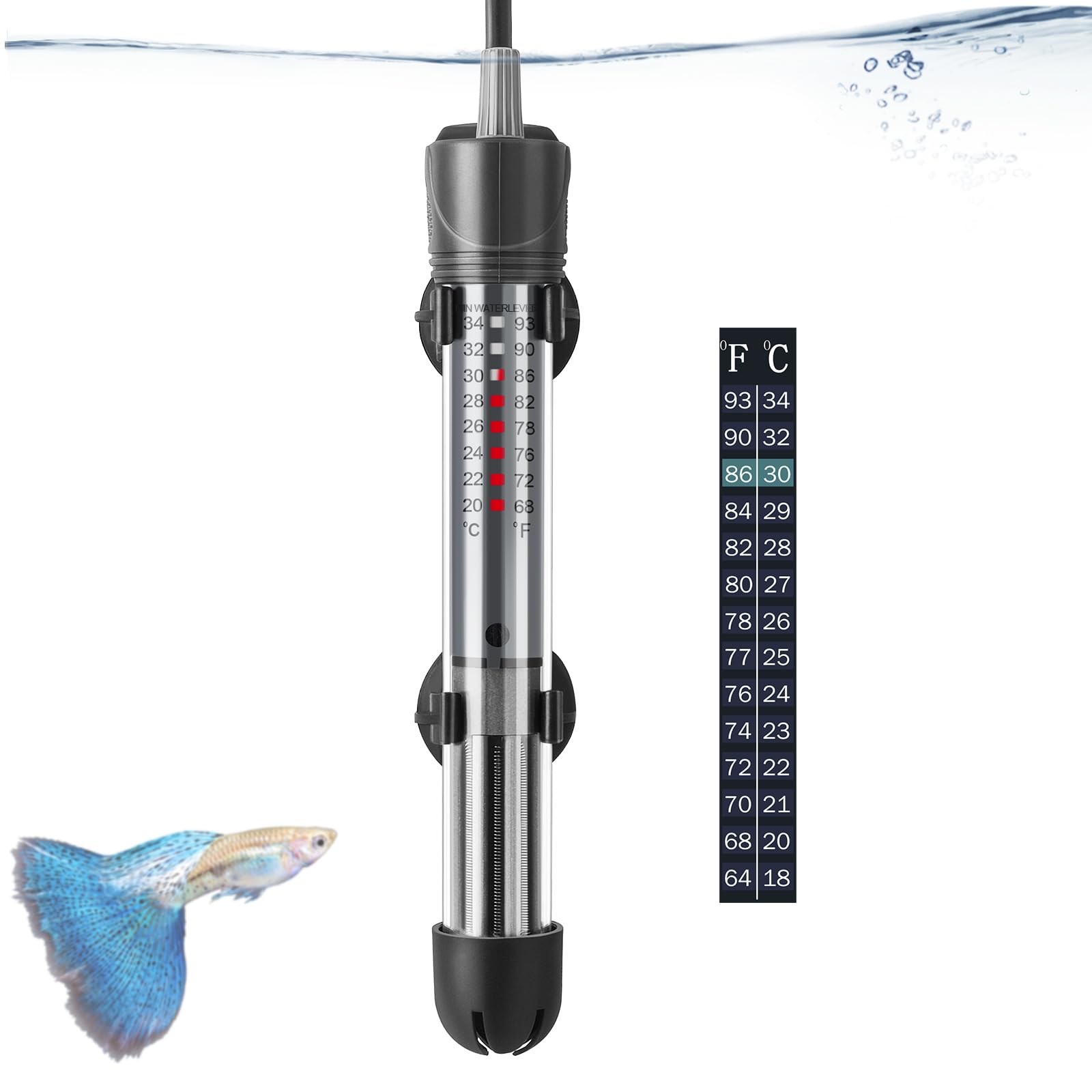
Rating: 4.4 ★ | Price: $ | Wattage: 50W | Adjustability: Adjustable 68-93°F | Build Material: Thickened quartz | Controller: In-water dial
For the lowest price you’ll find on an adjustable heater, this HITOP covers the basics – it fits 8–16 gallon tanks and can be set between 68–93°F. However, the dial is difficult to fine-tune and temperature accuracy can vary between units. Some owners also note cracks in the glass or melted suction cups, so this is best reserved for a quarantine tank or as a backup where close monitoring is possible.
Pros
- Adjustable 68–93°F range suits most tropical freshwater setups.
- Budget-friendly price for an adjustable heater.
Cons
- In a primary tank with sensitive livestock, glass cracking or suction cup melting may occur – use only where failure is tolerable.
A tempting price for an adjustable heater, but best for temporary or backup use where close monitoring is possible.
Best for Ultra-Budget
DaToo 50W

Rating: 4.4 ★ | Price: $ | Wattage: 50W | Adjustability: Adjustable external | Build Material: ABS shell + quartz | Controller: External
As the most affordable adjustable heater with an external digital controller, the DaToo is easy to install and compact for small tanks. Temperature accuracy can vary between units, and long-term durability has been noted as a concern. This makes it best suited for temporary or backup use where failure is acceptable, rather than as a primary heater for a 10-gallon tank.
Pros
- Budget-friendly digital heater with external controller
- Compact size fits easily in small tanks
Cons
- Temperature accuracy can vary between units, requiring monitoring for sensitive fish
For a temporary setup or when budget is the top priority, the DaToo 50W provides digital control at a rock-bottom price, but expect to check temperatures regularly.
Best for Glofish Tanks
GloFish 50W

Rating: 4.5 ★ | Price: $$ | Wattage: 50W | Adjustability: Preset 78°F | Controller: In-water
The GloFish 50W heater delivers simple operation with no dials to fuss with, and its branded look fits right into a GloFish-themed tank. However, the 78°F preset cannot be changed, so it only suits fish that thrive at that temperature, and occasional early-life issues have been noted with some units.
Pros
- Plug-and-play setup with no adjustments needed – ideal for beginners.
- Solid value with GloFish branding for themed aquarium owners.
Cons
- Preset 78°F limits compatibility to fish that prefer that temperature – no way to adjust for other species.
Best suited for GloFish owners who want a matching visual and don’t need temperature flexibility.
Best for Nano Tanks
SEAOURA 50W
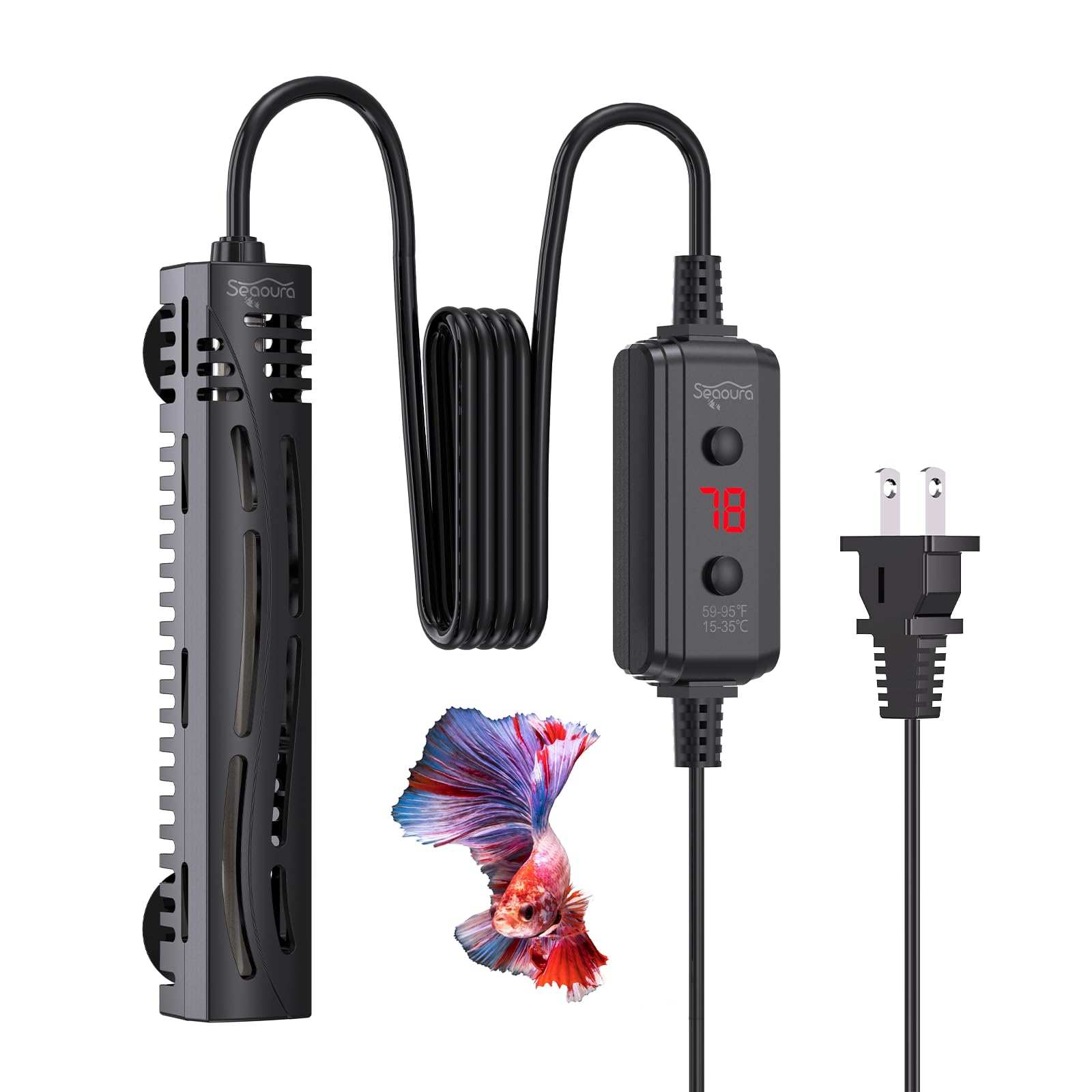
Rating: 4.4 ★ | Price: $ | Wattage: 50W | Adjustability: Adjustable external | Build Material: Plastic/glass | Controller: External
Compact and easy to set up, this 50W heater includes a plastic guard that prevents fish from touching the heating element. However, the temperature setting can differ from actual water temperature by a few degrees, so it fits best as a secondary heater or in tanks where slight variation is acceptable. Suction cups may not hold well on textured surfaces—placing on glass improves adhesion.
Pros
- Compact size with protective cover keeps fish safe from direct contact with heating element.
- Simple setup with an external digital controller for adjusting temperature.
Cons
- Temperature accuracy can be off by several degrees in some units, requiring a separate thermometer for monitoring.
A budget-friendly option for nano turtle tanks or as a backup heater when exact temperature control isn’t needed.
Best for Betta Tanks
hygger 50W Mini

Rating: 4.3 ★ | Price: $$ | Wattage: 50W | Adjustability: Adjustable 68-90°F | Build Material: Quartz glass | Controller: External
Compact size and an external controller are the hygger’s main draws — at 5 inches, it fits easily in nano tanks and betta setups without crowding the view. The tradeoff is a temperature dial that can be imprecise, with occasional temperature drift noted. For a 10-gallon tank where stable water conditions matter, the hygger suits casual setups where slight fluctuations are acceptable rather than precision-demanding aquascapes.
Pros
- Very compact size fits easily in small tanks
- External controller allows adjustment without wet hands
Cons
- Temperature dial can be imprecise and may drift, best for tanks where slight fluctuations are acceptable
For betta tanks or nano setups where space is at a premium, the hygger’s compact design and external controller are a good fit.
Best for Early Adopters
AquaMiracle 50W
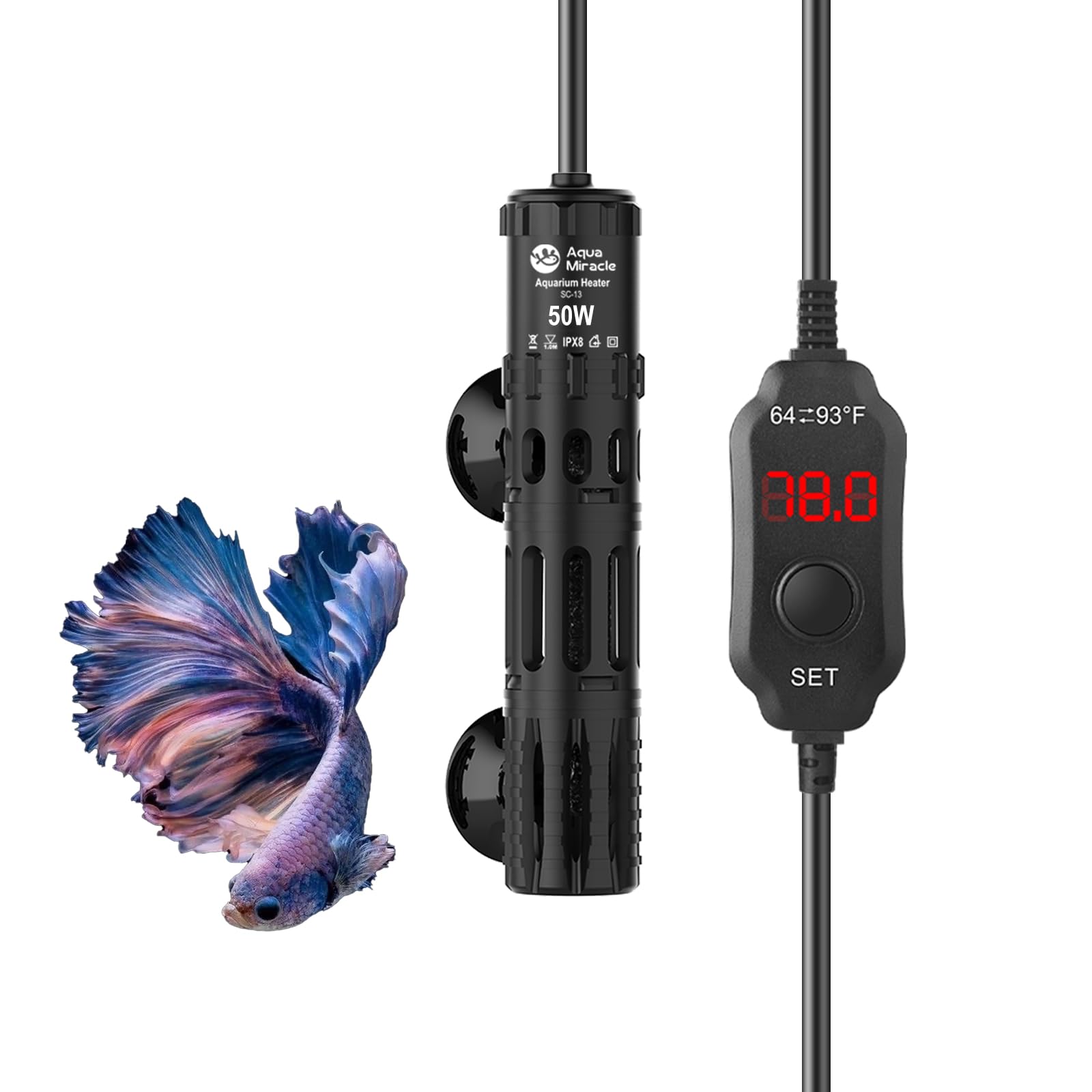
Rating: 4.7 ★ | Price: $$ | Wattage: 50W | Adjustability: Adjustable 64-93°F | Controller: External digital
Memory function and dry-run protection give it a safety edge, and early user feedback is positive. But suction cups may lose grip, and the short track record leaves long-term durability unconfirmed. This heater suits early adopters, not those wanting a longer track record.
Pros
- Memory function restores temperature setting after power loss.
- Dry-run and overheat protection reduce risk of damage.
Cons
- Suction cups can lose adhesion over time, needing occasional re-positioning.
Suitable for early adopters who value memory function and are aware of the suction cup limitation.
Best for Turtle Tanks
FREESEA 50W

Rating: 4.3 ★ | Price: $ | Wattage: 50W | Adjustability: Adjustable 63-94°F | Controller: External
The FREESEA 50W heater’s external digital controller makes temperature adjustment simple without disturbing the tank. Safety features like dry-run and overheat protection add peace of mind. However, in quiet rooms the unit may produce a noticeable whistle or click, and temperature consistency can differ from unit to unit – worth buying with a flexible return policy.
Pros
- External digital controller with LED display for easy temperature management
- Built-in dry-run and overheat protection for added safety
Cons
- In quiet spaces, the heater may produce a high-pitched whistle or clicking sound
A budget-friendly option for those who want an external digital controller and can accept occasional noise, with the flexibility to exchange if temperature runs off.
How to Choose
The most important factor in choosing a 10-gallon heater is getting the right wattage—50W for average rooms, 100W for colder rooms—to avoid temperature swings or overheating.
Wattage
For a 10-gallon tank, 50W is sufficient in most room temperatures. 100W provides a safety margin for colder rooms but requires careful monitoring to prevent temperature spikes, especially if the heater lacks a fine-tuned thermostat.
Using a 300W heater in a 10-gallon tank is dangerous—the thermal output is too high and can overshoot rapidly, cooking fish. Stick to 50–100W for this tank size.
Adjustability
Preset heaters (usually 78°F) are simple and cheap, but you cannot change the temperature. This works for common tropical community fish, but not for species needing warmer or cooler water.
Adjustable heaters use a dial or digital controller. Many cheap adjustable models rely on bimetallic strips that drift over time, causing the actual temperature to differ from the setting. A separate thermometer is essential to verify.
Safety Features
Auto shut-off when out of water (dry-run protection) prevents the heater from cracking or catching fire during water changes. Overheat protection cuts power if the water exceeds a safe limit.
Audible alarms and memory functions (which restore settings after power loss) add convenience. These features are more common in digital controllers and add cost, but provide peace of mind.
Build Material
Thickened quartz glass resists cracking from thermal shock better than standard glass or thin plastic shells. Some heaters add a protective guard to prevent fish from touching the hot surface.
Plastic components, especially suction cups, degrade over time. Stronger ABS shells last longer, but glass heaters with a guard are more durable for long-term use.
Controller Type
In-water dials are simple but often imprecise—the markings are rough and can be hard to read. External digital controllers allow you to set and check temperature without reaching into the tank, and usually offer ±1°F accuracy.
Digital controllers also enable safety features like dry-run alarms. However, they add complexity and a potential failure point; a failed controller can render the heater useless.
FAQ
Why does my aquarium heater keep the water several degrees below the set temperature?
Bimetallic strip thermostats in budget heaters drift over time, causing the actual temperature to lag behind the dial setting. The heater may also be underpowered for the room’s ambient temperature. Always verify with a separate thermometer and adjust accordingly, or upgrade to a digital controller model that holds more accurate setpoints.
Is it safe to use a 100W heater in a 10-gallon tank?
Yes, as long as the room isn’t extremely hot and the heater has a working thermostat. 100W gives a safety margin in colder rooms but can cause temperature swings if the thermostat is imprecise. Monitor closely for the first few days and use a separate thermometer. For normal 68–72°F room temperatures, 50W is usually sufficient.
How long do aquarium heaters typically last before they fail?
Budget heaters often fail within 6–12 months, especially if they lack dry-run protection. Premium models like Fluval’s with 3-year warranties can last 3–5 years with proper care. Heaters fail most commonly from cracked glass during water changes or corrosion of internal components. Regular inspection and unplugging during cleaning extend lifespan.
Do I need to unplug my submersible heater when cleaning the tank?
Yes, always unplug it before draining below the heater’s water level. If the heater is on while partially exposed to air, the glass can overheat and crack, or the thermostat can fail. Let the heater cool for 10 minutes before removing it from the tank.